Misconceptions

Seth Godin’s latest blog post reminds us how we can be relaying misconceptions to the students we teach.

The internet certainly presents us with possibilities. We can become creators and have our work appreciated by others. We can make a name for ourselves and reap the rewards that come from this. But we can also become part of the long tail of creators who are vying for voice and attention who don’t get noticed and don’t reap rewards.

Seth quotes a report from Charles Blow in the NY Times about the music industry;

“A study last year conducted by members of PRS for Music, a nonprofit royalty collection agency, found that of the 13 million songs for sale online last year, 10 million never got a single buyer and 80 percent of all revenue came from about 52,000 songs. That’s less than one percent of the songs.”

Pretty staggering figures really. So for every young band out there vying for an audience, the odds are pretty much not stacked in your favour.

That’s not to say we shouldn’t be encouraging our students to use this medium to be heard. What we should be doing is presenting them with the   realities of  the medium. You can’t expect that loading your latest and greatest effort onto YouTube is your entry point to worldwide noteriety. You need to face the reality that if you are going to take a crack at it you need to explore the medium to it’s full potential. You need to know how to market your online presence to full effect.

Even more reason why educators need to get up to speed. These are skills that need to be taught. The business model is changing.  It’s a new world out there.

School’s out Friday

You have to watch this.

This is a TED Talk from Jonathon Zittrain, a social theorist who proposes in his talk that the world is not becoming less friendly. In fact, we are seeing the opposite, and this is demonstrated through the way people have made use of the internet . The way we readily share and distribute information, the way we act as nodes in a network, the way we  support others through this medium means that we are seeing morality and humanity come to the fore in our interactions with one another.

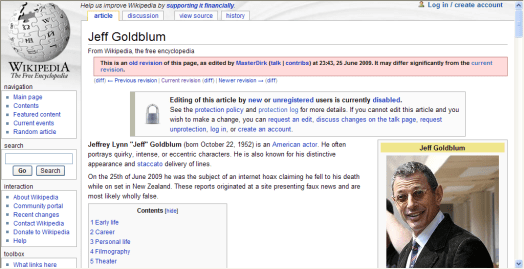
He uses some great examples. Wikipedia gets a mention. Jonathon states that we are always 45 minutes away from chaos on Wikipedia with spambots trying to embed ads and people trying to deliberately mess with pages. What saves Wikipedia are the Wikipedians; the thin geeky line who ensure it remains useable for the rest of us.  He refers to the Star Wars kid and the page on Wikipedia devoted to that ongoing episode. Wikipedians debated whether or not they should include the young boy’s name on the page and ultimately decided not to. This was due to the fact that the boy in question suffered psychologically from the exposure that video drew to him. Here is the information on the page indicating to contributors the conditions for any additions;

This biographical article needs additional citations for verification. Please help by adding reliable sources. Contentious material about living persons that is unsourced or poorly sourced must be removed immediately, especially if potentially libelous or harmful. (January 2009)

This will be a great video to use in media literacy classes. In fact, any class where you are discussing the impact of new media on our lives.

Have a great weekend. My pick for the Grand Final here in Melbourne tomorrow. St.Kilda all the way!!

Digital literacy lessons for all- me included! Glad you’re alive and well Jeff!

I woke today to the news that Michael Jackson was in hospital and it was suspected that he had died. I didn’t go to my computer, just followed the mainstream media on Channel Nine here in Melbourne for awhile. Eventually news broke that he had died.

I went to the computer and opened Twitter where the story was being discussed by all. Then Richard Wilkins on Channel Nine’s Today Show  announced he had just received a report saying that Jeff Goldblum had fallen from a cliff in New Zealand while filming and was dead. Now hearing it on mainstream media led to me sending out a tweet about it. That led to a series of retweets that spread like wildfire while I tried to verify if the story was true.

Some tweets came through pretty early on suggesting it was a hoax. The links wouldn’t open.  I went to Wikipedia and saw interesting developments take place within minutes. Jeff Goldblum’s page was open when I first visited. I refreshed not two minutes later and the page was locked to users who were new or unregistered.

Editing of this article by new or unregistered users is currently disabled.   

That led to me getting suspicious that something was up, be it truth or hoax. Right after this Richard Wilkins announced that New Zealand police were investigating the death of Jeff Goldblum from a fall while filming. Rightly or wrongly, I tweeted this, just as I had been tweeting about changes to the Wikipedia page. I searched the web for verification but the page that would have confirmed the hoax wouldn’t open. Later in the morning, Ann Van Meter sent the link that opened to Top Stories, a site that generates stories like this one.     

Refreshing the Wikipedia page was interesting over that period. At one stage they had information saying the reports of his death were likely a hoax. I tweeted this. At another stage this information was no longer on the page, but they had after his name his birthdate and death and referred to him in the past tense. Not soon after this the page was updated again with this information missing and he was once again discussed in the present tense.

Wikipedia page not long after mainstream media announcement.
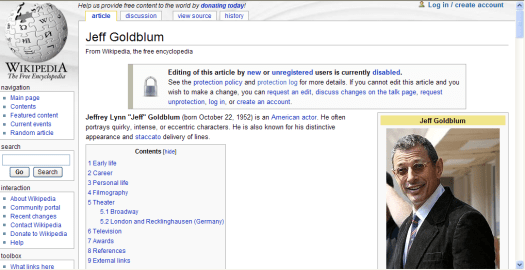
Jeff_Goldblum_Wikipedia_page_-jsut_after_media_reports

Hoax detail.

Jeff_Goldblum_hoax_info_on_wikipedia

Past tense reference to Jeff Goldblum.
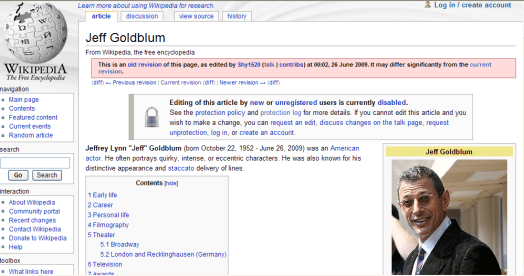
Jeff_goldblum_wikipedia_page_past_tense

(Using the history tab in Wikipedia enabled me to grab these screenshots of the relevant pages) 

At around this time, The Today Show’s, Karl Stefanovic, mentioned on Channel Nine that Twitter was reporting the story as a hoax. I tweeted this too.  I then started to read tweets about ethical behaviour and the like. I felt like some of this was directed at me. (Maybe that’s paranoia!) Here’s some of the flurry in a screen capture;
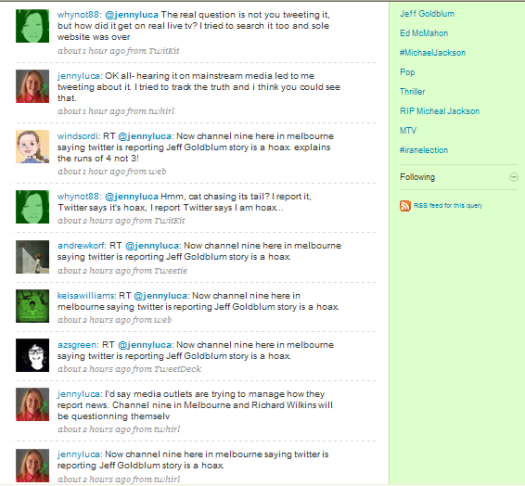
Jeff_goldblum_twitter_flurry

I’m prepared to admit that I feel pretty bad about putting out the Tweet in the first place. I trusted mainstream media. I honestly did not think Richard Wilkins would report something that had not been properly verified. The Today Show had been quite insistant earlier in the morning about saying that the reports of Michael Jackson’s death were coming from TMZ, a gossip website.   But I do think I was making a concerted effort to get verification from other Web sources.

It’s a lesson in Digital literacy for us all.

Should I have searched first and tweeted later? Probably.

Would this have been a good lesson to use with students as it happened? Absolutely.

Will I be using this post with the classes I teach? You betcha.

Have I learnt a lot this morning?  Too right I have. Snopes slipped my mind just when I needed it! 
Reblog this post [with Zemanta]

Aha moment – ever had one of those?

Ever had an ‘aha’ moment? An experience where revelation comes to you suddenly. I had one of those when I started writing this blog. Writing my first post and waking up the next morning to see a comment posted was a real ‘aha’ moment for me. Everything I had been reading about in terms of connections and the ability of the web to bring us together seemed to coalesce in that moment.

I really like ahamoment.com, a site dedicated to sharing the aha moments of the people who chose to share their stories. Thanks go to Tony Hollingsworth who alerted me to its presence on the Web via a tweet. I like how they describe an aha moment;

Aha moments come in all shapes and sizes. We know from the real people featured on this site and with those to whom we continue to speak, that aha moments are personal. They have been described as, “magic,” “enlightenment,” and, “that moment of clarity when all the pieces fall into place.” They’ve told us that having an aha moment is like, “getting hit by a bus,” and that it just “hits you.”

I’m intrigued by the research they say has been conducted into aha moments and what happens physiologically before they happen;

“In 2004, researchers at Northwestern University wanted to discover the physiological responses that lead to the breakthrough moments known as aha moments. What they discovered was that a split — second before having an aha moment, we experience a burst of electrical brain activity… kind of like a big light bulb going off in your brain.

Another study in 2006 by the same research team found that aha moments tend to occur more often in the “prepared mind.” In short, if we’re open to change and maybe even looking for some kind of change — an aha moment is more likely to happen.”

A part of me believes very strongly in the 2006 study. I do believe we create our own situations to some extent. I think you have to work it, but if you visualise where it is you want to be in life you can find yourself there.

I could see this site being useful in school settings. People sharing insights into what has sparked a new direction for them could help inspire our students and could be the basis for writing or digital media tasks. Perhaps our students could upload their own stories to the site. 

My only concern is that the site is run by the Mutual of Omaha Insurance Company. I’m wondering what their motivation is for running a site like this? It looks like a clever marketing ploy to me; run a site that’s interesting and plug a few products like life insurance, retirement solutions etc. This could be another interesting educational exercise- part of the digital literacy learning our kids should be aware of. Get your students to visit the site and find out who is running it by having them scroll down to the bottom of the page and check out the detail that you find in the links there.

Interesting from many angles. Exploring the site was a bit of an ‘aha’ moment in itself!


Reblog this post [with Zemanta]

Literacy for our age.

John Connell has written an excellent post, Literacy, Postliteracy, Modes of Expression….and a real Guitar Hero! that you really should read. In it, he muses over the notion of literacy and how it can be defined in our changing landscape. His post struck a chord with me; literacy, and our definition of it, was a frequent topic of discussion at Learning 2.008.

John writes so well it is daunting to even think of leaving a comment! But leave one I did, and here is my 2 cents worth;

This was a topic under frequent discussion at Learning 2.008 John. Doug Johnson calls it postliteracy, others call it digital literacy or 21st Century literacy. Clarence Fisher and others were asking the question, is it not just literacy? Sure, it’s different from our print based focus of the past, but it’s where we are today. I’m a Teacher-Librarian and I recognise that my students respond to visual media today far more than they do print based and I am trying to find ways to integrate the visual medium into my library space. I find myself charged by the visual medium and avail myself of stimuli off YouTube to spark my students’ interest in curriculum offerings. I have been moved by their digital creations that express meaning so eloquently without words, but through pictures that create a metaphor. It seems to me that as we deal with a highly visual world we will find our definition of literacy changing. When it becomes normative practice in our understanding of how we function we will become accepting that this is the literacy of our age.

I encourage you to visit John’s blog and read his post. While there, do yourself a favour and take a stroll through some of his other entries. I guarantee you’ll come away enriched by the experience.

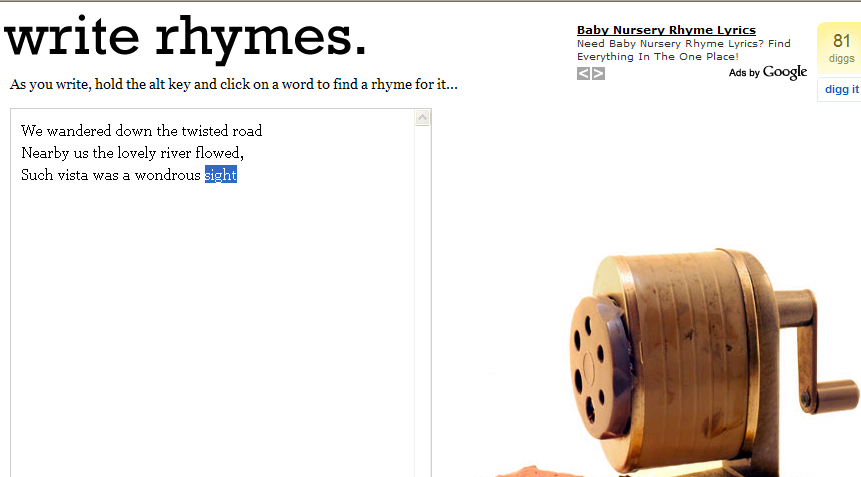
Write rhymes – students of English rejoice!

Do you remember when you were at school and you were given the task of writing a poem that rhymed? Do you remember the agony of not being able to find the word you needed? Well, students in the 21st century need worry no more thanks to Write Rhymes, a handy new tool that will find the rhyming word you need in your hour of need.  

All you need to do is type in the text you’ve come up with, press alt and click on the word that you need rhymed. Write rhymes will come up with alternatives for you to consider. Dead simple. Yet another reason why we as educators need to come up with high order thinking tasks that are going to extend our students thinking. Tools are becoming available to do the thinking for our students.  They will find them. We need to be rethinking our classroom practice to foster thinking tasks that require more than highlighting a word and having the answer magically appear! There’s the challenge; we must rise to it.  

That’s not to say I won’t be using Write Rhymes as a tool in my classroom this year. Teaching our students how to find these time saving devices is another skill entirely. To improve their digital literacy skills they need to be taught how to find tools that will make their lives easier -that’s smart too. As my husband always says to me, ‘You have to work smarter, not harder Jen.’ Advice I don’t always manage I have to admit, but an essential digital literacy skill that our students should be learning as we move into the 21st Century.

Learning to change – watch it and make up your mind.

There’s a bit of debate flying around the edublogosphere regarding this video. It’s healthy debate, because it’s questioning the motivations of the group that put this video together. I always think it’s healthy when people look beyond the surface and delve for deep understanding. These are the very skills we are hoping we will impart to our students to ensure that they become well rounded citizens of the world. Good modelling all round.

Most of the debate stems from Chris Lehmann’s blog post  Pearson presents: Learning to Change.

Chris has problems with the video for a number of reasons, and you’d probably be best served by following the link and reading what he has to say. One of the points he made that rang true for me was this;

And I don’t know… perhaps under it all, I have a sense that these folks think, “If we just change it all up, the kids will all suddenly just start learning like crazy” when that misses several points — 1) we still have an insanely anti-intellectual culture that is so much more powerful than schools. 2) Deep learning is still hard, and our culture is moving away from valuing things that are hard to do. 3) We still need teachers to teach kids thoughtfulness, wisdom, care, compassion, and there’s an anti-teacher rhetoric that, to me, undermines that video’s message.

It’s point three that resonates deep with me. What underpins all good teaching and learning (IMHO) is the formation of relationships. I firmly believe that no child will learn anything from me until I’ve shown them that I’m interested in them and what they have to say. Without passionate teachers, who realise that teaching the whole person is vital, no Web 2.0 tool is going to make any huge difference to learning outcomes. The tools can make the learning more interesting and can provide them with useful skills, but they still need guidance and purpose to direct the learning that needs to take place. There’s my sermon from the mount for today!

Chris questions the motivation of the creators of the video,  Pearson Learning, a company that has a web based formative assessment testing system and reporting tool. He asks us to consider if we should be paying attention to a message from a company with a vested interest in us using the web for learning. It’s a must read post – make sure you read the comment thread that follows for more interesting discussion. Here’s what I posted in response;

Great post. I’ve seen this video at numerous blog sites over the past week and none had made mention of the production company behind it. I still like it, because I think it makes people think about the shifts that need to happen if we are going to enable our students to become fully digital literate and make the most of what the web can offer. I do think you highlight an important point – this shift is not going to be easy and we do need to focus on the learning as our most important motivation rather than communication for communications sake. I’m going to watch your keynote – interested in what you have to say.
Thanks Chris for prompting me to think and probe deeper. It’s vitally important that we remember to not always take things at face value but to question and explore. These are digital literacy skills we all need to have; both we as educators and our students. I stand by what I said in my comment – I still like this video and the things it is saying to us. I think it will assist in making people think and help to make the shift happen. I just won’t be looking at it through the same rose coloured glasses that I was wearing last week when I first saw it.