Facebook is the primary social network most of our students are accessing to manage their social lives. Are they going to stop using it anytime soon? No, they’re not. They’re not going to stop because it’s their communication platform- it’s where their friends are and it’s how they plan their lives. And that’s why we have to understand how it works and ensure that we help them to understand how they use it safely. We need to be discussing Facebook’s privacy settings and how students can set them to a level that provides them with profiles they are comfortable with.
We need to put this in perspective. People of my generation were operating in social networks too. It’s just that our social networks were dependent on a single corded phone line placed in a usually busy part of the household. Our parents spent their lives bemoaning the fact that the phone line was under siege from their teenage children. Think about it; if a network like Facebook were available when you were young, would you have been there? I know I would.
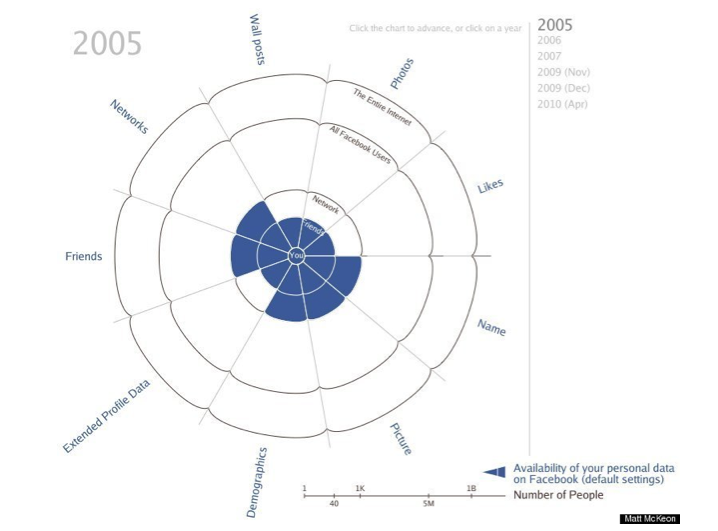
Facebook have made some significant changes to their privacy settings in recent months. Matt McKeon has created ‘an evolution of Facebook’ and has used some very interesting visuals to denote these changes over time. I used them with Yr 11 students last week and they certainly took notice.
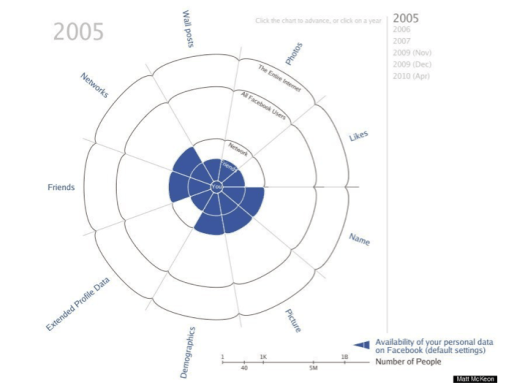


It’s a powerful representation of their default settings and the changes that have been made over time. Show these to your students and I’m pretty sure you’ll see them heading home to make some changes; changes they probably didn’t even know were necessary.
We have been taking our students through the account settings in Facebook, alerting them to changes that have been applied to their accounts. Some students know what’s happening and have ensured their settings are set to ‘only friends’, but many have no idea. Most don’t bother to check the ‘Applications and Websites’ settings, and don’t realise that Facebook has arranged to allow a user’s information to be accessible to nominated websites if a Facebook member accesses them. According to Facebook, it allows for a more integrated web experience and saves you time. According to me, it’s non-consensual use of my personal information. Facebook are overstepping the mark, and people are starting to sit up, take notice, and speak out.
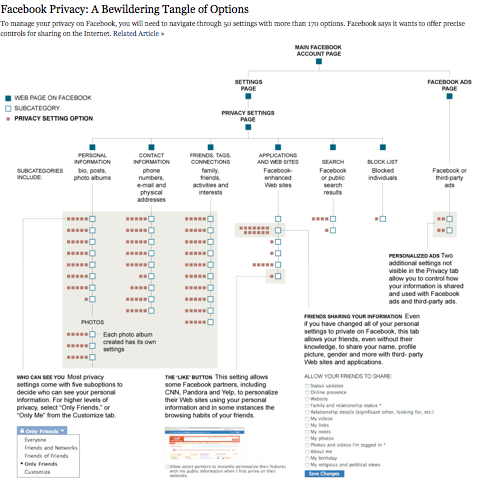
The New York Times have been keeping up with what is happening and have produced a very good graphic showing the default settings and what needs to be done to manage your privacy;

Danah Boyd has written a ‘rant’ about Facebook’s lack of transparency. In it, she makes some observations that I’ve noted are common to students here in Australia too. Most are unaware of the fact that their information is accesible to friends of friends. What follows is a lengthy grab from Danah’s post, but she makes such good points they are well worth sharing (and of course, I’d encourage you to visit her blog to read the post in its entirity);
Over and over again, I find that people’s mental model of who can see what doesn’t match up with reality. People think “everyone” includes everyone who searches for them on Facebook. They never imagine that “everyone” includes every third party sucking up data for goddess only knows what purpose. They think that if they lock down everything in the settings that they see, that they’re completely locked down. They don’t get that their friends lists, interests, likes, primary photo, affiliations, and other content is publicly accessible.
If Facebook wanted radical transparency, they could communicate to users every single person and entity who can see their content. They could notify then when the content is accessed by a partner. They could show them who all is included in “friends-of-friends” (or at least a number of people). They hide behind lists because people’s abstractions allow them to share more. When people think “friends-of-friends” they don’t think about all of the types of people that their friends might link to; they think of the people that their friends would bring to a dinner party if they were to host it. When they think of everyone, they think of individual people who might have an interest in them, not 3rd party services who want to monetize or redistribute their data. Users have no sense of how their data is being used and Facebook is not radically transparent about what that data is used for. Quite the opposite. Convolution works. It keeps the press out.
The battle that is underway is not a battle over the future of privacy and publicity. It’s a battle over choice and informed consent. It’s unfolding because people are being duped, tricked, coerced, and confused into doing things where they don’t understand the consequences. Facebook keeps saying that it gives users choices, but that is completely unfair. It gives users the illusion of choice and hides the details away from them “for their own good.”
What really worries me, is that there are not enough people in our schools today who are confident enough with new technologies to understand how to help our students work these things out. This is part of the new digital divide that is starting to rear its ugly head. I have the feeling we will have students who are given an understanding of the benefits of creating positive digital profiles and they will do just that. They will understand that you don’t upload that unflattering photo or you avoid being photographed in compromising situations. You post the great things you are doing and your social resume helps you to get that job you’re looking for. You won’t be the kid on the other side of the digital divide who uploads all those photos from that party that got out of control. That same kid on the other side never created any great digital content because their teachers didn’t understand new technologies and never set any tasks that allowed them to show people what they were truly capable of. Their social resume is the one that recruiters look at, resulting in them sending their work resume (the one they’ve written) to the bottom of the pile.
Schools do have a part to play in informing our students about managing their lives in social networks. What this requires is teachers who are up to date with what is happening and with the nous to direct them to the information they need. It worries me that the only professional development our teachers are given to support them with understandings like these, come from blog posts written by other teachers who are doing it late into the night with dark bags under their eyes!


 Lucacept - intercepting the Web