Watching an episode of Modern Family had me thinking about the importance of being able to have a context for understanding of so many things we are confronted with on a daily basis. Cameron, the big gay guy, was wandering the streets looking for Stella, the lost dog Jay adores. As he shouts out ‘Stella’, he realises he is wearing a tshirt very like the one worn by Marlon Brando who played Stanley Kowalski in Tennessee William’s, ‘A Streetcar Named Desire‘. His cries for Stella become more impassioned as a result. For me, the joke was obvious, but my two children, having no context, had to ask why was I laughing.
Today, I was reading an answer on Quora, and it made mention of Alexander the Great and Bucephalus. I was immediately taken back to my obsession with all things Ancient Greek in my first year at Teacher’s College. But once again, it had me wondering. How many times a day do we not entirely grasp the full intentions of information we read or view, because we don’t have enough context to understand it in it’s entirety? How much does our formal education play a part in our general knowledge base, and is that determined by the teachers you had or your ability to ferret for information yourself?
In Victoria’s VCE English curriculum, Area of Study 2 requires students to study a central theme or idea, and be inspired to write from a variety of texts, be they print or visual. I’m teaching Year 10 English this year, and we are beginning our course with a thematic study in a similar vein to what the student’s will encounter in Area of Study 2 in VCE. In past years, students have created a hard copy folio of stimulas material, but this year, we are going to have our students use Storify for the same purpose. Storify is a fantastic curation tool, and is currently being used by individuals, corporations and news organisations around the world to report on current events.
I can’t help but think that the students with a broad general knowledge base have the advantage over others when it comes to formulating a response to Area of Study 2. Hopefully, the use of a tool like Storify will help our students comprehend the importance of reading widely and accessing a variety of sources to help formulate understanding.
I know that when I introduce this topic, I’ll be talking about the importance of being well read and able to contextualise life. School’s purpose is not just to get students through the final exams of year 12 with a decent enough ATAR score to get them into University courses. We’re helping to prepare these young people for the rest of their lives, and we want them to know how important it is to have context for understanding. I think I might just get Cam and Marlon to help me make my point.
I returned last week from the CCAEducause conference and have been collecting my thoughts. The conference by line was, ‘The Game has Changed’. It has, but I’m not entirely sure both secondary education and higher education have quite understood just how much has changed. This conference was aimed at higher education, and I went along because I wanted to see what higher education was talking about in relation to technology and its role in the eyes of those running and working in universities in Australia. My idea was that I would be able to assess what we needed to do in Secondary education to prepare our students for the kind of tertiary experience they were heading for.
To say my eyes have been opened is an understatement. I’ve come away from this conference thinking that the situation might need to be reversed. Maybe it should be personnel from universities visiting some secondary education institutions and looking at what is happening there, so that they can prepare themselves for the students heading their way. Note I said ‘some’ secondary institutions. There is no doubt there is huge disparity in the take up of new technologies within our sector.
I suspect the final keynote speaker, Richard Katz, might even describe me as some sort of edupunk, because I write in a public space using web 2.0 technology and influence others with ideas. Heck, I’m not a ‘published’ author, and I have an audience. I’d prefer to think of myself as a public intellectual, as I’ve heard bloggers described by John Seely Brown. I refer to the ‘edupunk’ tag, because Richard described Jenny, the very savvy 27 Yr old creator of ‘60 second recap‘ as an edupunk and one of the perceived threats higher education faces. Jenny offers an informal learning experience. Anyone can tap into her site and watch her creations, as she dissects the plots, characters and themes of classic fiction and plays. I don’t view someone like Jenny as a threat. In fact, our Yr Nine students were watching Jenny’s creations last year as they explored the themes surrounding Romeo and Juliet. In my eyes, Jenny helps augment our curriculum, she’s part of my teaching arsenal and I’ll employ her to assist my students with their understanding. I’ll go one step further even and encourage them to replicate what she does and submit it to her site, so that they can become the creators influencing and helping to lead others to understanding.
Here are other perceived threats. The Khan Academy, iTunesU, MIT Opencourseware, P2PU, any of the burgeoning sites where a student can self direct their own learning. My gut is telling me that none of these things are threats if universities rise to the challenge and embrace new ways of doing things. Shirley Alexander, from University of Technology Sydney, spoke of the need to do things differently, to deliver instruction via a podcast if it could be done that way, so that face to face time could be spent with students dissecting ideas with lecturers. I was under the impression that this was happening already, and I suspect it is in some institutions. Please, fill me in if it is the case. She spoke also of the 20% drop out rate in first year, and the need to address this appropriately, and determine what is causing this.
I suspect a lot of the speakers were directing their thinking to those who are already trying to make a difference. There were many IT support personnel and Librarians present, many of whom who are doing the groundwork in their institutions to bring them up to speed. It seems the people missing from a conference like this, and those who most need to be there, are the lecturers themselves, the people delivering the content. Most of these people are obviously highly accomplished in their fields, but might be lacking the teaching skills that might help them to visualize alternate ways of delivering content.
There were some excellent keynotes. Bryan Alexander was so interesting that I had to stop sending out tweets so that I could concentrate on his fast paced delivery of possible scenarios for higher education in 2016. This was brilliantly mind mapped on Prezi, and I was so captivated I can forgive him for the seasick motion of the zoom that Prezi is noted for. If I could find the presentation on Prezi, I’d embed it here. It is visionary. I have found Bryan’s Slideshare presentation that made up the first part of his talk, and you can get a feel for the way he thinks.
Mal Booth, Librarian from UTS (University of Technology Sydney) gave an inspiring presentation about how their library is responding to change. Mal has shared his presentation and notes on Slideshare, so I can embed it here and you can benefit from his wisdom.
UTS staff delivered another presentation about mobile support for staff and students at their library. Sophie Macdonald, a Librarian, presented with Rajan Davio, the IT Manager who works in the UTS library. It was an excellent example of how librarians and IT staff can work together to find solutions for access to library resources. As we move towards mainstream usage of app driven mobile devices, it is even more apparent that close working relationships are necessary between Library and IT staff. I’m very pleased that our IT staff have moved into the new library building my school has just completed; we recognize the need to work together to ensure as seamless a delivery of services as we can manage.
Maxine Brodie, from Macquarie University, spoke of the new Macquarie Library, a very impressive building with 80% of its collection stored underground, and robotic book retrieval operating for on demand access to resources. Why have they done this? Because acres of shelving prevents patrons from accessing space, and space is what libraries as collaborative learning places and places for quieter reflection need. I’d like to know what they are doing to change up their service model in terms of support for students now that they have a space that can cater for more of the university population.
Mckenzie Wark was fascinating. He’s an Australian working in New York, and some of the work he is doing with a graphic novel looks like it will be very useful as a text explaining different political systems when it is eventually published. He has written a book called ‘Gamer’s Theory’ and used the plugin commentpress in WordPress to encourage co-contribution to the text’s development from gamers and other informed and interested members of the public. What he has done represents new models for authors to consider as they create informative texts.
I tweeted long and often, (well as long as 140 characters each tweet!) and battled with the demons of autocorrect on my iPad. My iPad came into its own. I used it to tweet, search and check the emails streaming in from school. It was great for that. In fact, when I got home my right forearm was aching from holding the iPad all day. Can you claim Workers Comp for an iPad RSI conference injury? ; )
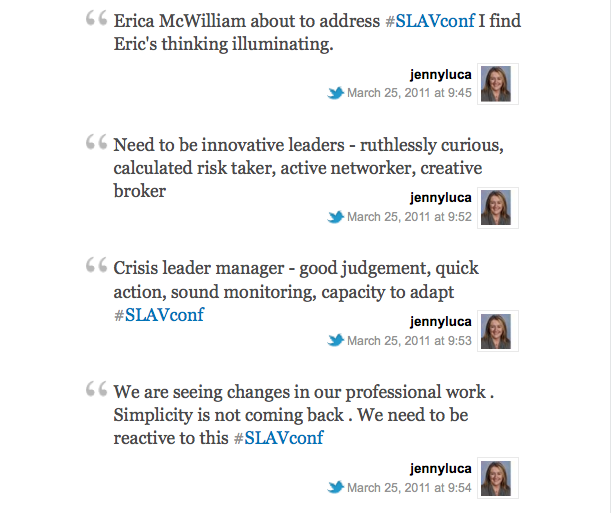
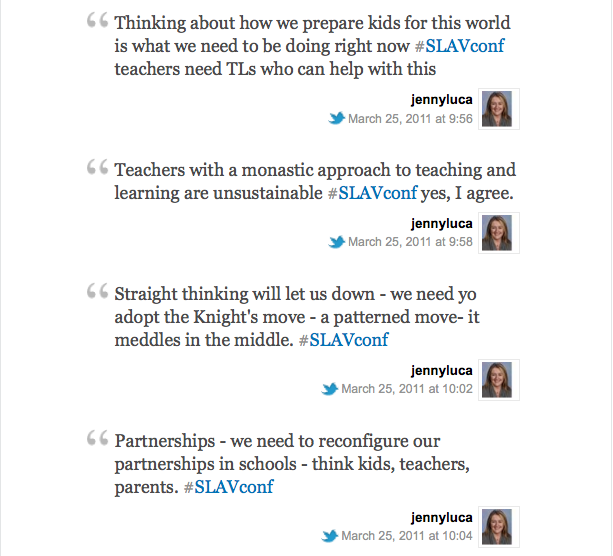
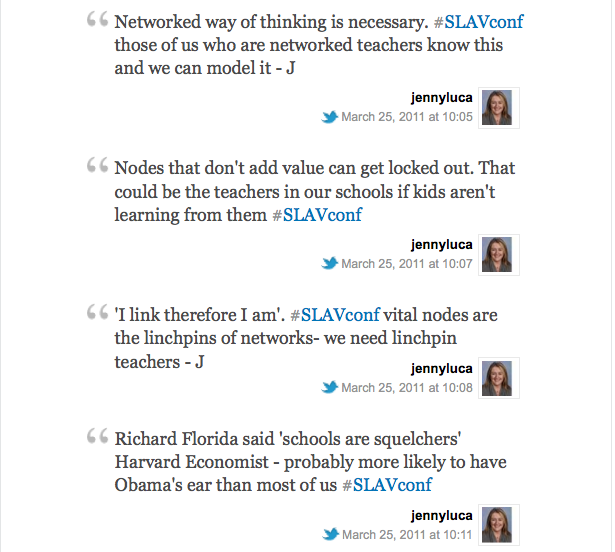
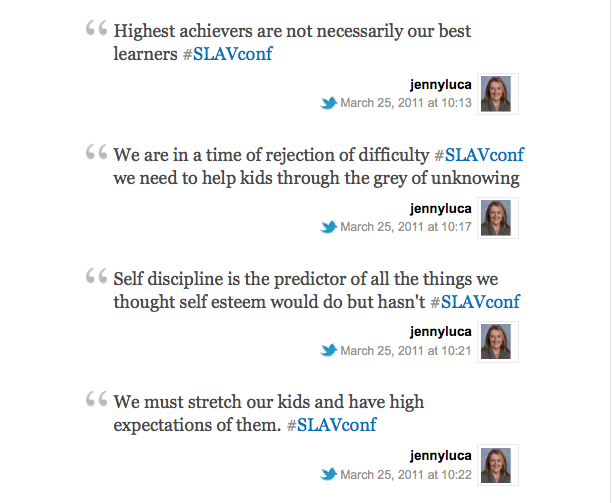
My tweets were my means of notetaking. I’ve done this at the last two conferences I’ve attended, and I can see myself getting better at it. My tweets become a combination of what speakers are saying and my own reflection on their words. If I add my input, I try and separate my thinking from the speakers by adding a ‘J’ at the end of my contribution. It works for me, anyway! I’ve collated my tweets in Storify, and they give a reasonably good run down of my conference experience. If you go and take a look, remember to start from the bottom and scroll up to follow the conference from beginning to end.
The conference has strengthened my belief that in Secondary Schools, we need to be preparing our students to be effective digital citizens. They need to understand how to use new technologies safely and ethically, and they need to know how to manage their digital footprint. I heard no mention of this kind of talk at this conference. If our students don’t understand the importance of managing their digital lives by the end of secondary school, then they seem likely to be entering Universities and their working lives under-prepared.
CCAEducause 2011 has left me thinking. To the best of my knowledge, I was the only representative from the Secondary education field. There is a need for the different streams of education within our country to talk more openly with one another. We need to prepare our students adequately for a system that requires them to take control of their learning, and universities need to be ready for students who are used to employing mobile and social technologies as their means of communication. Some of our secondary schools are going to be sending along students who are well versed with new technologies as a means of communication and creative output. A delegate presenting spoke of the “ever lengthening tale of non engagement” that keeps getting told within his institution, as people refuse to budge from tired methods of instruction. Universities today can ill afford to tell this story. Our next generation is ready for the new edition.
(This post exists on Storify, but it seems impossible to embed it here on this WordPress blog, so I’ve copied most of it here. To see it on Storify, follow the link.)
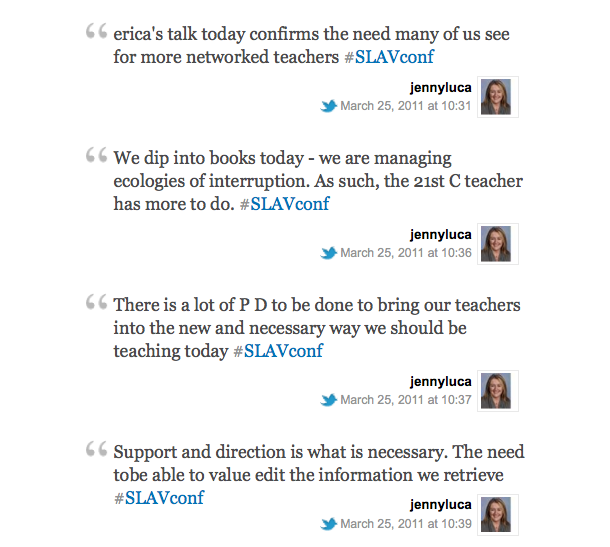
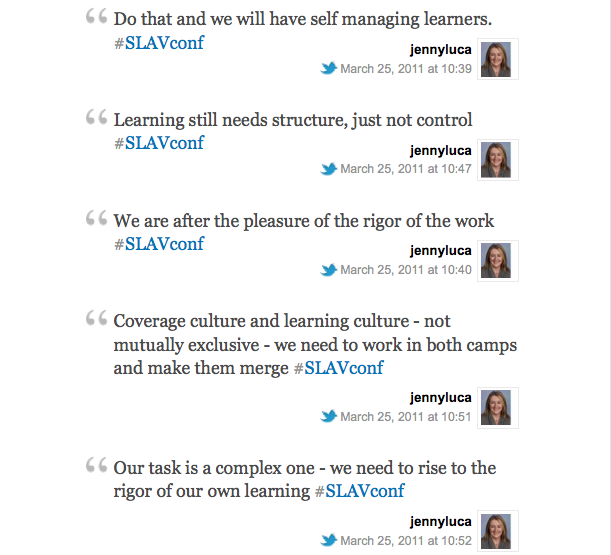
Below is my Twitter stream while I was listening to keynote speaker, Erica McWilliam, present at the SLAV conference here in Melbourne last Friday. The theme of the conference was ‘Creating collaborative learning spaces: Future school library scenarios’. Erica’s talk was entitled, The e-shift: What does it mean for 21st century literacy and learning? Ericais a woman worth listening to – if you ever get the opportunity, leap at it.
So refreshing to hear a learned woman speak at a conference, given the fact that so many keynotes are delivered by men.
Lyn Hay, from Charles Sturt University, also presented a thought provoking presentation about the role of Teacher-Librarians and libraries as physical spaces as we move into an increasingly digital world. Lyn’s presentation has been uploaded to Slideshare and I’d encourage you to take a look at it.
On the day, there were very few of us using Twitter to push the ideas out to the wider world. In fact, most were taking notes using the pen and paper model. Hardly a laptop or iPad in sight. Maybe people were using their phones, but I didn’t see much of anything like that happening around me. In 2011, I’d expect a Teacher-Librarian audience to be wired up and sharing ideas in collaborative spaces. If we are to respond to the ideas presented by Erica, then we better see our profession rise to the challenges of our age. We need more networked Teacher-Librarians to model for our staff and students how we self direct our own learning, and how we can seek out opportunities to make the learning experiences in our schools today reflective of the connected era we are living in.



 Lucacept - intercepting the Web