School’s out Friday

Here’s a cautionary tale.

If you can only communicate through the twittersphere you are seriously in trouble!

Going to be a cold and rainy weekend here in Melbourne by the looks of things. A nice excuse to bunker in by the fire I’m thinking and maybe just shoot off a few tweets! Enjoy whatever it is you may be doing.

“Books, newspapers face battle in dawn of digital revolution”. So says the Geelong Advertiser.

Yesterday I posted about the Geelong Advertiser and the interview I conducted with them after they contacted me via Twitter. At that stage I’d searched the site but couldn’t find any article referencing my name.

Today I received this tweet from John Pearce;

mrpbps @jennyluca The Geelongaddy article re U and someone called Pesce who dominates conversation 🙂 is now online Go Jenny http://bit.ly/3fkxj

Mark Pesce’s comments were the main focus of the article. He made reference to the function of Libraries in the future and this is where my comments were slotted in. Here’s what was mentioned;

While it sounds like a new world order, Mr Pesce believes people will turn to libraries to restore order in their own lives.

The public library will be where people go to catalogue the huge data shadows they are creating with digital photographs and recordings, he said, while books will become archives.

“Today librarians keep catalogues to keep books ordered. They are going to pass this on for you to use.

“It’s going look different but it’s going to help order your digital lives,” he said.

Toorak College librarian Jenny Luca said libraries will become a place for discussion and connection.

“It’s absolutely essential that we look at the new technology and find ways to make it meaningful for the kids that we teach. The collaborative nature of those tools is such now that we will actually make connections with the people behind the keyboards and learn from those people.”

But books will still have a role. Fiction is still a vital collection, Ms Luca said, while non-fiction was losing relevance to online content

I have to admit to being pretty chuffed to see my name in an article alongside Mark Pesce’s. Thanks Peter Farago for interviewing me and getting the article to print.  Special thanks go to John Pearce for making the effort to let me know the article had been published. 
 

Reblog this post [with Zemanta]

Newspapers using Twitter

I had an interesting experience last week as I was heading out to attend the Digital Fair at Geelong Grammar. I sent out a tweet saying I was about to leave and received a reply from Geelongaddy. Geelongaddy turned out to be someone from the Geelong Advertiser, the local newspaper for the Geelong area, and they wanted to talk to me about the upcoming Digital Fair.  

A few tweets back and forth resulted in me participating in a phone interview where I was asked questions about the future of libraries and why we need to be aware of new technologies. The reporter and I shared a discussion about newspapers and their need to embrace online publishing in order to survive. I was extremely impressed that they were using Twitter to disemminate news about the Geelong area and that they were actively searching it to find reference to the Digital Fair. This proactive action enabled them to make connections with me, a participant and presenter.

They also interviewed Mark Pesce who delivered a powerful keynote about digital citizenship and how we as a society need to respond to the influence of the internet on our childrens’ and students’ lives. You can watch this keynote archived on his blog.

I’ve searched their site for the report to no avail. It may well be that it will appear later this week. I’ll post a link if it does. 

*update. A couple of people have sent me the link to the article written by the Geelong Advertiser. No mention of me; guess that’s the nature of newspapers. You have to be newsworthy. Mark Pesce is, I’m not! 

It seems to me that this is the way of the world now. Newspapers obviously need to react to our changing world and find a way to remain relevant. Looks like the Geelong Advertiser is on its way. 

Reblog this post [with Zemanta]

The future of libraries, continued….

I’m finding it harder and harder to get to my RSS feeds in my Google Reader. I’ve no doubt this is in large part due to Twitter consumption. The temptation is always there to just check in to see what’s going on and before you know it you’re off exploring 8, 9, 10 links to new stuff that’s just downright interesting. Of course, as you’re exploring those, the hypertext environment that feeds off these links takes you other places and before you know it, two hours have elapsed!   

Well, I’m glad I found some time because I stumbled on a link to a blog post by Adam Corson-Finnerty, a Library Administrator from Pennsylvania. He was referring to Academic libraries, but I think his message has meaning for school librarians too. It’s time we shifted our mindset if we are going to remain at all relevant in years to come. Read what he has to say;

              Get out of Real Estate

Close as many libraries as you can.

Get out of the Study Hall business.

Your remaining facilities should be recast as “learning labs” or “learning environments.”

Downsize or eliminate your high-density-storage facilities.

Get in to or get out of the Book Storage Business.

Convert your storage facility into a regional storage facility that is self-funding, or

Pay another institution to store any books that you absolutely have to own, and

Pay this institution to loan you books as you need them from their combined holdings, or

Have this institution scan any book that you need and produce your own POD copy, and give it to the patron to keep (you really don’t want it back).

Get out of the book-buying business—only buy books when they are requested.

Keep only what is heavily used

Use “scan on demand” ILL services wherever possible

Use print on demand

Use in-house or nearby print-on-demand service for quick production.

Re-deploy your people

Get your people out of supervising the study hall, standing-behind-a-service-desk, giving directions to the nearest bathroom.

Retrain Librarians as “Informationists” or “Informaticians” or whatever new term breaks them out of the old mold. Your new librarians will be full members of academic research teams, or will “team” with individual scholars, including undergraduates. Many on your staff will have to become data curators, if not database creators.

Focus on the delivery of digital resources, services and tools

Continue and strengthen your role as Information Broker for the entire University

Emphasize training patrons in information-finding skills.

Emphasize digital self-help.

Emphasize collaborative tool-development with faculty

Emphasize collaborative resource-building, and resource-sharing with other Research Libraries

Emphasize physical and digital preservation of assets.

Lots of what he says here rings true for me. What about you? I’m sure there is still much to be said about the future of libraries. How we respond to prompts like these is the truly difficult and confronting challenge facing us, but face them we must if we want to remain relevant.

Adam provided a link to No Brief Candle: Reconceiving Research Libraries for the 21st Century. You can download the PDF at that link.

   

Reblog this post [with Zemanta]

Twitter Mosaic

I needed to post this Twitter Mosaic for a presentation I’m doing this week for the Australian College of Educators at their Digital fair in Geelong. Some of my talk will focus on Twitter as a learning network. This mosaic shows my followers. It’s pretty overwhelming, even for me, to comprehend. It’s certainly one powerful network for learning. Many of these people lead me to information I wouldn’t access any other way.

Get your twitter mosaic here.

Reblog this post [with Zemanta]

Stephen Downes – learning is distributed

I saw Stephen Downes present on Monday afternoon at Wesley College here in Melbourne. As I anticipated, it was an interesting and informative presentation focused on the importance of recognising that learning has become distributed. The message was that learning consists of interacting in communities of practice; we want students to engage with learning communities from an early age so they know how to navigate them, giving them the ability to take charge of their learning. 

You’ll get no argument from me in regards to that message. My engagement in these networks has led to enormous personal and professional growth. The challenge that exists is how to convince other teachers to join the show and then how we transfer this to the students we teach. I feel like I’m working towards the realisation of this for my students in as much as I’m testing out the formation of an internal learning community with our Yr 9 Ning. The sheer fact that I recognise that I need to find ways to extend the reach of my students by having them write in a hypertext environment puts me one step ahead of most I’d think.  I still have to work towards the realisation of that.

 I asked Stephen, “How do we scale teacher involvement”. His reply was model and demonstrate. I’m not entirely sure that the audience on Monday night were ready for the message. Stephen spoke about the formation of learning networks from an intellectual standpoint and I’m not sure that the audience came away realising that he was talking about the formation of human connections and not computer hardware connections. Perhaps modelling and demonstrating what one of these networks looks like would have been a wise move to get the audience understanding where he was coming from.

It was Stephen’s birthday and thanks to a Twitter connection I managed to go the dinner after the talk. At the end of the evening one of the people there asked me if I’d managed to get my work done during the presentation as I’d had my laptop out. When I explained that I’d been sending out tweets via Twitter about the presentation she was amazed. It brought home to me how many people really have little idea of these means of communication and just how much work needs to be done to help people gain an understanding of learning communities and the power of sharing ideas and insights.

Model and demonstrate. Let’s all remember that message and keep at it!

Reblog this post [with Zemanta]

Using Social Media to effect change

 I presented  today at a conference for students that was held at my school. My presentation was ‘Using Social Media to effect change’. I’ve been trying to embed it here but the code is not cooperating. I used SlideRocket to create the presentation and was once again impressed with this tool. Being able to search within the application for creative commons pictures from flickr made it easy to find the pictures I needed to create impact. (at least I hope I achieved that anyway)  The theme for the gathering was ‘Global issues and women’ and students from Yr 11 were in attendance from my school and other schools in our vicinity.

I think it went well. I know the teachers accompanying the students were impressed. Probably the most powerful part of the session was being able to demonstrate the Twitter network. I presented twice and on both occasions put out a Tweet asking people to say hi and tell us where they were from. We received over 20 replies on each occasion and the students were able to see the array of locations where the tweets were coming from. They were really amazed that people in Beijing, Montana, Ho Chi Minh city, Bangkok, Maine, Nottingham, Sydney, New York, etc etc were replying to them. It certainly demonstrated what it means to be globally connected.

The other part that had impact related to building your digital footprint. Many of them had not considered the possibilities of being googled by employers with their only web presence being a myspace or facebook page. I think they left the day considering what it is they need to do to create a positive digital profile for themselves.

During the day they were presented with information about various causes they could get involved with and do something to support. I’m hopeful that some of them will join Working together 2 make a difference and chart their progress there. In doing so they’ll be helping to generate that positive digital profile!

(I’ll persevere with trying to get it embedded -think I need to try to post it with vodpod but I’ll have to reinstall the button again. So annoying to have your computer reimaged!) 

Reblog this post [with Zemanta]

Twitter’s going mainstream

Image representing Twitter as depicted in Crun...
Image via CrunchBase

It seems like I keep hearing about Twitter in the mainstream media all the time of late. Celebrities are using Twitter, radio personalities like Dave Hughes here in Australia are talking about it and journalists like Mia Freedman are joining and writing about their experiences. My friends, who have been perplexed by my use of Twitter over the last year, are now interested and fill others in about what it’s used for, based on the ear bashing they’ve been exposed to from me!    

I’ve seen my followers grow considerably since December last year. Quite a number of them came to me from a post written by Richard Byrne (from Maine in the USA), recommending people to follow on Twitter.  But what I’ve also noticed is the amount of people following me who are using Twitter for their financial gain. I can understand this. I use it as a means of connecting to like minded educators whose ideas and recommendations lead me to new learning, but I’ve no doubt there’s money to be made by promoting a service to others and publicising what you can do.

Today, my list of new followers appeared in my email with a couple of surprises. My cousin’s wife has started following me; they are using Twitter to promote a business they run. But the really interesting one was a new follower who I suspected might be a student from my school. When I checked out her profile I discovered I was right. She was in the audience last Friday when we skyped in Mark Lukach from San Francisco who talked to our students about Daraja Academy, a free girl’s school in Kenya that opened its doors last week. We are thinking about trying to support Daraja Academy in some way and the focus group for this is our Year 9 group of students. Her first tweet said, ‘I am researching the Daraja academy’. The second tweet was;

I was apart of the year nine students you talked to the other day via skype on wekbcam at TC. i want to be more involved. how can i be?           

and her third looked like this;moniques_tweet

I just love the evolution in her thought processes that you can see from these three tweets. First she’s researching, then she tries to make contact but hasn’t directed her message to anyone in particular. By the third tweet she’s discovered Mark Lukach is on Twitter and has realised you need to put the @ symbol at the front of his Twitter name in order for the message to reach him. Fantastic stuff, and amazingly proactive. Can’t wait to catch up with her at school tomorrow to see what she wants to do because I suspect she could be a powerhouse to get support for Daraja going.

I wonder how other professionals are using Twitter. I’m sure it’s very similar to the way educators (particularly those interested in Educational Technology and how it’s utilised in school systems) have adopted it. It’s a means of disseminating information quickly and forming reciprocal connections that prove beneficial. It’s certainly much more than the trifling treatment it received in the article by Mia Freedman, ‘Tweet Tweet nothings’  that appeared in last weekend’s ‘The Age’ here in Melbourne. I think you can see that in the above example. It’s not all mindless drivel; it can be an incredibly powerful means of communication, and all in 140 characters at a time. 

By the way, I’m jennyluca on Twitter if you’re not there yet and wanted to find someone to follow!

Reblog this post [with Zemanta]

100+ (E-)Learning Professionals to follow on Twitter

Do you ever have days when you waiver? Days when you wonder if the time you are investing is worth it. Days when you wonder where you are going in life.  Days when you think that maybe it’s just not worth it.

These days cross my path every now and then. What I have found is that when I feel like this, invariably something happens that strengthens my resolve and keeps me ploughing onwards.

Today was one of those days. When you spend a considerable amount of time learning about how we transform learning with the use of new tools you find yourself online a lot. Most of this effort happens outside of my working day which impacts on sleep, family time and time spent with friends. It’s the same for all of us I suspect. I was contemplating this today when Alec Couras put up a link on Twitter to 100+ELearning Professionals to follow on Twitter.  

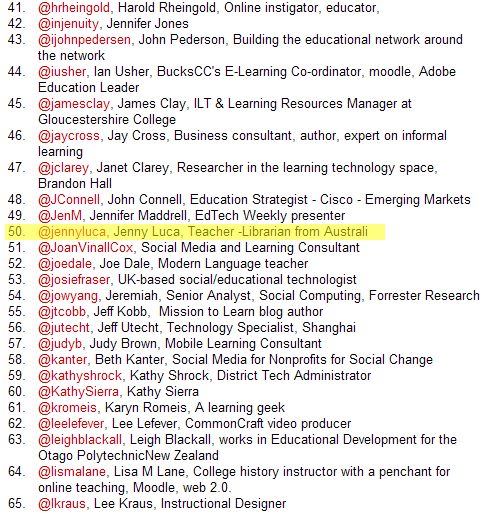
Scrolling through the list I could see names of people I follow. People like Alec, John Connell, Britt Watwood, Judy O’Connell, Sheryl Nussbaum Beach, Joe Dale, Sue Waters, Doug Belshaw, Jeff Utecht, Lee Lefever and quite a few others. No. 50 on the list was me!! Me. Gotta tell you this was unexpected. Don’t know how it came about but it has stopped me wavering. 


If you’re not familiar with Twitter you should be. It’s a fantastic tool for networking and learning about others who have an interest in educational technology. You find yourself discovering new things all the time. But it’s not just that. It’s also about the human face of the network. Just the other day Andy Carvin put out a tweet about how he and his wife were heading to the hospital for the birth of their second child. The next day he posted the link to the Flickr photos of the birth of Sean Carvin. Andy Carvin doesn’t know me from Adam, but I’m happy to share with his good news and pass on my congratulations. You find yourself connecting on many levels, not just professionally but personally as well. And that’s what makes it work – it’s the human network forming once again with humanity linking us.  

There are people who are not on that list who should be. People like Julie Lindsay, Kim CofinoChris Betcher, Tom Barrett, Dean GroomChrissy Hellyer, Jo McLeay and Sue Tapp and many others. So that’s my next job. Time to send an email recommending others for inclusion on the list so that we all can benefit from the human network.

*I hope this doesn’t sound like a ‘Look at me’ post. I know it could be interpreted that way. I am genuinely surprised at my inclusion on that list.

The power of Twitter

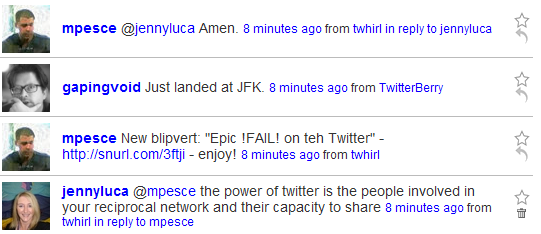
This tweet from Mark Pesce got me thinking this morning. So many people I know don’t write blogs or operate in an online environment. Some have difficulties dealing with email. Most of them have no understanding of what Twitter is or why on earth you’d want to spend time looking at the 140 character responses that are posted on this microblogging tool.

I was with them once. And it wasn’t all that long ago. I’d heard about Twitter but wondered why people would be interested in using this tool. Twitter’s prompt is ‘What are you doing?’ Why would you want to tell people about the minutiae of your life. I danced around it for awhile but finally started using it. Clay Burell helped me to form my network by doing a shout out for me asking people to follow me. The thing with twitter is is that you have to follow people and they need you to follow you back in order for you to see each other’s posts (tweets!). It’s a reciprocal relationship and when it’s like that that’s when it works best.

Seeing Mark’s tweet this morning prompted me to reply with my belief about the power of Twitter.


And that’s it really. It’s the capacity of your network to share with you that makes it such an essential tool. Twitter has taken me places I never would have found without the valuable links being provided by the wonderful sharing people involved in my network of reciprocation. Sometimes those same people who post those great links also share with me that they’ve just burnt dinner or have to put the kids to bed. And that’s OK too. I get to know them as people and enjoy the human experience with them.

Let’s face it, it’s powerful. How else would a teacher like me get to connect with a mind like that of futurist Mark Pesce? Personal learning networks are amazing. If you’re dancing around the edges of Twitter it’s time to take your turn in the middle and explore the potential of what is an incredible tool for connecting and sharing.