This film was made by Mixtape club, and according to them, it’s an artistic espresso conveying happiness. I’ll leave it up to you to decide if they’ve succeeded.
Easter holidays for most of us. That time of the year where chocolate abounds. I’m determined to not let the abundance of chocolate haunt me past Sunday. Well, maybe it will until Tuesday. But after that, no more!!
Hope you’re Easter break treats you well. Enjoy, within limits!
One of the constants that I reiterate in English classrooms year after year is the need for students to actively build their vocabulary. A strong vocabulary can be the making of you, particularly when it comes to writing essays that are marked by assessors. If your writing shows flair, and you choose your words carefully and use them in the right context, your work can rise above the run of the mill.
My students always ask how can they build their vocabulary. I tell them to pay attention. If they are listening to a speaker, notice when a word is used that they aren’t familiar with. Go home and look it up, understand what it means and how you can use it in a sentence. If you’re reading a book or magazine, do the same. Don’t trip over words and assume you understand their intent from the context of the sentence, make a determined effort to understand why the writer made that word choice, and see if it’s something you can use yourself in discussion or in your next essay. Don’t be frightened of words, embrace them and make them work for you.
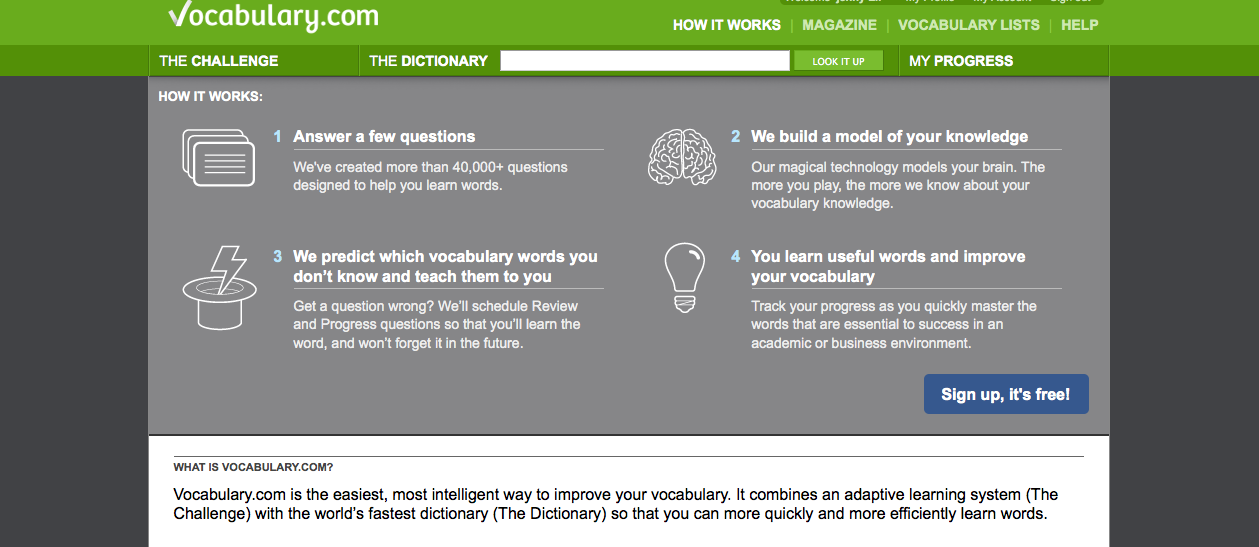
I’d heard a whisper or two (read twitter references!) to Vocabulary.com, but hadn’t seen it until this evening thanks to a tweet from Lisa Thumann. I signed up, and spent the next 30 minutes or so pitting my knowledge of vocabulary up against ‘The Challenge’. This entails the site presenting you with a series of words and you having to identify their correct meaning from four options. You choose the level you operate at based on your level of education. It is challenging, and I’ve learnt a thing or two already. It charts your progress, and revisits words you had difficulty mastering. Here’s a screenshot of part of their ‘How it works’ page.
I definitely think Vocabulary.com is something worth showing to your students. It’s not a lesson replacement, but could be something you’d use as a lesson starter for 10 minutes, to get your students thinking. I’d also be recommending it for use as some ongoing self directed learning. Don’t phrase it as homework, that’s sure to turn anyone off!
OK, if you’re an American, you probably have seen it already as it was one of those ads played in prime viewing time during your Superbowl. Somehow, it missed my radar until last night when my son showed it to me and suggested it should go on my blog. I’ve been laughing ever since. Maybe I just have one of those quirky sense of humours. That, and the fact that I have a soft spot for anything that evokes my memories of that epic experience of seeing Star Wars when I was thirteen. I’ve said it here before, but that image of the Star Cruiser panning across the screen surpassed any cinematic experience I’d had up to that point in my life. It made Jaws look amatuerish. And that was saying something in 1977.
And for those of you with a sense of black humour, take a look at this parody that inserts a Toyota in place of a Volkswagon.
It’s school holidays here in Victoria, and I’ve just spent an idyllic day at the Melbourne Zoo with my children and my Mother. Days like that make me wish I was always on holidays. I hope you have had a wonderful week, and that there is something special awaiting you this weekend
I returned last week from the CCAEducause conference and have been collecting my thoughts. The conference by line was, ‘The Game has Changed’. It has, but I’m not entirely sure both secondary education and higher education have quite understood just how much has changed. This conference was aimed at higher education, and I went along because I wanted to see what higher education was talking about in relation to technology and its role in the eyes of those running and working in universities in Australia. My idea was that I would be able to assess what we needed to do in Secondary education to prepare our students for the kind of tertiary experience they were heading for.
To say my eyes have been opened is an understatement. I’ve come away from this conference thinking that the situation might need to be reversed. Maybe it should be personnel from universities visiting some secondary education institutions and looking at what is happening there, so that they can prepare themselves for the students heading their way. Note I said ‘some’ secondary institutions. There is no doubt there is huge disparity in the take up of new technologies within our sector.
I suspect the final keynote speaker, Richard Katz, might even describe me as some sort of edupunk, because I write in a public space using web 2.0 technology and influence others with ideas. Heck, I’m not a ‘published’ author, and I have an audience. I’d prefer to think of myself as a public intellectual, as I’ve heard bloggers described by John Seely Brown. I refer to the ‘edupunk’ tag, because Richard described Jenny, the very savvy 27 Yr old creator of ‘60 second recap‘ as an edupunk and one of the perceived threats higher education faces. Jenny offers an informal learning experience. Anyone can tap into her site and watch her creations, as she dissects the plots, characters and themes of classic fiction and plays. I don’t view someone like Jenny as a threat. In fact, our Yr Nine students were watching Jenny’s creations last year as they explored the themes surrounding Romeo and Juliet. In my eyes, Jenny helps augment our curriculum, she’s part of my teaching arsenal and I’ll employ her to assist my students with their understanding. I’ll go one step further even and encourage them to replicate what she does and submit it to her site, so that they can become the creators influencing and helping to lead others to understanding.
Here are other perceived threats. The Khan Academy, iTunesU, MIT Opencourseware, P2PU, any of the burgeoning sites where a student can self direct their own learning. My gut is telling me that none of these things are threats if universities rise to the challenge and embrace new ways of doing things. Shirley Alexander, from University of Technology Sydney, spoke of the need to do things differently, to deliver instruction via a podcast if it could be done that way, so that face to face time could be spent with students dissecting ideas with lecturers. I was under the impression that this was happening already, and I suspect it is in some institutions. Please, fill me in if it is the case. She spoke also of the 20% drop out rate in first year, and the need to address this appropriately, and determine what is causing this.
I suspect a lot of the speakers were directing their thinking to those who are already trying to make a difference. There were many IT support personnel and Librarians present, many of whom who are doing the groundwork in their institutions to bring them up to speed. It seems the people missing from a conference like this, and those who most need to be there, are the lecturers themselves, the people delivering the content. Most of these people are obviously highly accomplished in their fields, but might be lacking the teaching skills that might help them to visualize alternate ways of delivering content.
There were some excellent keynotes. Bryan Alexander was so interesting that I had to stop sending out tweets so that I could concentrate on his fast paced delivery of possible scenarios for higher education in 2016. This was brilliantly mind mapped on Prezi, and I was so captivated I can forgive him for the seasick motion of the zoom that Prezi is noted for. If I could find the presentation on Prezi, I’d embed it here. It is visionary. I have found Bryan’s Slideshare presentation that made up the first part of his talk, and you can get a feel for the way he thinks.
Mal Booth, Librarian from UTS (University of Technology Sydney) gave an inspiring presentation about how their library is responding to change. Mal has shared his presentation and notes on Slideshare, so I can embed it here and you can benefit from his wisdom.
UTS staff delivered another presentation about mobile support for staff and students at their library. Sophie Macdonald, a Librarian, presented with Rajan Davio, the IT Manager who works in the UTS library. It was an excellent example of how librarians and IT staff can work together to find solutions for access to library resources. As we move towards mainstream usage of app driven mobile devices, it is even more apparent that close working relationships are necessary between Library and IT staff. I’m very pleased that our IT staff have moved into the new library building my school has just completed; we recognize the need to work together to ensure as seamless a delivery of services as we can manage.
Maxine Brodie, from Macquarie University, spoke of the new Macquarie Library, a very impressive building with 80% of its collection stored underground, and robotic book retrieval operating for on demand access to resources. Why have they done this? Because acres of shelving prevents patrons from accessing space, and space is what libraries as collaborative learning places and places for quieter reflection need. I’d like to know what they are doing to change up their service model in terms of support for students now that they have a space that can cater for more of the university population.
Mckenzie Wark was fascinating. He’s an Australian working in New York, and some of the work he is doing with a graphic novel looks like it will be very useful as a text explaining different political systems when it is eventually published. He has written a book called ‘Gamer’s Theory’ and used the plugin commentpress in WordPress to encourage co-contribution to the text’s development from gamers and other informed and interested members of the public. What he has done represents new models for authors to consider as they create informative texts.
I tweeted long and often, (well as long as 140 characters each tweet!) and battled with the demons of autocorrect on my iPad. My iPad came into its own. I used it to tweet, search and check the emails streaming in from school. It was great for that. In fact, when I got home my right forearm was aching from holding the iPad all day. Can you claim Workers Comp for an iPad RSI conference injury? ; )
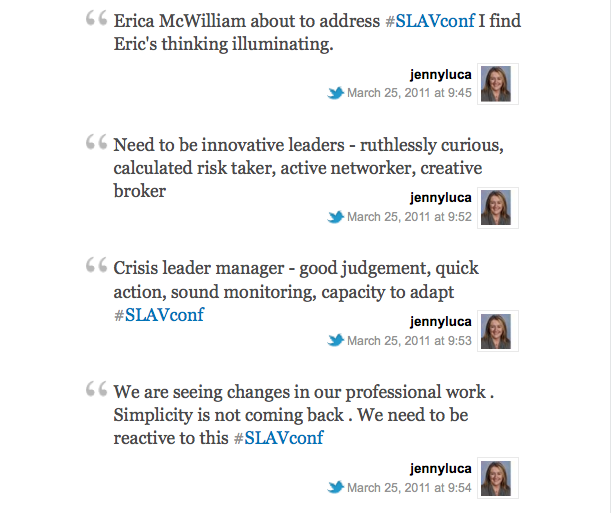
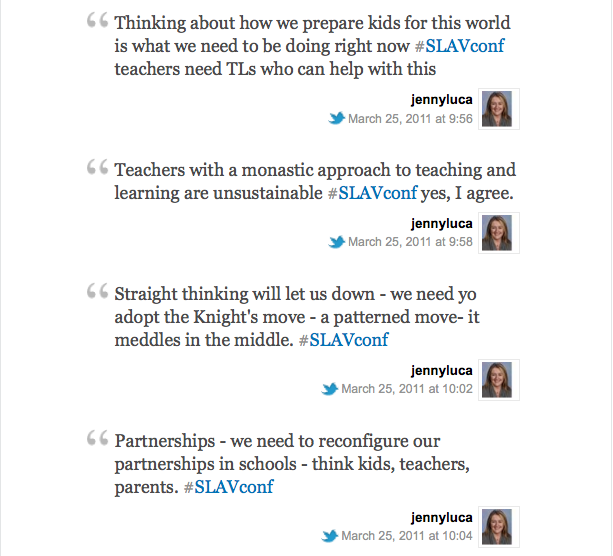
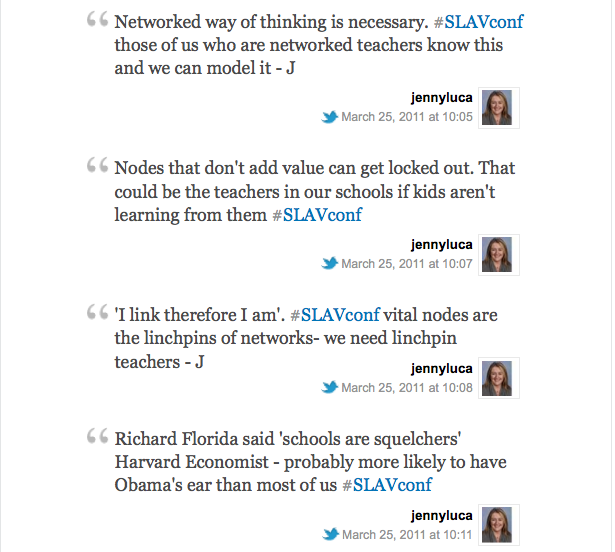
My tweets were my means of notetaking. I’ve done this at the last two conferences I’ve attended, and I can see myself getting better at it. My tweets become a combination of what speakers are saying and my own reflection on their words. If I add my input, I try and separate my thinking from the speakers by adding a ‘J’ at the end of my contribution. It works for me, anyway! I’ve collated my tweets in Storify, and they give a reasonably good run down of my conference experience. If you go and take a look, remember to start from the bottom and scroll up to follow the conference from beginning to end.
The conference has strengthened my belief that in Secondary Schools, we need to be preparing our students to be effective digital citizens. They need to understand how to use new technologies safely and ethically, and they need to know how to manage their digital footprint. I heard no mention of this kind of talk at this conference. If our students don’t understand the importance of managing their digital lives by the end of secondary school, then they seem likely to be entering Universities and their working lives under-prepared.
CCAEducause 2011 has left me thinking. To the best of my knowledge, I was the only representative from the Secondary education field. There is a need for the different streams of education within our country to talk more openly with one another. We need to prepare our students adequately for a system that requires them to take control of their learning, and universities need to be ready for students who are used to employing mobile and social technologies as their means of communication. Some of our secondary schools are going to be sending along students who are well versed with new technologies as a means of communication and creative output. A delegate presenting spoke of the “ever lengthening tale of non engagement” that keeps getting told within his institution, as people refuse to budge from tired methods of instruction. Universities today can ill afford to tell this story. Our next generation is ready for the new edition.
Thanks go to Frances Manning, who pointed me in the direction of this amazing virtual choir, featuring 2052 performances of ‘Sleep’ from 1752 singers in 58 countries, individually recorded and uploaded to YouTube between September 2010 and January 2011. Here’s an explanation of how it all began from the Virtual Choir site;
The Virtual Choir began in May 2009 as a simple experiment in social media, when Britlin Losee – a fan of Eric’s music – recorded a video of herself singing “Sleep” and shared it on YouTube.
After watching the video, Eric responded by sending a call out to his online fans to purchase Polyphony’s recording of “Sleep”, record themselves singing along to it, and upload the result…
…Ever ambitious, for this latest Virtual Choir project Eric called for 900 singers to record themselves singing “Sleep”. At the final tally he received 2052 contributions from singers in 58 countries.
Upon previewing the video at TED 2011, Eric (and the choir) received two standing ovations – testimony to the power of the internet to connect people of all backgrounds and abilities and create something beautiful across time and space.
People are interested in coming together to create something special. If only we could harness this kind of energy in fields like medicine or science, where people could come together to share thinking and make concerted efforts to address issues affecting mankind. Collective action always seems to me to be such an altruistic act, benefiting all, but many people can’t get past the ‘what’s in it for me’ approach.
Been a big week. The CCAEducause conference took it out of me, and I’m glad to see the start of school holidays this afternoon. Time to recharge the batteries. I’m even thinking of starting a mosiac project tomorrow. I just need to clear my headspace and do something that will enable me to see something creative emerge.
Enjoy your weekend. Seek sunshine and soak it up. : )
Did you notice the date? If you didn’t, and you happened to stumble over the above video contained on this page, then I think you might be attempting to compose your mail in a very kinesthetic way by now. You might also be wondering how they managed to collate a top 5 list of viral YouTube pictures from 2011.
Google have been up to their April Fool’s day tricks again, something they are noted for. Here’s my favourite from this year’s batch;
Are you passionate about helping people? Are you intuitive? Do you often feel like you know what your friends and family are thinking and can finish their thoughts before they can? Are you an incredibly fast Google searcher? Like, so fast that you can do 20 searches before your mom does 1?
Every day people start typing more than a billion searches on Google and expect Google to predict what they are looking for. In order to do this at scale, we need your help.
Google’s quality team is looking for talented, motivated, opinionated technologists to help us predict what users are looking for. If you’re eager to improve the search experience for millions of people and have a proven track record of excellence, this is a project for you!
As a Google Autocompleter, you’ll be expected to successfully guess a user’s intention as he or she starts typing instantly. In a fraction of a second, you’ll need to type in your prediction that will be added to the list of suggestions given by Google. Don’t worry, after a few million predictions you’ll grow the required reflexes.
Responsibilities:
Watch anonymized search queries as they come in to Google.
Predict and type completions based on your personal experience and intuition.
Suggest spelling corrections when relevant.
Keep updated with query trends and offer fresh suggestions.
Requirements:
Excellent knowledge of English and at least one other language.
Excellent knowledge of grammatical rules (e.g. parts of speech, parsing).
Understanding of the search engine space.
Proven web search experience.
Good typing skills (at least 32,000 WPM).
Willingness to travel (in order to provide local autocompletions) or relocate to obscure places like Nauru and Tuvalu to develop knowledge of local news and trends.
If you want to see evidence of what they’ve done in past years, check out this About.com page where they’ve collected some of their efforts in years gone by.
I’m heading to Sydney over the weekend for the CCA-Educause Conference. Its focus is Higher Education, and I’m going to see what the thinking is so that I can gauge how we best prepare our students for the environments they will experience in their post secondary school life. There is a library strand for the conference, and I’ll be listening intently to discussions surrounding the future of libraries and the integration of ebooks and new devices.
I hope your weekend treats you well. Have fun. : )
OK. Part two of my quest to be a person who understands code.
For those of you unfamiliar with what code is, it’s the parade of letters and brackets and delimiters that makes the pages on the Web look the way they do. Without code, we’d be looking at computer screens full of boring reams of text and numbers. There would be no fancy buttons to click, no aesthetically appealing anything much to hold our interest. That’s what it was like in my College days, when I’d walk into the bowels of a primitive computer lab in what must have been 1986, and look at guys (because everyone in there was male!) staring at green screens typing in letters and symbols. Ahhh…the folly of my ways. If only I’d been paying a little more attention? If I had, I’m pretty sure my bank balance would be looking a lot healthier than it is right now!
Over the last couple of years, I’ve become a whole lot more interested in what is the backbone of the web: code. Because I’ve been using tools in my classrooms that sometimes require me to embed code to make things appear, I’ve begun to realise there are gaps in my knowledge base that need filling. I’m pretty sure I could continue on and function perfectly well without knowing the ins and outs of code, but there’s something in me telling me it’s important that I make some effort to have an understanding of how things work.
I’ve also begun to look closely at what we do in the school I teach at. We don’t offer formal ICT classes. We are a 1:1 school, and we expect that our teachers use technology in a meaningful way in their classrooms. But that leaves a pretty big gap when it comes to student understanding about the workings of the web. I don’t want the kids I teach to miss out on opportunities. I figure if I gain understanding, I can find a way to transfer my knowledge to them, and I think that’s important.
I’m hoping to learn how to have a working understanding of how HTML and CSS work. I’d like to be confident enough to construct a webpage myself; to be able to tweak pre-existing code to do something that can change the look and feel of a page. I’d like to be able to participate in discussions where I felt like a participant rather than an observer.
My previous post contained questions that I had to give myself a score on. I tried to be brutally honest, but I do have to admit that I’ve never really been able to bend a spoon using the powers of my mind, despite the hours of practice I gave to the task after seeing Uri Geller do it on The Done Lane Show when I was eleven. I think I was pretty straight up on the other answers though, and my series of ‘0’ responses attests to this. I know what it is, but I have limited knowledge of how to do it!
What I do know is that you can change the look of a page by tweaking code. Occasionally I play with the sizing of objects by changing the numbers in the code, but that’s about as far as I go. I’d love to feel confident enough to just inherently know what it is I need to do to significantly change something.
Jamie has asked participants to tell him what makes them happy. Plenty of things.
My son still holding my hand when we are walking in public places.
A student who appreciates what you’ve done for them and tells you with a smile.
My dog who greets me effusively every time I walk in the door.
My daughter sharing stories with me as we drive to and from school.
My husband telling me he loves me.
My parents being proud of me still, and supporting me in everything I do.
My close friends sharing laughs, and sometimes tears, over a glass of the good stuff.
Writing this blog.
Sharing my thinking with others and feeling like I’m making a dent in the universe.
Jamie also asked us to tell him what we’re passionate about.
I’ve expressed interest in a Peer 2 Peer University course, and Jamie Curle, the guy running the course, has asked potential participants to write two blog posts as a pre-requisite task that will help him to identify suitable candidates. This is necessary, because there are 20 places in this course, but around 60 people have expressed interest.
So, these next two posts are make or break moments for me. Will I have what it takes? What exactly will it take? I have no clue really – I’ll just do my best to be honest and try and inject a bit of me into my writing. The course is, as the title of this post suggests, about HTML and CSS coding -something I’ve become increasingly interested in over the past couple of years. My first task is to do as follows:
I want you to rate yourself on a scale of 0-10 where 0 is ‘none at all’ and 10 is ‘lots and lots’ on the following questions.
I understand html – 5
I understand the concepts behind HTML – 5
I understand how to view the source of web pages – 3
I understand how to structure a HTML document correctly -2
I understand how to use the right tag for the right purpose – 2
I understand the difference between classes and id’s – 0
I understand what makes a good class name and a good id – 0
I can ‘think in html’ – 0
I understand css – 0
I understand the concepts behind CSS – 0
I understand how to view the source of CSS documents – 0
I understand the best method to attach CSS to a HTML document in any given context – 0
I understand how to apply style rules to a HTML document – 0
I understand the general syntax of CSS – 0
I understand the basic CSS selectors – 0
I understand the advanced CSS selectors – 0
I understand how different browsers interpret CSS – 0
I can ‘think’ in CSS – 0
I am able to bend spoons with my mind – Can’t everyone?
I understand the quirkiness of browsers – 4
I am motivated to learn – 10
I am enjoying myself – 10
Now, in our current education system, I’m pretty sure my responses would equate to a ‘you are not a suitable candidate’. But in the Peer 2 Peer University system, I’m hedging my bets that my final two responses hold a fair bit of weight. I’m hoping so anyway.
So, Jamie, part one completed. While I’m on a roll, I just may leap into part two.
(This post exists on Storify, but it seems impossible to embed it here on this WordPress blog, so I’ve copied most of it here. To see it on Storify, follow the link.)
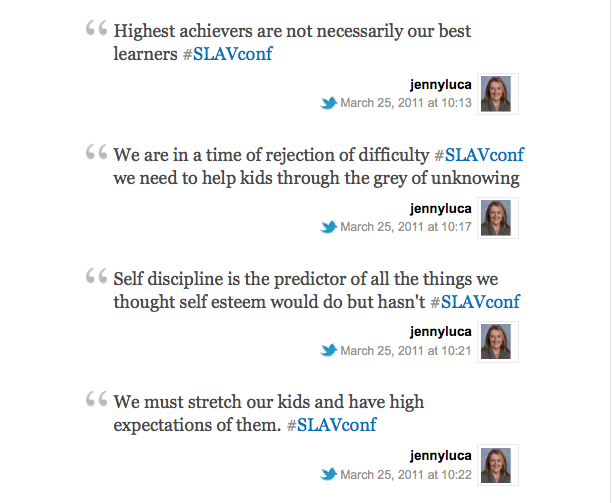
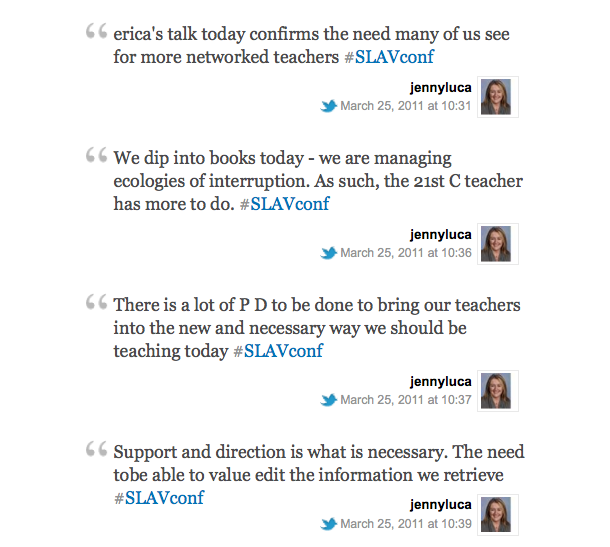
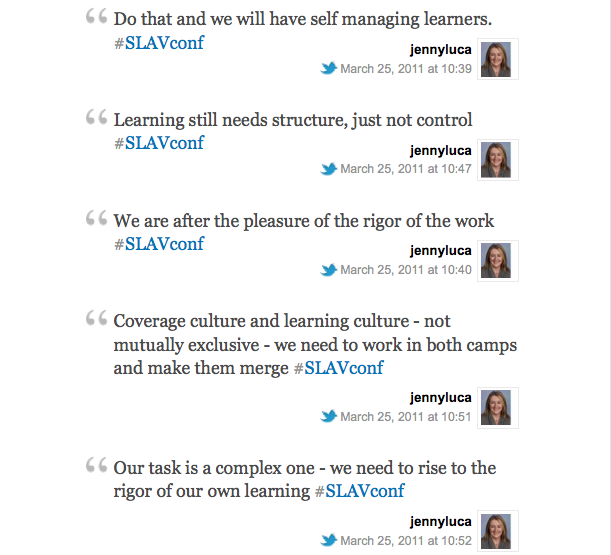
Below is my Twitter stream while I was listening to keynote speaker, Erica McWilliam, present at the SLAV conference here in Melbourne last Friday. The theme of the conference was ‘Creating collaborative learning spaces: Future school library scenarios’. Erica’s talk was entitled, The e-shift: What does it mean for 21st century literacy and learning? Ericais a woman worth listening to – if you ever get the opportunity, leap at it.
So refreshing to hear a learned woman speak at a conference, given the fact that so many keynotes are delivered by men.
Lyn Hay, from Charles Sturt University, also presented a thought provoking presentation about the role of Teacher-Librarians and libraries as physical spaces as we move into an increasingly digital world. Lyn’s presentation has been uploaded to Slideshare and I’d encourage you to take a look at it.
On the day, there were very few of us using Twitter to push the ideas out to the wider world. In fact, most were taking notes using the pen and paper model. Hardly a laptop or iPad in sight. Maybe people were using their phones, but I didn’t see much of anything like that happening around me. In 2011, I’d expect a Teacher-Librarian audience to be wired up and sharing ideas in collaborative spaces. If we are to respond to the ideas presented by Erica, then we better see our profession rise to the challenges of our age. We need more networked Teacher-Librarians to model for our staff and students how we self direct our own learning, and how we can seek out opportunities to make the learning experiences in our schools today reflective of the connected era we are living in.
The improveverywhere crew are at it again, this time in the Metropolitan Museum of Art in New York. This time, Agent Elliot, who bears a striking resemblance to King Philip the IV of Spain (from the 17th Century), spent time dressed as the King standing in front of his portrait. The scenario this time was that Agent Eliot was the actual King, and was there to sign autographs. It never ceases to amaze me how many people out there take what’s being presented to them as the gospel truth, or maybe they were all just going along for the ride.
As is often the case, the story behind the story is the most interesting one. In this case, Charlie Todd tells on their site how he asked their user base for any ‘special skills’ people had that they could build a mission around. This was the response he got from Agent Elliot;
“The mission I would like to propose is to cause a scene in the Metropolitan Museum of Art. In the museum there is a painting of King Philip the IV of Spain and I look identical to him.”
He does too!
I spent today at the SLAV conference here in Melbourne and might try and write about it ove the weekend. Right now, I’m looking forward to laying my head on my pillow and drifting off to a sound night’s sleep.
Have a good weekend everyone. I hope good times find you. : )



 Lucacept - intercepting the Web