Google Search Stories for classroom use

I worked with my school’s Humanities faculty this afternoon showing them some Web tools that they may like to use in their classes. They’ve had a lot of success with Glogster, and now feel like they need to look into different tools to help with demonstrating students’ understanding of the subject areas they are teaching. I’ve created a page on the wiki I use as a resource base and I shared that with them. We explored quite a few things they’d not seen such as Capzles Voicethread, timetoast, and Google Search Stories.

I’d never made a Google Search Story until this afternoon, and I found the experience incredibly easy, but enlightening too. While it’s no doubt a bit of marketing for the Google juggernaut, it could very well have a place in classrooms. The search story above deals with the recent crisis in Japan. All I had to do was go to the search story creator, type in the search terms I thought were applicable and select what kind of search I wanted for each search inquiry eg: web search, maps, news etc. It’s a way of highlighting that there are different kinds of searches you can do on Google- you aren’t limited to the home page search box. There’s the first lesson for our Google addicted students!

It got me, and the others in the group this afternoon, thinking about how it could be used in classrooms. Our International Studies teacher could see immediate application for current world events, as either something she created to hook the students in at the start of a lesson, or something they created to demonstrate their understanding of the timeline or complexity of an issue. We thought about books they’d read, and how they could tell a character’s journey via a search story. They are certainly fun to create and can be done easily within a lesson, even within ten minutes really.

The difficulty comes with uploading them to YouTube. I have an account so the process was very easy for me. All I needed to so was sign into my account from the search story creator and the video was uploaded for me. It was a very quick process. Both of my children have YouTube accounts, so if they were sitting in your classrooms you’d have no worries with them, but it’s not going to be the norm for the majority of our students. I also think we’d have a fair few parents who probably don’t want their children having an account. We were trying to work out how we’d overcome this and be able to use this in our classrooms. We thought we could create a school account on YouTube, and when it came to upload time, the teacher could input the school email and password for the account. We weren’t keen on sharing this with the students, just in case someone thought it ‘funny’ to upload something inappropriate under the school’s name. I’m not sure how we’ll proceed just yet, but I do think it’s worth following through with. If anyone reading this has any other ideas, please leave a comment and enlighten us!

It’s worth taking a look at the search stories site and looking at some of the videos there. Some are very clever, even touching, and all in 30 seconds or so. Take a look below and you’ll see what I mean.

Teenagers, Legal Risks and Social Networking Sites

On Friday, I attended the launch of a final report from the Learning with New Media research group who are from Monash University’s Faculty of Education. Their report is the title of this post, and it includes some important recommendations that should be heeded in school communities today. I have replicated their key findings and recommendations below, and hope the authors feel that this is appropriate dissemination of their work. I am particularly pleased that they have identified the need for schools to “equip(ping) children and young people with the skills required to be effective digital citizens, and not focus(sed) on rare or hypothetical fears.” For too long, many of us have been trying to do just this using new media tools like Ning networks in our curriculum, and now we have some solid research based recommendations supporting their use.

I have not yet finished reading the report in its entirety, but intend to do so. I encourage you to download it from the following link;

Teenagers, Legal Risks and Social Networking Sites

The authors (Melissa de Zwart, David Lindsay, Michael Henderson and Michael Phillips) have also produced an educational resource for teachers and parents that can also be downloaded. Access it at the following link;

Will u friend me? Legal Risks and Social Networking Sites

What follows are the key findings and recommendations from research conducted, using data collected from seventeen Victorian Secondary Schools from State, Catholic and Independent systems in both rural and metropolitan locations.

Key findings:

The findings confirm that SNS usage has become integrated into the everyday social lives of most Victorian middle school students. The findings also indicate that there is a general awareness of risks in using SNS by middle school students, although concerns about risks differ markedly between parents and teachers, on the one hand, and students, on the other. However, there is very little clear understanding by students, parents and teachers alike, of the precise nature of the legal risks that may arise from everyday SNS use.
1.    The overwhelming majority (94.9%) of middle school students (years 7 to 10) have used SNS.

2.    Facebook is the most popular SNS, with 93.4% of students using it, followed by MySpace, with 26.6% of surveyed students using it. Many students use more than one SNS.
3.    The majority of surveyed students update information on their SNS at least every day, and over a quarter update their SNS profile several times a day.
4.    The surveyed students use SNS primarily to maintain current social networks, while making new friends and flirting were relatively low in students’ reported practices.
5.    The majority of parents (80.4%) indicated that they had seen their child’s SNS profile at least once.
6.    The most common content reported as posted to SNS by surveyed students is photographs of themselves (60.9%), closely followed by photographs of their friends (52.6%). Nevertheless, posting of third party content, including music, video and photos of celebrities, is still significant. The proportion of students posting videos to SNS increases with age.
7.    A significant proportion of students (45.6%) reported that their photos had been posted on their friends’ SNS. The majority of students were not concerned with this practice.
8.    The most highly valued feature of SNS was the ability to stay in touch with friends and family. SNS are also perceived to be less expensive than other forms of communication.
9.    Surveyed students felt that SNS were safer than did their teachers and parents. Thus, while 48.8% of students recognised that there was some element of risk in using SNS, more than one quarter (28.3%) thought that SNS were safe. Moreover, 19.6% of students were ambivalent about risk, essentially reporting that the degree of risk was irrelevant to them as it is “just what everyone does”.
10.    Students from years 7 to 10 are increasingly more selective in who can see their profile. The survey results suggest that year 7 students not only have more visible profiles, but are more likely to perceive SNS as safe or only a little bit risky.
11.    A majority of surveyed students (72.4%) indicated that they had had unwanted or unpleasant contact by strangers via their social networking profile.
12.    A minority of students (13.8%) were concerned about security risks, such as identity theft. A small group of student respondents (3.2%) identified concerns relating to privacy or unwelcome disclosure of data.
13.    Parents and teachers were particularly concerned with issues of cyber-bullying, and grooming or stalking, with a lesser number expressing concerns about identity theft and disclosure.
14.    Despite the acknowledged risks of students using SNS, there is surprisingly little ongoing conversation about SNS use between parents and their children, on the one hand, or teachers and their students, on the other. In this respect, almost half of the surveyed students (46.1%) reported that they did not talk with their parents about SNS use, while almost three quarters of the students (74.6%) reported that they did not talk with their teachers about SNS use.
15.    Surveyed students reported an awareness of a variety of strategies for avoiding risks or problems associated with SNS use, including ignoring ‘friendship’ requests from strangers, blocking or deleting unpleasant or unwanted friends, setting their profile to ‘private’, not disclosing personal details, frequently changing their password, threatening people who wished to be added to the student’s SNS and self-censorship. Only 1% of respondents reported asking for guidance or help from adults as a viable strategy.
16.    The majority of teachers have not used SNS in an educational context. However, a significant minority (36.1%) of the teachers who were asked this question indicated that they had used SNS for educational purposes, including communicating with their students about schoolwork.
17.    The majority of teachers who were surveyed on the issue indicated that they were generally aware of risks, including legal risks, of teachers using SNS. However it is also clear that teachers had a variety of understandings about the specific nature of this risk.

…the key recommendations arising from this project are as follows:
1.    In order to enhance the benefits of SNS use, and minimise the disadvantages, it is important for children and young people to be equipped with the necessary information to empower them to effectively manage risks associated with the everyday use of SNS. The best way to do this is through specifically tailored educational activities. As children and young people must be primarily responsible for managing their own risks, it is essential that educational activities focus on providing clear and accurate information about all risks associated with SNS use, including legal risks. These educational activities should be aimed primarily at equipping children and young people with the skills required to be effective digital citizens, and not focussed on rare or hypothetical fears.

2.    Education about the full range of legal risks potentially encountered by the use of SNS should be part of a fully integrated cybersafety school curricula. This means that attention that is properly given to more dramatic issues, such as cyber-bullying and ‘sexting’, should be balanced with attention to other potential areas of legal liability. This strategy should also assist in promoting awareness of, and debates about, the Australian legal system as it applies to online activities. While acknowledging the crowded nature of school curricula, the importance of SNS in the lives of students, and the potential significance of social media for future digital citizenship, suggests that room should be found for these issues to be directly addressed.
3.    The best way to approach the teaching of legal literacy in the digital environment, is by the use of practical examples drawn from real life case studies. With this objective in view, one of the outcomes of this project is the Education Resource Book, which includes a series of classroom exercises aimed at promoting understanding and discussion of specific legal issues. The researchers for this project encourage the production and use of this and similar resource material for the use of teachers of middle school students.
4.    The reported prevalence of posting of photographs of students to SNS, suggests that the legal and ethical issues involved with the posting of photographs – which include privacy, confidentiality, defamation and copyright – merit specific attention in any cybersafety curriculum. The significance of understanding these issues is emphasised by the incidents involving a Melbourne teenager posting naked photos of AFL footballers to her Facebook site.
5.    The potential disparities in the approaches to, and understandings of, legal risks associated with SNS use between parents, teachers and students, as well as the reported paucity of communication on SNS use between students and parents and teachers, suggests that there is some need for education and training of teachers and parents, as well as students. Much can be gained by the community from greater informed discussion of the implications of SNS use, including legal implications, among parents, teachers and students.
6.    Consideration should be given by Commonwealth, State and Territory authorities to encourage and guide SNS service providers operating in Australia to enter into a self- regulatory agreement similar to the Safer Social Networking Principles for the EU. This would provide baseline commitments against which practices of SNS service providers in their dealings with young people could be periodically assessed.
7.    Given the concerns expressed by teachers interviewed for this project, there appears to be an identified need for further guidance to be provided to teachers about the use of SNS, especially in the pedagogical context. In particular, there is a pressing need for research and policy work to be undertaken in determining the extent of the ‘duty of care’ owed by teachers in any interactions with students via SNS. In this respect, it is important that the salient differences between interactions via SNS, and interactions offline, including the different legal implications, are fully taken into account.
8.    There is a need to promote holistic policy responses to the full range of risks associated with the use of SNS by young people. Any responses should be coordinated so as to minimize the risk of fragmented, inconsistent, and potentially contradictory, policy initiatives at the Commonwealth, State and Territory levels. If, following the forthcoming report by the Commonwealth Joint Select Committee on Cyber-Safety, it is decided to establish an Online Ombudsman, the Ombudsman’s portfolio should extend to promoting education about the full range of legal risks associated with the use of SNS. In doing so, the Ombudsman should coordinate with Commonwealth, State and Territory Privacy Commissioners.
As the discussion of the project above indicates, this was a preliminary study, which, as well as highlighting the issues analysed above, also indicated the need for further work to be done in this area. There is a need for further research directed at understanding young people’s use of SNS and how they can better be empowered to be confident and safer digital citizens. There is also a significant need to further work to be done to assist teachers to be better equipped to understand their rights and responsibilities in the digital communication environment.

Research findings like these will support our use of new technologies in classrooms. What is evident from their recommendations is that further teacher professional development is required to ensure that we have teachers with the skill set to produce the ‘effective digital citizens’ we need in society today. The authors acknowledged on Friday that further research into how schools effectively do this is required. Let’s hope this happens sooner rather than later.

School’s out Friday

My family and I were roaming YouTube on our television last night, when we stumbled on this video from Key of Awesome.  (You have to watch an ad at the start – a way to monetise what they do I figure) They’re a group who create a weekly musical comedy show on YouTube spoofing celebrities, pop-culture and the latest internet memes. We all really like Bruno Mars, and found this one particularly funny. Compare it to the original video and it gets even funnier. (IMO anyway!)

Something else we stumbled onto while on the Bruno Mars trail, was footage of him as a four year old impersonating Elvis Presley in the movie, “Honeymoon in Vegas”.

I feel a little guilty highlighting mirth and merriment, while we see Japan and its people struggling with the devastation of the Tsunami and the nuclear crisis unfolding at the Fukushima Dai-ichi nuclear power plant. Brian Farrell, a Teacher-Librarian who works in Japan has written a post eloquently describing the reaction of the Japanese people to their situation. I encourage you to visit his post. Here’s an excerpt;

Amidst this chaos, the Japanese people have shown me just how incredibly disciplined, calm, and selfless they are. There is no panic in the air, just a saddened calmness and resolve as people try to go about their lives. There have been shortages of food, but there’s been no pushing or shouting in the shops as people try to buy what little they can. After the earthquake, people walked for hours on end to get home, but would never have considered stealing a bicycle (many of which can always be found sitting unlocked) to shorten their journey. There have been lineups at gas stations (those that have managed to stay open) with several hundred cars in them, all waiting to get even a few litres of fuel, but no one is honking their horn, no one is demanding that they somehow be treated differently from everyone else.

My thoughts continue to be with the people of Japan. Let’s hope the nuclear situation doesn’t get any worse.

I hope the weekend treats you well. I’m off to see Chris Isaak tomorrow, with Joe Camilleri and The Black Sorrows as the support act. Should be a good night! : )


Voices from the Learning Revolution

I feel honoured to have been asked to write for the new ‘Voices from the Learning Revolution‘ blog. It’s contained within the Powerful Learning Practice site and has contributors who range from the very experienced to those who are just starting to work with new media in their classrooms.

Voices from the Learning Revolution

Voices from the Learning Revolution

From the site comes this introduction to the contributing voices:

Dolores Gende has been teaching science and math for over 28 years in the U.S, Mexico, Belgium, and the Netherlands Antilles. She is the Director of Instructional Technology at Parish Episcopal School in Dallas where she also teaches Honors Physics. Her award-winning AP Physics website serves as an important reference tool for teachers all over the world. Dolores is a member of The College Boards’ AP Physics Curriculum Development and Assessment Committee, presents at national and international conferences and leads week-long summer institutes for new and experienced physics teachers.

As a district assistant superintendent (West Clermont Schools, PA), M.E. Steele-Pierce works at the intersection of policy and practice where, she says, it’s all personal. She’s an alum of the Harvard Change Leadership Group and is currently learning with the PLP Network. She’s interested in how individuals and systems change. Home is Cincinnati OH where she finds balance in books, film, arts, and slow food. When she was recently called a bureaucrat, she countered, “a creative bureaucrat.”

Ed Allen is a high school teacher and administrator in the Philadelphia area. He firmly believes that learning needs to be networked. He has also been involved in arts education for many years and believes that the arts are critical in schools. Ed blogs at http://imagineteach.org

Bud Hunt

Bud Hunt is an instructional technologist for the St. Vrain Valley School District in northern Colorado. Formerly, he taught high school language arts and journalism at Olde Columbine High School in Longmont, Colorado. He is a teacher-consultant with the Colorado State University Writing Project, an affiliate of the National Writing Project, a group working to improve the teaching of writing in schools via regular and meaningful professional development. Bud is a co-founder of Learning 2.0: A Colorado Conversation. He reads, writes, and worries about the future of reading and writing and teaching and learning at http://www.budtheteacher.com.

Ann S. Michaelsen is a teacher and administrator at Sandvika High School in Oslo Norway. She has promoted the use of computers in school since 2002, working on the county level to implement the Skillsoft LMS in our 34 schools. Sandvika was Norway’s 2009 Pathfinder school in the global Microsoft Partners in Learning Innovative Education Forums, and Ann presented at the same event in South Africa 2010. She is an active writer of the blog Teaching English Using Web 2.0 where she offers advice to fellow educators.

Renee Hawkins is a 4th/5th grade teacher and Director of Instructional Technology at Garrison Forest School, a nursery-to-grade 12 girls’ school near Baltimore, MD, and co-author of the blog, The Flying Trapeze. A teacher for 28 years, she has taught in the US and Japan and currently lives with her husband in Baltimore County.

Shelley Wright is a teacher/education blogger who lives in Moose Jaw, Saskatchewan, Canada. She teaches high school English, Science and technology. Her passion in education is social justice, global education and helping her students make the world a better place. She blogs in Wright’s Room.

Lyn Hilt is an elementary school principal and technology integrator/coach. She believes in learner-centered, passion-driven educational experiences, and seeks to model for her students and staff the power of connected learning. Her thoughts on learning can be found on The Principal’s Posts and Connected Principals. She lives in Pennsylvania, has enjoyed many world travels, and encourages everyone to adopt a greyhound or two.

Jenny Luca is a Teacher-Librarian from Melbourne, Australia who is passionate about exploring the potential of new technologies in educational settings. She writes a blog called ‘Lucacept – intercepting the Web’ and has presented at conferences in Australia and internationally. Follow Jenny on Twitter @jennyluca

Jennifer M. Jones is an young educator and scholar. She has been in education for four years, teaching secondary students. Jennifer lives in Texas and teaches in at large public high school in the Bryan Independent School District, where she pursues learning and educating with enthusiasm.


Screencasting as assistive technology – Sal can teach us a thing or two.

I came across Salman Khan and his work last year, well before Bill Gates did the big shout out for him that led to the Gates Foundation and other Venture Capitalists injecting tens of thousands of dollars into his Academy that produces videos explaining maths, biology, chemistry, physics and a myriad of other topics. I was impressed with his work and continue to be so. I’ve pointed students to the Khan Academy and even recommended it to my daughter tonight to help her understand physics concepts.

He spoke recently at the TED conference about using video to reinvent education. Sal began the videos as a means to help his nephews who he was tutoring. As he says in the video above, they told him they preferred watching his videos to the face to face tutorials. I think that is the key to Sal’s success. Students need to see things explained and it helps if they can revisit it to see it explained again if they didn’t get it the first time around. So, why does this seem like a new idea when in fact, it’s quite easy to do?

I’m going to make a stab at surmising why we haven’t seen our teachers take this approach on a widespread basis.

They don’t know how to do it.

Yes, I think most would understand that this type of assisted instruction is worthwhile, and if they record themselves explaining a concept, it means that they would have more time working with students in their classrooms as they nut out problems. What holds them back, I think anyway, is a lack of understanding about just how easy it is to record your screen and audio as you explain something. To do what Sal does, also requires you using a tablet device and most of our teachers are working with computers that are not tablet computers. Most probably don’t have access to a tablet attachment for a laptop.

I’ve been using Jing for a couple of years now, and have used the video screen capture option to explain ideas and leave instructions for my class when I’m unable to be there. It’s very easy, but every time I show it to someone, they are really surprised that something like that is possible. There are other free alternatives too. Screenr is an online application that will record your screen and allow you to share a link with others so that they can view your recording. Phil Bradley has a list of other screencasting alternatives too. Even Interactive Whiteboards offer screen recording options that can be saved and shared with your students.

Time is no doubt an issue too. Many of our teachers are on very full teaching loads, and are tied up after hours with correction and preparation. Yes, a screencast could be a part of that preparation, but a lot of people would find it a skill that requires refinement. Some just aren’t comfortable explaining a concept while recording, and it would take multiple attempts to get it right. I’ve done that quite a few times myself!!

Perhaps what is needed is some professional development time allocated to staff to get work like this done. It lends itself to maths concepts, and videos could be prepared and shared across classrooms. There’s a great site called Mathtrain, a free educational “kids teaching kids” project from Mr. Marcos & his students at Lincoln Middle School in Santa Monica, CA. It’s there where students are uploading screencasts explaining concepts. They even include videos explaining their screencasting techniques. Getting our students to create screencasts themselves is a great teaching idea. To teach something effectively to others, you need to demonstrate your own understanding. What an innovative assessment tool a screencast can be!

Sal’s work complements the work of teachers in classrooms today. He’s not replacing teachers as some are claiming in the comment stream on the TED talk. We should be embracing what he offers, and thinking about how both teachers and students can use screencasting as assistive technology to explain concepts that can be revisited.

School’s out Friday

It seems entirely inappropriate to me to post a funny video tonight. Not when we are watching devastation unfold in Japan and other countries anticipating the effects of Tsunami waves crossing the Pacific ocean.

I’ve spent this evening watching scenes I could only have imagined might have been possible. The incredible push of tonnes of sea water crossing the coastline of Japan demonstrates to us all the vulnerability of mankind when nature unleashes its force. It was like watching a scene from a Hollywood studio, only the houses, ships and cars being lifted and propelled forward were life sized, not balsa wood models. You know there are people in those houses, ships and cars, and you know that we will hear of massive loss of life in the coming days.

If you’ve been under a rock these last few hours or so, visit the ABC Australia news site, where they used Storify to collate links, pictures and video to relay what has been happening.

[View the story “Japan earthquake and tsunami” on Storify]

Once again, as has been the case so many times these last few weeks, Twitter has been an incredible news source. I knew of the Earthquake and impending Tsunami before news media on commercial stations had made mention of it. I will be watching the Twitter stream closely over the weekend for updates and links to information our commercial stations never seem to find.

My thoughts tonight are with those in affected countries.

Purpos/ed: encouragement and opportunity

I’ve been asked by Doug Belshaw to add my voice to purpos/ed. And I keep coming back to two words.

Encouragement.

Opportunity.

Encouragement and opportunity. Easy words to say, but encouragement and opportunity can be hard to come by. With them, we can be more than we ever anticipated. Without them, we may still get there, but it’ll be a harder road to travel.

When I cast my mind back to my own education, and I think about the role I’ve played in the education of others since I began teaching 23 years ago, I think about encouragement and opportunity. I think about minds being opened, I think about seeing other points of view, I think about social interactions that might have had little to do with curriculum, but plenty to do with being human. I think about having and providing encouragement and opportunities.

You see, the institution that is a school is a very important cog in the societies we live in. I’m a firm believer in sending kids to school, in trusting in our education systems to nurture and guide, in those systems helping our young people to learn with and from others. I’m disappointed when I hear of education not delivering all that, but I hold onto the ideal that it can and must.

I grew up in a less than affluent area, and the committed and inspiring teachers I was fortunate to cross paths with provided opportunities for impassioned debate and thoughtful reflection. They believed in me and actively encouraged me to strive for an academic path through life. I remember a teacher sharing the story of a student at the school who had never entertained the idea of a university degree. His teacher encouraged him to think beyond the life he had imagined for himself. That student is now Associate Editor of ‘The Age’ newspaper, one of the most prestigious newspapers in Australia today. Would he have had the opportunity to pursue that career without the active encouragement of that teacher? A person who could see possibility and seed the idea that there was more out there than what that young man visualised.

A moment in my career stays with me. A Year Seven class, and students working in a computer lab. One young girl couldn’t get access, so instead she sat with me while others worked, and we talked about what was happening in her life. For me, it was an incidental conversation, one of many I share with my students. A couple of days later, the same young girl submitted her workbook. On the inside cover was a note;

“Dear Mrs. Luca,

Thank you for talking to me the other day. When I went home I felt really good.”

A few years later I took a call in the staffroom. It was that same young girl. She had just given birth to her first child, and wanted me to know. She was seventeen. She was seeking my encouragement, and I gave her that. Life had not provided her with an academic career, but she remembered someone who had taken an interest in her, and she sought me out when she was facing what was, without doubt, a daunting task at a tender age.

Not all of our students ride the busy motorways of life and reach the dizzying heights of career success, some take the quieter laneways. Their journey is no less important. All of them deserve our encouragement and their eyes opened to opportunity.

So, all of you out there. Do your job well. Do it well so that you can motivate others, spark a desire within them to reach for their dreams. Never underestimate the power of your words and actions to encourage and provide opportunity. You never know who it is that you are influencing, who out there is remembering the kind word, the supportive comment, the friendly smile, the nudge to extend themselves beyond what they thought they were capable of doing.

It’s the purpose of education; probably the most important thing we can do.

School’s out Friday

The TED Conference is being held right now in Long Beach California. This year’s TED Prize winner is JR, an artist from France, whose incredible artwork has been seen in the slums of Kenya, in Brazil, in India and even in Israel and Palestine. Here’s what they say about JR on the TED site;

Working anonymously, pasting his giant images on buildings, trains, bridges, the often-guerrilla artist JR forces us to see each other. Traveling to distant, often dangerous places — the slums of Kenya, the favelas of Brazil — he infiltrates communities, befriending inhabitants and recruiting them as models and collaborators. He gets in his subjects’ faces with a 28mm wide-angle lens, resulting in portraits that are unguarded, funny, soulful, real, that capture the sprits of individuals who normally go unseen. The blown-up images pasted on urban surfaces – the sides of buildings, bridges, trains, buses, on rooftops — confront and engage audiences where they least expect it. Images of Parisian thugs are pasted up in bourgeois neighborhoods; photos of Israelis and Palestinians are posted together on both sides of the walls that separate them.

JR has been awarded the prestigious TED Prize. His wish? To use art to turn the world inside out.

His work has such appeal he just might be able to inspire people to run with this idea. Imagine if our schools connected, and we worked cooperatively to make an impact on issues our world faces using art as our impetus.He has started Inside Out: a global art project. I think it will be amazing.

“INSIDE OUT is a large-scale participatory art project that transforms messages of personal identity into pieces of artistic work. Everyone is challenged to use black and white photographic portraits to discover, reveal and share the untold stories and images of people around the world. These digitally uploaded images will be made into posters and sent back to the project’s co-creators for them to exhibit in their own communities. People can participate as an individual or in a group; posters can be placed anywhere, from a solitary image in an office window to a wall of portraits on an abandoned building or a full stadium. These exhibitions will be documented, archived and viewable virtually.”

There’s something in that, and considering the art faculty of our school were thinking of including the work of JR in the curriculum, maybe this is something we need to discuss next week!

Enjoy your weekend. Spend some time on the TED site and get inspired. : )

Creating a Library for the future – Part two!

Recently, I wrote about our new library and how we had tried to create a library for Toorak College that would meet the future needs of our school. There are lots of photos in that post, but most were taken before our furniture had arrived. I thought I’d provide an update with more pictures and discuss some of the furniture choices we made.

Making spaces flexible was always a motivating factor behind our choices. We have flip tables on castors in our large conference space. The chairs are incredibly comfortable and are on a sled base. (We are still waiting for our full complement of chairs. In the photo above you can see some loan chairs that will be replaced with the orange 3D chairs once the next shipment arrives) The sled base makes them really easy to move around. We are constantly reinventing this space to meet the needs of large groups and special functions, so easy movement of the furniture is important. It’s not back breaking work sliding chairs and wheeling tables away! You’ll notice a portable interactive whiteboard off to the side in the picture above. We have three of these in our library and they can moved to where they are needed. Floorboxes dot the floor and have power and data points within them. They are constantly in use as our school is a 1:1 laptop environment and access to power is critical. There are large sliding doors that can close this room off, and we are finding it’s getting constant use.

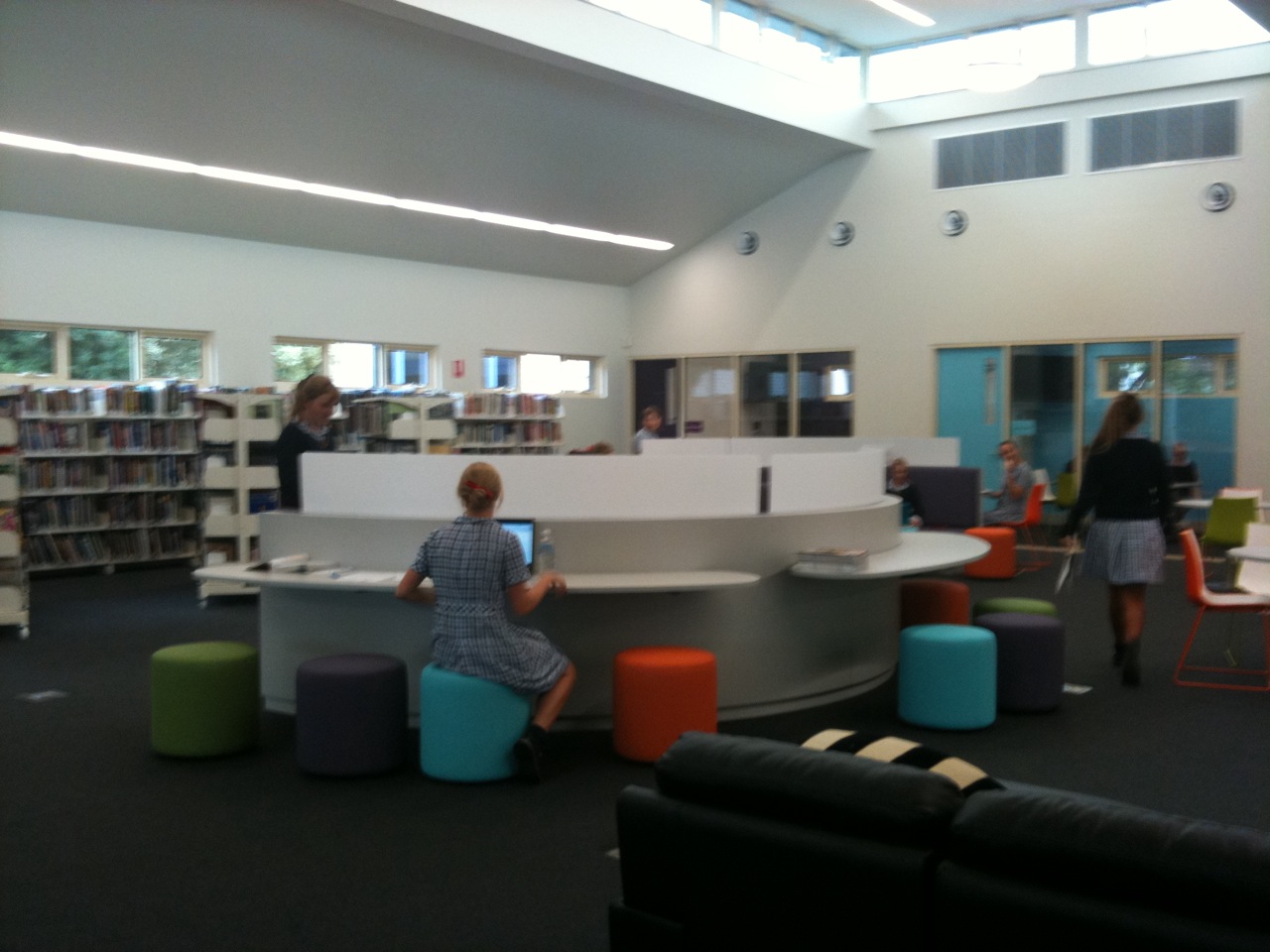
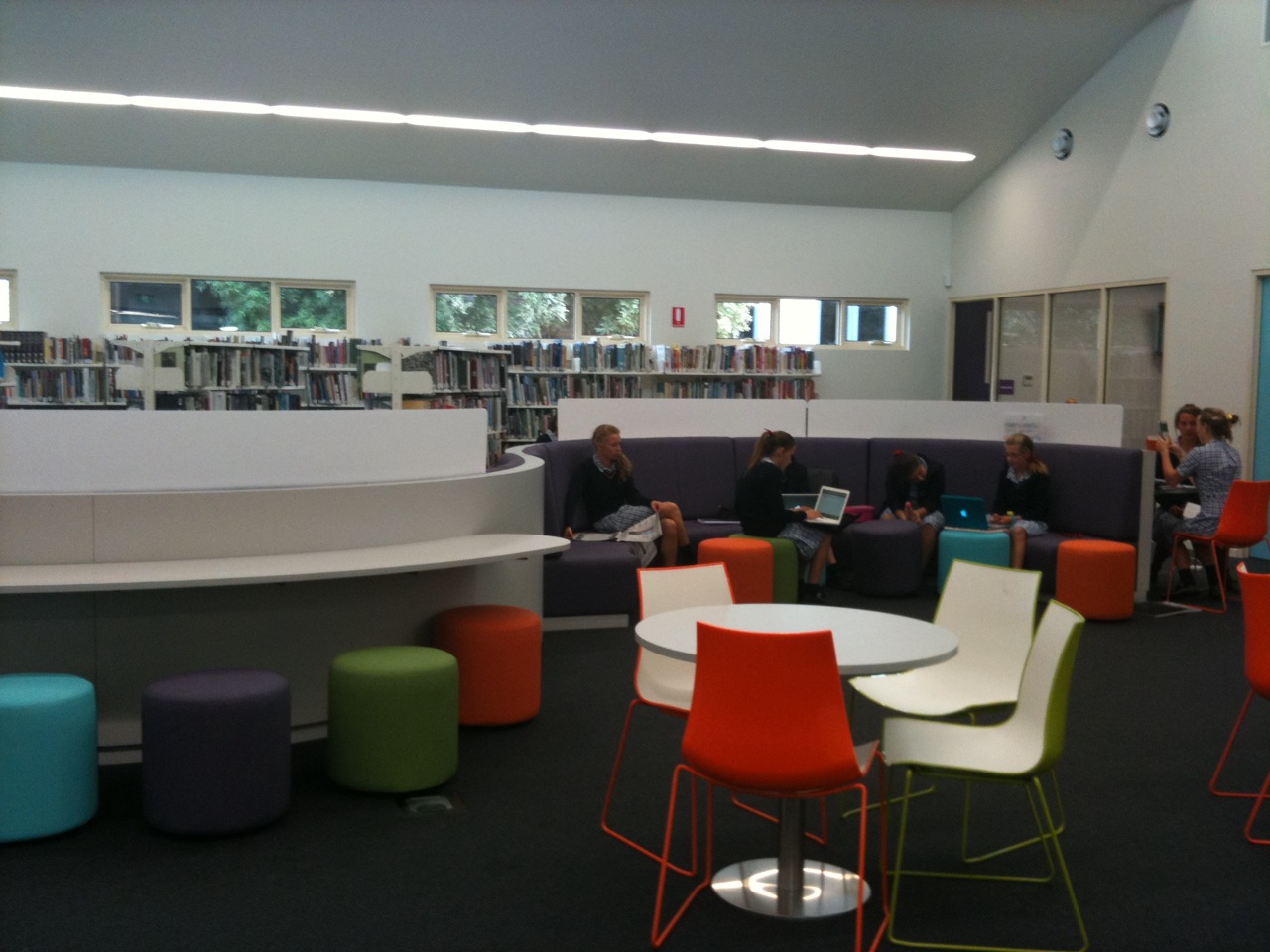
What we’ve been really excited about this week was the arrival of what we call our ‘Snake Lounge’. This is a very large signature piece that winds its way through what we call the Learning Commons part of our library. It’s been enthusiastically embraced by students and staff alike. Seeing people’s reactions to it when they see it for the first time is incredibly rewarding. We are thrilled with how our vision was translated by the furniture craftsman, Abbas, who listened to what we described and built something that probably has surpassed our expectations. Judge for yourself from the following pictures.


It is beautiful! Watching the students use it is so gratifying. Today, during lunchtime, every part of it was being used. Some students were relaxing and talking while others were working at both the attached tables and the benches. The ottomans serve as both stools and tables for laptops and books. Once again, they can be easily moved around -the ottomans that is! The Snake lounge isn’t going anywhere -it’s a permanent fixture. I’m not about to go breaking my back moving that one!

Our Multimedia room has been fitted out with desktop Mac computers.

I included this picture in my last post about the library, but it remains one of my favourite spaces, although it’s probably tied with the Snake Lounge now! We called it the Presentation Room, but our students have coined it the Beanbag room, and that name has stuck. It gets constant use, both with classes and as a relaxed space for students during recess, lunch and after school.

All of these spaces require teachers to rethink their use of the library. Our previous building had clearly designated class spaces that mimicked classroom configurations of the traditional classroom. This new library is very different, and students find spaces that work for them. Quite often a class is not contained in one space; they spread out and use breakout rooms, couches and tables. We are seeing our senior students gravitate back (they have their own senior centre) and they especially enjoy the small breakout rooms that allow them a quieter space for study. (You can see the breakout rooms behind the Snake lounge in some of the pictures above). That’s another thing I am pleased about having; the quiet spaces that we never had in our previous library. There are some who crave quiet, and others who are content with ambient noise.

I am so pleased with how this building has turned out. We still need end panels for shelves and some more relaxed seating options. The end panels will arrive in the coming weeks, but other new furniture options may be on the backburner for awhile. Vinyl lettering and designs for our walls is something else we are putting thought into. It’s exciting to be involved in a project like this, and truly wonderful to walk into work every day and see a vision realised.

School’s out Friday

I’m off to a wedding tomorrow, and I’d love it if it went something like Brian and Eileen’s Wedding Music Video. What a great way to remember such a special day. Better reliving the day watching something like this rather than a two hour extravaganza of the whole box and dice.

Before the wedding though, I’m off to work to await delivery of a custom built piece of furniture that will (hopefully) be the signature piece of our new library. I hope it looks as good as I’m expecting it to, because I’ve built it up to such an extent amongst staff and students that it’s going to be a massive letdown if it doesn’t live up to expectations!! According to the furniture supplier, it’s pretty specky, so look for a post on Monday with pictures so you can make up your own mind.

Enjoy your weekend. Hope there’s something special in it for you. : )