
Programming Challenge 4 Girls has got me thinking

Today I took two students from my school to the Programming Challenge 4 Girls event at the University of Melbourne. I can’t remember how I found out about it, but I registered them a couple of months ago and they were certainly excited to participate. They haven’t had any experience with programming and since we’ve spent quite a bit of time in my Language of our Times class discussing the need for better representation of women in the field of computer programming, they were keen to have a go.

The programming language they were using was Alice. It has a graphical user interface and the students were dragging and dropping commands into it  – they could preview what the commands were directing their characters do and were learning by doing. While they got the hang of the drag and drop interface, the precision and attention to detail required to get the character to perform the most basic of functions was very challenging for them. After the 3 hour challenge, they came out quite exhausted with the mental effort that was required to see them create 15 seconds of what would equate to a game type interface. I’m very sure they have new found appreciation for the programmers of games they play and the thousands of hours that must go into creating the landscapes and complex scenarios.

While they were participating in the challenge, the teachers present were listening to Steven Bird,  Associate Professor in Computing and Information Systems at theUniversity of Melbourne. Steven was discussing the new Unit 3 and 4 VCE Computer Science curriculum due to be offered across the state in 2015. My tweets from the day are below:

Screen Shot 2013-11-13 at 10.32.37 PMScreen Shot 2013-11-13 at 10.33.05 PMScreen Shot 2013-11-13 at 10.33.23 PMScreen Shot 2013-11-13 at 10.33.39 PM

*apologies for the spelling mistakes! When you’re trying to tweet and keep up with the presenter, mistakes happen!

What was very interesting was the discussion around delivery of this curriculum. Steven Bird and a computing professor from Monash University are going to be delivering some of this curriculum via video using Google Hangouts and utilising Google + to form the learning community around it. This is in recognition of the fact that the expertise to teach a curriculum like this is going to be difficult to source in Victorian schools.

Is this the beginning of MOOC style delivery of curriculum for VCE students? It looks a bit like it to me, and why not? If expertise is required and it’s not available within our ranks, then we do have to do the right thing by our students and find ways to provide it.

The challenge is going to be finding students who want to study this discipline. Teachers at the event today were talking about the low numbers of students choosing the VCE IT Software Development course. Steven was talking about how the new Computer Science course is really directed at the kinds of students who are currently selecting courses like Specialist Mathematics and Physics and teachers were again sharing how courses like these often attract only small numbers of students. Hopefully the new Australian Curriculum Technologies subject will see some students’ eyes open to possibilities, but Steven discussed how that curriculum doesn’t go far enough into the computational mathematics and algorithmic thinking that is required for Computer Science. It was mentioned that we may have lost an opportunity given that our new Australian Curriculum for Mathematics has not identified computational mathematics within its scope and sequence.

If you’re a Victorian teacher and interested in joining a discussion around this new VCE Computer Science curriculum, an event is being held at the University of Melbourne from November 20th – 22nd. The programme for CS4HS looks very interesting. I’m hoping to make it to the first day at least.

Thank you to the organisers of the Programming Challenge 4 Girls. Definitely an event that has me thinking!
School’s out Friday

Back to the Future is one of my favourite movies. The Improv Everywhere team have done a pretty good job of recreating it for their ‘Movies in Real Life’ video series they have running now. I’m still waiting for the hoverboards that featured in Back to the Future II to become part of everyday life – we’ve still got two years to have that dream realised as it was 2015 when Marty made his way into a future where they were commonplace. Then again, maybe it’s a good thing they’re not ready for purchase – I can barely keep upright on a skateboard, let alone on something hovering in mid air!

Have a great weekend. I’ll be searching for sun, but the prospect of that in Melbourne this weekend is looking pretty grim. I hope the forecast ahead bodes better wherever it is you reside. Enjoy 🙂

School’s out Friday

I love a good marching band, and the Ohio State University Marching Band are better than good, they’re exceptional. If you’re not impressed by their Hollywood Blockbuster show, then I’m sorry, but you’re very hard to impress.

I’ve been impressed by my students this week. We’ve been looking at the future of journalism in the digital age, engaging in plenty of discussion and even talking with Skye Doherty, a Lecturer in Journalism from the University of Queensland. Skye skyped in last week to give my students her thoughts about the impact of the digital world on journalism and its future. Next Friday, Jewel Topsfield from ‘The Age’, is visiting the class to add her thoughts to the discussion. I’ve been trying to think of an appropriate form of assessment and was really pleased when they embraced the idea of tackling another Project Based Learning task, this one with the driving question being, ‘How do journalists report news in the digital age?’ Here’s the outline of the task:

You are part of a team of investigative journalists who have been assigned the job of responding to a strange incident (or series of incidents) at Toorak College.

You are reporting on the spot, and are using whatever means possible to pull together a story quickly for readers who have heard that something has happened and are hungry for news. Your newspaper is highly regarded and your readers are interested in learning about what has happened.

To get your report out quickly, you will be using a page on iVE* to curate the story. We’ll be trying to get our iVE page looking like Storify. Storify can be updated quickly and is used by some of the most highly regarded newspaper teams in the world to deliver digital content to their readers who are used to accessing the digital versions of the paper.  http://storify.com/guardian

What will your story contain???

*iVE is the name of our Learning Management System

They are enthusiastically working in groups and have come up with some terrific scenarios. They are planning in Google Docs and are assigning group members differing roles eg: some are writing the report, others will be filming witness interviews, footage of the incident etc. I love watching them sculpt the learning and really enjoy the creative process. Stress levels will increase as some of them realise that time constraints may inhibit their grand plans, but that’s all part of the process. Me, I can’t wait to see the outcome of their efforts – they have yet to disappoint!

Melbourne Cup Day here in Melbourne means a four day weekend ahead for me. I am beyond excited about that – relaxation, here I come! Enjoy the weekend ahead. Find the sun and soak in it. 🙂

My rare privilege

I have enjoyed a rare privilege over the last six years, and now it has come to an end.

My daughter has just completed her education at the school where I work. For the last six years I’ve been able to participate in her education in a way that is not afforded to most parents. I’ve shared a ride to work nearly every morning and many afternoons been there for the return journey too. I’ve been there to share the experience of school assemblies, camp experiences, sports days, house events, and even taught lessons where she has been a participant.

Like I said, it’s been a rare privilege. I know intimately the spaces she’s inhabited and we share memories of school life that we can fondly recall together in the years to come. I may even be able to return for her school reunions, because, after all, I’ll have a legitimate reason to be there too.

I thought her leaving would be easy, just another day, something that wouldn’t affect me all that much. But as I stood in their final Valedictory assembly last week, the opening words of the school song finally took on their true meaning and I found myself unable to sing, tears pouring down my cheeks.

They of the school before us

Now tread the wider ways

Their thoughts to her returning

Who ordered once their days

I suppose most parents feel the same about their children leaving school – it’s a rite of passage and denotes the end of a stage of your life. For me, it’s a little different. I think I’m going to spend the next year experiencing that strange series of ‘firsts’ at my place of work. First day travelling there without her, first event where she’s not a presence, and on and on.

I’m going to miss you Cassidy. I hope my rare privilege was something that you will reflect on warmly in years to come too.

School’s out Friday

Hamish Curry shared this on Google+ and it made me smile. If you’re not familiar with the way many of the social networks and websites represented in this video work, then you’re probably going to be more confused than amused. But, if you are familiar, I’m pretty sure you’ll be thinking this is pretty clever.

It’s nearly the end of October and I’ve only posted once this month. Practically unheard of! Yes, I’ve been busy at work and have really struggled trying to find time to write. I’ve started posts, but find myself paralysed at the keyboard, knowing that if I’m going to do the post justice then I need to invest a couple of hours into its construction and I just don’t have that time available. So I start, then stop, and for the first time ever I have drafts sitting in my dashboard, taunting me, making me anxious that I’m never going to get anything of substance written ever again.

Hopefully, the paralysis will leave me and I’ll find myself writing again soon. Got lots to share, so I hope so!

Enjoy the weekend ahead. The forecast for Melbourne is not pretty. I’ll be seeking sun  – I can feel myself deficient in those Vitamin D stores!

Gearing up: Chromebook Classroom – GAFE Summit presentation

Today I’m presenting about Chromebooks at the Google Apps for Education Conference here in Melbourne. Of course, the presentation is about more than just Chromebooks. It’s also about Google’s approach with Chrome and why you might be thinking about taking this direction in your school. Not all of that is evident from the slides above, but hopefully those who come along will take something from what I have to say and be able to leave with some knowledge that helps them understand Chrome and how Chromebooks work.

Time permitting (seem to be finding less and less of that!) I’ll write a follow up post about the conference and how the session went. Stay posted!

School’s out Friday

Now, if you’re not a Twitter/Facebook/Instagram or any other social network user you might not have any clue what Jimmy Fallon and Justin Timberlake are going on about in the video above. If you do use a social network where hashtags are a common form of curating ideas around a theme or conference experience, or expressing an opinion or statement about how you’re feeling, then you’ll be smiling and possibly laughing along as you watch.

The hashtag is an artform in itself. Don’t use it, and you may struggle to find the tweets you’ve shared, overuse it, and what you tweet is in danger of being lost in a form of hashtag hell. New York magazine has identified seven kinds of hashtag abusers, and the first on their list is the kind that I think delivers you into hashtag hell. Here’s their description;

1. The Hashtag Stuffer

The most common form of hashtag abuse. The Stuffer is incapable of simply sharing a photo of his July Fourth fireworks; he festoons it with #firework #fireworks #july4th #July4 #pretty #boom! #red #white #blue #1776bitches! (Not an exaggeration. A quick search of #fireworks took me here.) Sometimes #he hashtags random #words in sentences.

So, lesson for you all out there. Avoid at all costs the temptation to become the Hashtag Stuffer. Your tweets will become those that are passed over in the stream, avoided at all costs because you can’t see the words for the invasion of hashtags polluting them.

Enjoy your weekend. Grand Final day here in Melbourne tomorrow, and my team are contenders. Go Hawks! 🙂


School’s out Friday

I don’t know about you, but I’ve watched this at least 5 times already, and I don’t think it’s something I’ll tire of easily. Who hasn’t wondered what the world looks like from a bird’s perspective and secretly desired to soar at speeds like this through landscapes?

I thought it apt to share this video tonight, when teachers in Victoria and other states of Australia embark upon a two week break. The first Friday night of any holiday period feels like flight. You’re unemcumbered from responsibility, the days are stretching out before you, you’re literally soaring with the possibilities of what could unfold within the next two weeks.

Of course, for many teachers, the holiday period is peppered with correction, preparation and sometimes professional development. All three of those will be features of my break, and I’ll be presenting as well at the Google Summit in Melbourne at Yarra Valley Grammar on the 3rd and 4th of October. My session abstract is as follows;

Chromebooks are changing the face of computing in classrooms across the world. Find out how Chromebooks work, why they are a viable and equitable option for 1:1 deployments, how they can be managed in the Chromebook console of Google Apps, how the Chrome Web store works and why you might consider a Chromebook vs a Mac or PC option.

I’ll be presenting on the Friday, which coincidentally, just happens to be my birthday. Hope there’s cake at the conference – it’s no birthday without cake!

Have a great weekend. Soar to great heights. 🙂

Anticipating the future

I gave myself the luxury of dedicating 30 minutes of my day to watching this video from Valerie Hannon from the Innovation Unit in the UK. It was delivered here in Australia at the AITSL Professional Practices Symposium. My suggestion is that you do the same, and after that, share it with educators you know so that we can continue the discussions around reconceptualising what it is we do to create engaging learning environments for the students we teach.

After using Project Based Learning methods in my classes this year and last, I’m in deep agreement with Valerie that this is the kind of pedagogical practice that needs to become more commonplace in schools today. I’ve seen my students challenged by imposing tasks, and watched them use collaborative techniques and creativity to produce results that often exceed their own expectations. I decided to give my students an individual learning task recently and was very surprised to have many of them say they would like to do more PBL work because they’ve enjoyed the dynamics of working this way. I’m going to have them analyse the differences between the individual task work and their PBL experiences later this week and am very interested to see what they’ll be saying. Hopefully they’ll agree to me sharing some of their reflections here.

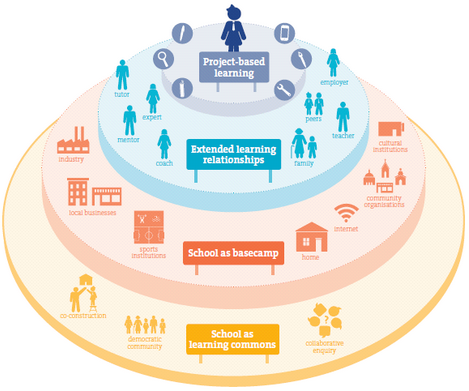
Screen Shot 2013-09-16 at 9.42.03 PM


(image accessible here)

Valerie elaborates on this diagram in the video at around the 20 minute mark (if you’re impatient!). I think it presents interesting ideas about approaches to learning and teaching that would be worthy of staff discussion. For some, ideas like this are very challenging. They present a very different approach from ‘traditional’ classroom instruction and requires heavy investment from teachers to change up their practice and rethink assessment. To gain a better understanding of Project Based Learning, I’d recommend you take a look at the Innovation Unit publication, ‘Work that Matters: the teacher’s guide to project based learning‘. The guide grew from a partnership between the High Tech High Schools in San Diego, California and the Learning Futures project in England. It’s very thorough and will give you some very good insight into what Project Based Learning looks like in classrooms.

We’ve been looking at the draft Technologies curriculum from ACARA for the Australian Curriculum. My reading of it sings Project Based Learning approaches to meld the related subjects of Design and Technologies and Digital Technologies. I’d love to hear from educators who are looking at this draft document to see how they are envisioning delivering this in their schools. Feel free to leave comments (a bit of a rarity in the blogging world today I have to say!) to extend the conversation.

School’s out Friday

I will be sharing this with my students next week. I teach girls, and what Sarah Kay has to say to them here may not translate so well at their delicate age, but maybe it will plant a seed and when they need it one day they will return to it. I hope so, because there is a powerful and important message in the words she speaks.

My students have watched a lot of spoken word poetry performances this year, largely because I want them to appreciate the power of language and performance when they combine so beautifully to create something that moves you into a space you weren’t occupying before you entered the world of the poet. One of my new students this term asked me if I’d seen Shane Koyczan‘s ‘The Crickets Have Arthritis‘ and I confessed I hadn’t. I went home that night and read it from his blog and was moved by the words on the page. The next day we listened to it in class, and for seven minutes, there was no sound other than the transcendent quality of Shane’s voice. When it finished, the silence continued as we appreciated the story that had unfolded and the profound impact it had on us all. Here it is. Maybe it will move you as much as it moved us.

Have a lovely weekend. Make the most of all life offers.  🙂