9/11

On September 11th, 2001, I was home with my two children, then aged five and two. My husband was away with work, and at around 11.00pm, I was lying in bed with the television on, watching Channel 10’s late night news. Sandra Sully was delivering the headlines, and suddenly breaking news was announced, and the screen shifted to vision of smoke plumes streaming out of one of the buildings of the World Trade Centre. The word was that a light plane had flown into the building, but even then, I was wondering how a small plane could cause so much damage. Channel Ten toggled between Australian news and what was happening in New York, and on one cross back to the scene, I saw a large passenger plane fly behind the South Tower, and then just disappear. Smoke began streaming, and my first thought was ‘this is no accident, it’s a terrorist attack.’

For the next three and a half hours, I lay there, fixed to the screen, watching first the South Tower, and then the North, come crashing down. What I was witnessing was unthinkable. Those towers represented the might of the United States, a nation that seemed impenetrable. Reports were coming in that people were jumping from the towers. Again, unthinkable. The news shifted to the Pentagon, where something had happened to cause a huge rupture in another symbol of the might of the USA. As news came in that another plane had been hijacked and was heading to Washington DC, it seemed that we were potentially on the brink of World War III. I surrendered to sleep,  knowing that the world that would meet me in the daylight would be markedly different from anything I had ever encountered.

For the next few days, I saw that unthinkable footage over and over, until discussion started to surface that maybe those scenes were too damaging for young eyes, and older eyes too.

My immediate experience of 9/11 was just me and television commentary. I was by myself, my husband was away, and I had no-one to talk through what I was witnessing. 10 years on, I am following Jeff Jarvis’ tweets about his experiences that morning. My twitter stream is full of people’s memories of that day.

@jeffjarvis If we’d had Twitter and cameras and been connected that day, the world’s view of 9/11 would have been at eye-level. #911

@ASE: It was only a matter of a couple weeks after #911 that my name, Ahmed, became problematic while I was in undergrad. #racism

Will never forget the initial puzzled feeling when lined up to give blood and found out–so horrible and telling– there was no need.#911

campbellsuz  The water memorial at Ground Zero looks beautiful; families trace the names of loved ones etched in bronze with pencils and paper#911
My thoughts go to all those affected by this disaster, both in the United States, and in every country with citizens who were involved. I think too, of the people of Iraq and Afghanistan, and the loss of innocent human life in those countries after 9/11. It has impacted on us all. Our world is different, our approach to life is different. I still think of the potential of a terrorist attack whenever I attend an occasion that brings large swathes of people together. Prior to 9/11, thoughts like these never really crossed my mind.
The world suffers from the actions of the few. Now we are hearing of those in the immediate vicinity on the day who are suffering from lung diseases and cancers from the toxic dust cloud they encountered.
9/11 is a disaster that will continue to haunt us all for many years to come.

School’s out Friday

OK, time for a bit of good old Aussie humour. Hamish and Andy, an Australian comedy duo (remember ‘ghosting‘- featured here before on School’s out Friday) are here to entertain you once again with ‘Stranger Racing.’ If you haven’t already chuckled through the 6 minutes above, then you need to know that Stranger Racing involves attaching a helium balloon to two strangers without them being aware of this, and then seeing who can make it across the road first. My kids and I were laughing our way through this segment last night. I hope you enjoy it as much as we did.

I promised last week that I’d post about the work we are doing at my school that has occupied so much of my time this year. I’m halfway through the post, and with any luck, will actually manage to complete it this weekend. I know it sounds ridiculous, but I just haven’t had a spare minute to get to it during this week. My energies went into supporting our Ning for our Yr 8 Inquiry Week, and it was worth every minute of the time invested. The sharing that took place in that space made the learning very transparent, and was due reward for the teachers who worked diligently to ensure the students were supported and encouraged.

I hope the sun is shining where you are this weekend. I don’t think the forecast here in Melbourne is looking that flash, but I’ll gladly grab some moments in the sun when and if they present themselves.

Enjoy. : )


Why we’re paying for Ning

It’s Inquiry Week for our Year 8 students, and we are using a Ning to support the students to communicate and archive evidence of their research. We collapse curriculum for a week, and allow our students to investigate in groups a topic in depth around the idea of Triumph over Adversity. We first used a Ning two years ago, when they were free for educators and it was a dynamic learning environment then. What was great was that our students could form groups within the space and use the chat function at night to help them organise themselves for the next day. Last year, after Ning started charging for the service, we looked for an alternative. We used Wall.fm, but it was fraught with problems that I outlined in a post and not something I would use again. One of the stumbling blocks last year was the price Ning charges for a network that includes groups and chat. At the time, we felt that the $200 outlay was too expensive.

This year, our Head of Year 8 really wanted to run a paperless inquiry week. We had a wiki we used last year for the inquiry week, and we added pages that incorporated what the students would formerly receive in booklet form. When we discussed an online environment to support the project, I recommended that we bite the bullet and outlay what is now a $239.00 a year cost to run a Ning that has the features we needed; in particular, groups and chat.

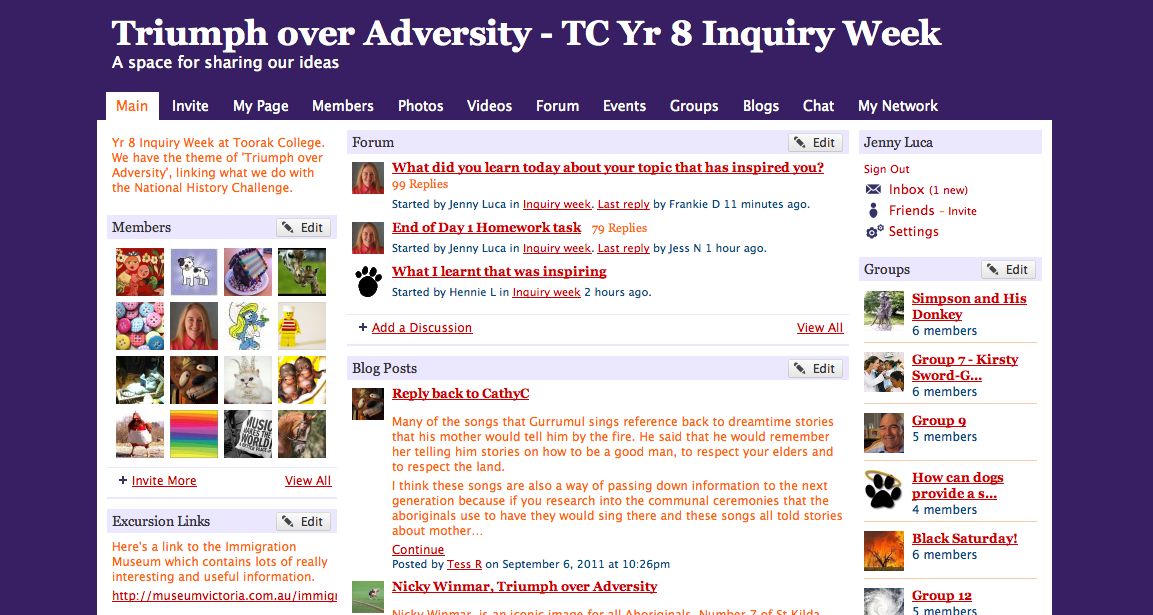
I’m glad we did. I spent time last week in classes explaining the Ning environment and making sure the students were signed up so that we could hit the ground running this week. Yesterday the students went on an excursion and were asked to post a reply to a discussion prompt in the evening. Over half of them got something up last night, and those who didn’t were busily posting this morning. What has been amazing is watching it develop during today and this evening. Groups are formed, and the students have posted their topics and guiding questions within these spaces. This afternoon’s discussion prompt has seen over 100 replies this evening. These are from students, detailing what has inspired them about their topic, and replies from teachers who are encouraging their efforts. The chat space has been used this evening, and i’ve been pleased to see students suggesting that they move to Google Docs to work on their planning for tomorrow. (There’s some transference happening : ) They used Google Docs earlier this year in a Humanities project) The Head of Year 8 sent me an email late this afternoon and said,

The Ning’s like some living organism!

Here’s a screenshot of part of the front page from earlier tonight.

It is most certainly a living organism. It’s providing focus, encouragement, and transparency to our learning environment this week. Even though I’d love to see the powers that be at Ning work more closely with education and provide better pricing, our financial outlay is already paying off. I can’t wait to what it’s hosting by the end of the week!

School’s out Friday

Improveverywhere‘s latest effort, ‘Say Something Nice’, is like visiting an old friend. It’s filmed in Union Square and this was where I caught the subway every day when I visited New York last year. The shoe store in the background is where I purchased shoes for my family. It’s funny living here in Australia and seeing something that is so far away and yet so familiar to me. Here’s hoping I get back there some day. It’s definitely my kind of town.

I’ve had an interesting week. I wrote a post for the VFLR blog called ‘5 Reasons Why Our Students Are Writing Blogs and Creating ePortfolios‘ and it was picked up by Zite, the iPad app that creates a personalised magazine based on your interests. It got a lot of attention as a result and was retweeted from people all around the world. Thanks to John Norton, who helps us with the Voices blog, it was picked up by the Mind/Shift blog in the United States. It was formatted for their readership and titled, ‘Six Reasons Why Kids Should Know How to Blog.‘ The post has been tweeted out 279 times and liked 76 times on Facebook according to the stats running on their page. It was also picked up by Zite. I know it’s being read throughout the US, UK, Finland, Canada, Germany, France and many other countries. Interestingly, it hasn’t seemed to spread too far throughout Australia, and yet the example being provided is from this country. I’d like to see more Australian educators reading it, and sharing it around their networks. I think the message it holds is an important one for our consideration, and for the futures of the young people we teach. I’m in the process of writing a lengthy post detailing how these blogs form part of a wider initiative at my school, and I hope to get it posted in the coming days.

Gorgeous weather is descending on Melbourne tomorrow. I intend to get my fair share of Vitamin D in the process. I hope you get an opportunity like this too.

Enjoy your weekend. : )

School’s out Friday

You can thank my YouTube surfing son for this week’s School’s out Friday video. It’s the Google+ Rap, and Funnyz certainly does a pretty good job selling it for Google. I do wonder though, if he’s also having a bit of a swing at it too with the inclusion of the interviews with people who have no idea what it is!

Google+ is certainly not on the tip of everyone’s tongue right now, but it does have the potential to be a very influential network. Right now, I scan it everyday, but I’m not posting much at all. Nor are many others in my circles I might add. I’m still finding that twitter is my network of choice. It’s high frequency sharing of information, and that’s where my life’s at right now. I’m pressed for time, and dipping in and out of a network is all I can afford during the working week. Google+ is more like longform journalism; the stream can be quite thoughtful, and the discussion requires more thinking. That’s obviously not a criticism, in fact, it’s a compliment. It’s the kind of thinking network I’d like to spend more time in, but the pace of life dictates otherwise right now.

The end of yet another busy week brings with it the promise of a quieter weekend. The sun looks like it will be shining in Melbourne this weekend, and this makes me a very happy woman.

I hope the sun shines on you this weekend, wherever it is you are in the world. Enjoy. : )

University entrance requirements – has anything changed in the last 25 years?

I attended Melbourne University’s Open Day today with my daughter, who is interested in Science and wanted to explore options there. We went to the lecture outlining the Bachelor of Science degree, and I was once again taken back to my own University experiences.

It seems nothing has changed. It’s still a huge competition, with those who are good at retaining information and regurgitating it effectively under exam conditions winning the prizes. It seems if you can attain an ATAR score of 99.9 (an amazing personal achievement, without question) you are assured of a place in a course like Medicine. There’s no interview, no assessment of whether or not you are suited to a profession that requires not only the ability to understand all facets of the human body, but also empathy and the emotional intelligence to deal with the real life people you will be working with and supporting on a daily basis. If you don’t get this kind of amazing score, you will be required to sit the Graduate Australian Medical School Admissions Test (GAMSAT).

There seemed to be hundreds of students interested in a science career, and I do understand that we need a process that will filter those who can access places available from those who can’t. It just seems a bit artificial to me still, to base things entirely on a number. A score on a page tells me something about a person’s ability to retain and present knowledge for an outcome or an exam, but it doesn’t tell me much about a person’s passion and commitment to something they hold dear.

I don’t have the answers to what I see as problems in the university entrance process, but I do wonder if those with passion and commitment, but not the magic number score that grants them access to the education they desire, will begin to seek learning in alternative ways. In years to come, will we see initiatives like University of the People, a tuition free online university, gain some traction? Their philosophy reminds me of Mechanic’s Institutes, formed in the 19th century in Australia, the UK, Canada and the United States, to advance the knowledge base of working men. I often drive past the Frankston Mechanic’s Institute, and every time I do I ponder the lives transformed by the opportunities they afforded.


A lot about how our world works is changing, but not a lot seems different about the University entrance process. Judging by the numbers at Melbourne University today, the process may not change for some time to come. A degree from a Sandstone institution, the likes of Melbourne University, holds sway in the employability stakes.

For now, at least.

School’s out Friday

By now, you’d all be aware that I love a good flash mob. I love the shared commitment, the synchronised dancing, the sheer enjoyment of watching people loving life. But this week’s flash mob really takes the cake. This is the Sock Summit 2011 Flash Mob. Here we see hundreds of knitters coming together to dance for the love of yarn. I never knew people could have such a passionate relationship with a ball of wool. Obviously, I’ve been missing something all these long, lonely, yarn free years. Maybe I need to re-evaluate my life? These people look really happy. One YouTuber has left a comment with this video, saying,

That’s it, it’s official: I’m taking a skein of yarn to Prom this year and slow-dancing with it.

This could be the start of something!!

No other postings this week is testament to a full on week where I’m feeling overwhelmed with what needs to be done. I don’t know about you, but I seem to be chasing my tail all the time of late and just never seem to be able to find the time to dedicate to a good blog post or two. Hopefully, I’ll get another post happening before the weekend’s end, but if not, so be it. Maybe I’ll take up knitting instead, and find happiness and fulfillment with a ball of wool!

Hope your weekend’s memorable. Have the time of your life, with wool, or without!

Enjoy. : )

School’s out Friday

I wish I was at Columbia University Library when this flash mob descended on a normally serenely quiet library environment. Great fun!! If you want to create your own Barbra Streisand moment, check out GOBARBRA.com, where you can customise your own version of the song. If I ever get to have the 40th birthday I wish I’d had, then I’ll be cranking out the Jenny Luca version over the sound system!

Have a great weekend. I’m sure you deserve to.

Enjoy. : )

Sexting, the conversation we need to have.

Often, it’s the difficult conversations that are never tackled. And yet, more often than not, they are the most important conversations we need to have. When you’re a teacher, having honest, up front conversations related to adolescent behaviour and sexual curiosity are sometimes uncomfortable for both yourself, and your students. But these conversations are necessary. Sometimes, it’s the only time a student will be offered advice from an adult concerned for their welfare.

Today, I had one of these conversations. It wasn’t one to one advice, it was an address to our Year 11 cohort, and the topic was sexting. When I told them we were going to be discussing this today, there was an uneasy rustling in their seats. I assured them that I knew they were probably feeling a tad uncomfortable about our topic, and I let them know that I wasn’t totally at ease myself, but that I thought it was important that I impart information they need to know.

I didn’t use a slideshow for this presentation. What we did was look at some recent published articles from online newspapers that made the complexities of the situation pretty clear. But first, we began with the law as it stands in Victoria today, using information from the Victoria Legal Aid site. The language used is not legal speak; it’s clear cut and simple for them to grasp. Here are the sections we looked at today.

Child pornography

You could be charged by the police with producing child pornography if:

  • you take a nude or semi-nude picture of a person under 18, even if they are your friend and consent (agree) to the picture being taken
  • you take photos or video of a person under 18 involved in sexual activity or posing in an indecent sexual manner (or who looks like they are).

You could also be charged with possessing child pornography if you go onto the internet and download pornography showing people under 18.

If you put a pornographic photo or video on the internet or your phone, print a photo, or email or text it to a friend, you could be charged with publishing or transmitting child pornography. You could be charged even if you are the same age or younger than the person in the picture or video.

People found guilty of sexual offences or child pornography are stopped from working or volunteering with children – for example, as a teacher or a sports coach – or volunteering with children.

Mobile phone pictures and the risks of ‘sexting

’‘Sexting’ or sending ’sext messages’ is where nude and/or sexual images are taken on a mobile phone, often by young people and their friends. This is a crime if the photo includes a person under 18. Sexting is already leading to young people being charged by police with child pornography offences.

Think carefully about the consequences of taking or sending pictures of your friends on your mobile phone, especially if they are not fully dressed and even if they agree. You could be charged by police for committing a criminal offence.

It may seem like harmless fun, but be careful – once you send pictures electronically they can become part of your ‘digital footprint’ and this lasts forever. It could damage your future career prospects or relationships.

Victoria Legal Aid

From the reactions of the students, it was pretty clear most of them had not much of an idea of the legal ramifications of actions detailed above, particularly the receiving and forwarding on of images via mobile phones. I let them know I shared their concern about the punitive nature of the law as it stands, and the serious impact on a person’s digital footprint and work prospects if they are charged with a child pornography offence. To illustrate its effect, I explained how a 17 year old who might want to be a teacher, would not be able to complete their degree if they had been charged, as they would be unable to obtain a working with children check. They would not be able to enter a school to complete a teaching placement.

We then looked at three recent articles, one from the New York Times, and two from The Age, one of Victoria’s daily newspapers.

A girl’s nude photo, and altered lives – New York Times article

Teen sexting: it’s illegal, but it’s in every high school – The Age

‘Sexting’ youths placed on sex offenders register – The Age

These stories were enough to cement the learning intentions of this session. I would think it fair to say that the majority of students learned a great deal today and went home with much food for thought.

Honest, up front discussions like these form part of our responsibility to create effective digital citizens out of the teenagers in our care. Are you having these conversations in your schools today? If you aren’t, perhaps use the above information as your guide.  We may not agree with the legislation, but it exists, and our young people need to be informed. We really can’t afford to have our young people unnecessarily punished due to a lack of understanding about the ramifications of their actions.

Life, death, and the Internet in between


I came across a couple of posts this weekend that have me thinking about the nature of living, and dying, in a networked world. In the TED talk above, Adam Ostrow contemplates a future where we continue to exist in our digital archive. He started thinking about this when he saw Derek K.Miller’s final blog entry, posted posthumously by his family after he died from complications of stage 4 metastatic colorectal cancer. I saw Derek’s post in May, and spent the better part of a morning learning more about his battle with cancer as I backtracked through his entries. I found reading his blog very moving, especially his final entry where he reflects on the passage of his life and leaves messages for his wife and daughters. I can only imagine how many times they have read and re-read that post, and the comfort it brings to them.

More than a year ago, a friend of mine died unexpectedly. A facebook page was set up as a tribute to her, and continues to have people making contributions. I looked at it tonight, and was touched by the effect this woman had on people. Again, it made me think that this must bring a great deal of comfort to her family, if they do indeed, look to see what people are posting. I wrote a post about her passing, and I see it listed in Google results when you search her name. I hope it was a fitting enough tribute to her memory. It’s become part of her archive too, you see.

All this reminded me of Dave Cormier’s 2009 post about his brother Stephen, who died 24 years ago when he was 14. In that very moving post, he reflected on how his brother was alive in his memories, but no digital archive of his life existed because he never had a digital life. His post was, as he described it, “a flag in the ground for my long lost brother.” Dave made these comments in his final paragraph, that really ring true for me.

“There is a longer, more human thing at work here that I’m reaching for. There is a sense in which we are storing the memories of ourselves, of our friends, of the ways that we are all connected to each other. Of our love.”

I keep reading articles and books about the dehumanising influence of the Web on our lives, but I can’t help but hear the niggling words of Dave’s in my ear. When I think of this blog, I am beginning to have a greater understanding that this is not just a professional space where I share my thoughts about teaching and the impact of new technologies. Traces of me are here, my voice is here. If you read enough of it, you will have a sense of me and the things I hold dear. I’m realising that my ‘School’s out Friday’ posts may very well become the connective tissue my family members would hang onto, because that is where I often post the more personal details about my life. I suppose I’m realising that this space is a place where I am storing not only information, but memories too.

So, what will happen in our future? Will online spaces like facebook and individuals’ blogs be the digital archives of peoples’ lives? Somehow, I can’t bring myself to call such spaces digital graveyards, a term I have heard people use. I suppose they would, and do, fulfill a similar function though. They are spaces that allow people to reflect and remember, much like a graveyard or memorial garden. What will happen when they are not tended? Will the Web be scattered with unused accounts forever more? Who will make decisions about deletion? Will family members be consulted, if any can be found? Will we see sites like facebook talk of ‘active’ and ‘inactive’ accounts, and include such detail in their statistical data? I certainly don’t know the answers to questions like these, but I do think we will ponder them as we see our populations embracing social media.

And perhaps we will see real world graveyards make greater use of QR Codes (a barcode with embedded data such as text, or links to video or web pages), to provide a visitor with more detail than that written on the person’s head stone. Here’s what’s happening in the United States.

“A company in Seattle is offering to add a QR code to the head stone of the deceased person. When family or loved ones scan the QR code, it reveals additional information about the person including photos, videos and text about the life they lived.”

The title of the post was, QR codes on headstones in graveyards: Is it brilliant or creepy? I have to admit, my initial reaction was that it was creepy, but then I got to thinking about how important data like this could be for families in years to come. TNW’s post added this thought,

“Added to people that died in wars or long ago could be a valuable way for teaching new generations about wars or other ways in which people used to die that have long been forgotten.”

Other than the fact that I think TNW should do some serious proofreading of sentences before pressing publish, I think they make a good point about how a QR code could be used in a meaningful way. Right now I’d say the majority of the population, most who have no knowledge of what a QR code is, would think the whole idea rather creepy. Maybe, as our level of comfort with new technologies grows, we will see something like this become the norm.

Lots to ponder. As my parents grow older, it has me thinking. You would find no trace of either of them right now on the Web. In years to come, they will exist in my memory and in old photo albums. I don’t know if that’s enough really. I want my childrens’ children to know more than a potted history of their existence and some photos that may not hold up to the ravages of time. Perhaps it’s now up to me to archive their stories for generations to come. Adam Ostrow talks of sites popping up now to help us do just that. 1000 memories is one he references, and I’ve spent some time tonight looking at it. It’s free, claims it will never charge fees, and some of the memory sites are truly beautiful collaborative portraits of people’s lives.


There’s a lot to think about and discuss really. I’m pretty sure I don’t want a hologram of a person who has passed away roaming my loungeroom, as Adam suggests will one day be possible in the TED talk that begins this post. But I do want to see people understand the potential of digital archives as a means of remembering those who may have shared our lives, or came before us.