Teaching students (and teachers!) how to search for Creative Commons images and music

I ran a session recently with our Year 7 students about ethical use of images and music from the Web and the need for them to understand Creative Commons licenses. Our Head of Year 7 understands the need for us to be informing our students about ethical use of the Internet and we’d discussed the fact that a session like this was necessary for our students. It’s great when you work with people who support what you’re doing and understand this knowledge is important to impart.

I made reference to this session at a conference I was presenting at in Perth last week. I was talking about Cloud Computing, but a participant’s question at the end of the session referred to what I’d done with the Year 7 students. She wanted to know how you search images on Google that are licensed Creative Commons. The entire room seemed to not know how to do this. It made me think. Just how is it that we expect students to be using the web ethically, when there would be, potentially, the majority of their teachers who have no idea how to do so also?

So, here’s how you do it. First step would be visiting the Google Web Search help page where they explain in detail what it is you can find when you use the Advanced Search options. You can follow this link, or read what I’ve copied from the site (I hope this constitutes fair use -at least I’ve let you know where it’s from!);

Find all types of reusable content using the Advanced Search page

The usage rights filter on the Advanced Search page shows you pages that are either labeled with a Creative Commons license or labeled as being in the public domain. Here are the different usage rights options available:

  • Free to use or share
    Your results will only include pages that are either labeled as public domain or carry a license that allows you to copy or redistribute its content, as long as the content remains unchanged.
  • Free to use, share, or modify
    Your results will only include pages that are labeled with a license that allows you to copy, modify, or redistribute in ways specified in the license.
  • If you want content for commercial use, be sure to select the appropriate option containing the term commercially.

Find reusable images using Advanced Image Search

If you’re looking for reusable images, use the Advanced Image Search page. In addition to images labeled as being under the Creative Commons license or in the public domain, the usage rights filter on this page also shows you images labeled with the GNU Free Documentation license.

In the Usage Rights drop-down, select one of the following options:

  • Labeled for reuse
    Your results will only include images labeled with a license that allows you to copy and/or modify the image in ways specified in the license.
  • Labeled for commercial reuse
    Your results will only include images labeled with a license that allows you to copy the image for commercial purposes, in ways specified in the license.
  • Labeled for reuse with modification
    Your results will only include images labeled with a license that allows you to copy and modify the image in ways specified in the license.
  • Labeled for commercial reuse with modification
    Your results will only include images labeled with a license that allows you to copy the image for commercial purposes and modify it in ways specified in the license.

If you find images with the wrong usage rights in the search results, let us know by reporting them in the help forum.

Before reusing content that you’ve found, you should verify that its license is legitimate and check the exact terms of reuse stated in the license. For example, most licenses require that you give credit to the image creator when reusing an image. Google has no way of knowing whether the license is legitimate, so we aren’t making any representation that the content is actually or lawfully licensed.

I direct my students to select Usage rights – return images that are – labelled for commercial reuse. This screenshot shows you what I mean;
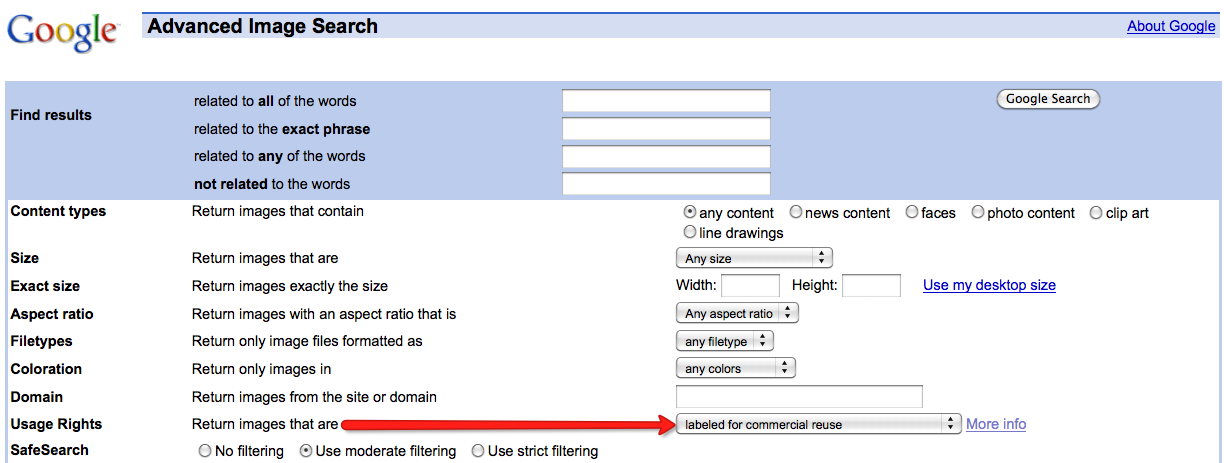
It was a wake up call for the Year 7 students, most of whom admitted to using Google Image Search but paying no heed to copyright issues.

Of course, we had to preface the talk with a discussion about just what Creative Commons was and what the different licenses represented;

Creative Commons licences

Attribution
Attribution

Attribution
by
You let others copy, distribute, display, and perform your copyrighted work — and derivative works based upon it — but only if they give credit the way you request.

Share Alike
Share Alike

Share Alike
sa
You allow others to distribute derivative works only under a license identical to the license that governs your work.

Noncommercial
Noncommercial

Non-Commercial
nc
You let others copy, distribute, display, and perform your work — and derivative works based upon it — but for non-commercial purposes only.

NoDerivative Works
NoDerivative Works

No Derivative Works
nd
You let others copy, distribute, display, and perform only verbatim copies of your work, not derivative works based upon it.

We also explored other sites that allow you to search for images that are in the Creative Commons. These included Morguefile, Compfight, and Flickr itself. We also looked at sites that provide free music in the Creative Commons. These included Jamendo, CC Mixter, opsound, Dmusic and Soundclick.

(A twitter link tonight led me to a site for free stock photo images – Veezzle)

Hopefully, the session had an impact on the way they go about using images and music from the Web. For Australian educators, the Smartcopying website provides an excellent port of call for reading about copyright, and understanding what you can do in schools with text, images and music.

Really, I should be running sessions like this across the school. Something to put on the list for Semester Two!

School’s out Friday

If you haven’t yet come across this I’m sure you’ll find it amusing. This is the students and faculty from the University of Washington’s Information School and their ‘Librarians do Gaga‘ effort. I’m sure Lady Gaga would approve!

I love the line, ‘Don’t forget the databases’. Hopefully our databases will no longer be overlooked now that we have them available for searching within our library catalogue. We have moved over to a new system this year and it enables Federated Searching. This means that any site that is Z39.50 compliant can have their information fed though our library catalogue. Search results come up with whatever selections you have chosen. For example, you could select the search areas of Toorak College database, World Book Encylopedia, Facts on File databases and EDNA resources. Your search return would concurrently  list results from each of these resources.  When you visit a result you leap directly into the database. Brilliant. No longer is there a need for students to leave our library OPAC for a database search. We demonstrated it to our staff last night and could hear their favourable reaction to the search results that appeared on the screen. Next step is getting our students familiar with the system. Hopefully we will see greater use of the databases we subscribe to as a result. Let’s face it, they are great resources and ensure authoritative search returns, but they cost a bomb and need to justify their purchase.

Correction and report writing this weekend. Yippee! Hopefully some time will be available for a bit of light relief too!

Enjoy whatever comes your way. : )

A story about longing, loving, and coming to a realisation

I am one very proud mother tonight. This is the work of my beautiful daughter; it’s her multimodal creative response for an English assignment based around the theme of ‘Romance and Relationships’. It’s all her own work, inspired by the poet Rives and his ‘Story of mixed emoticons‘ that we used as stimulus material in our English classes.

My response when I saw it was, “That’s going straight to YouTube”. It’s a pretty impressive addition to her digital footprint in my view. She’s definitely a product of her upbringing, of this I have no doubt!!

School’s out Friday

Thanks go the wonderful John Pearce for sending me the link to this video and suggesting it for School’s out Friday. I love it. It’s from Denmark, and Mukhtar, a bus driver, had a birthday I’m sure he will never forget.

Humanity at its finest, if you ask me.

I’m about to spend a night sleeping over at school celebrating humanity at its finest with Yr 10 girls, who are fundraising to support Daraja Academy in Kenya. We are skyping late in the evening with Mark Lukach, who lives in San Francisco and is a spokesperson for Daraja Academy. This is the second year of holding Sleepout for Schools in support of Daraja. I am very proud of this fine group of young women who think beyond themselves and do what they can to support those in need. I am very lucky to know them and have the privilege of being one of their teachers.

Why don’t we all perform a random act of kindness for someone else this weekend. There’s something we can do to celebrate humanity.

Enjoy.

The quiet revolution

Here’s Sir Ken Robinson delivering the TED talk that occurred in February, but has just been released on the TED site. Please watch it, not just once, but two or three times, and internalise the message. Ken asks for a revolution in our schools. A revolution that allows our students to explore what they are passionate about. A revolution that will require a rethink of curriculum structures that bind us to an industrial model of teaching. A revolution that needs teachers who understand new technologies and how we can use these tools to assist our students in pursuing their passions. Sounds like the ethos underlying Students 2.0 really.

In my own workplace, I’m trying to do my bit to force the revolution. I feel like I’m making a dent in recent times. In the early days, I was evangelistic in my mission, and it didn’t do me any favours. Now, I’m quieter in my intent, and I’ve probably been assisted not so much by my own efforts, but more from the shift in society. The fact that people accept Twitter as an acceptable medium now, and more people are aware that options exist with online applications like Google Docs, makes it easier for me to be heard and sought out.

We are currently working on a thematic study of Romance and Relationships in our Year 9 study of English. Part of our assessment is a task requiring the students to use technology to put together a creative response. I’ve spent time in classes showing our students tools like PreziGlogster, Voicethread, Wikis, Blogs, podcast tools and a site called 60 Second Recap. We’ve tried to encourage our students to think about sharing their presentations with a wider audience than just their classroom, and have tried to make them realise that, in doing so, they can help to create a positive digital profile for themselves.

Today, was a good day. It was a good day because yesterday I spent time in classes outlining how these tools work, and this morning I walked into work and a student excitedly showed me what she had achieved with Prezi last night after getting inspired seeing what it was. This is a student who doesn’t get all that excited about English assignments. She told me she spent four hours working out how to use it and missed all of her TV programs! I tell you, I was smiling all day just thinking about the effect this had had on her. And she wasn’t the only one; another student had gone home and worked out how to use it and had already created a presentation for something she does out of school hours.

These experiences make me hopeful that we will see inroads made. Maybe it’s not the revolution that Sir Ken hopes for (and me too!), but a quiet transformation that just might help to make our students realise that they can direct their own learning, and make others realise that change is in the air.

School’s out Friday

This brought a smile to my face and caught my interest at the same time. It’s the improveverywhere crew reliving the opening scene of Ghostbusters in the New York City Library.

What’s interesting is that improveverywhere were approached by the New York City Library to stage a mission within their building. The Library is facing a 37 million dollar cut to their budget and they were hoping that the exposure they could get from an improveverywhere mission would help remind people how great the Library is. Considering the video has been viewed 1,277,169 times since May 17th I’d say they’ve got plenty of exposure.

It’s great to see the NYC Library being seriously smart in their approach to raising public awareness. I bet it’s because all of the Librarians who work there are right up there with their social media knowledge. It can certainly work for you if you know how to work it the right way. Let’s hope it works for them. I visited the NYC Library in January and it certainly is an impressive building that was getting a lot of use on the day I was there.

You’ve gotta love this close up of what the ghost was searching for on his computer screen!!

Have a great weekend. Spend time with people you love and have a few laughs. I intend to do just that.

Facebook and privacy – is your school helping students to understand privacy settings?

Facebook is the primary social network most of our students are accessing to manage their social lives. Are they going to stop using it anytime soon? No, they’re not. They’re not going to stop because it’s their communication platform- it’s where their friends are and it’s how they plan their lives.  And that’s why we have to understand how it works and ensure that we help them to understand how they use it safely. We need to be discussing Facebook’s privacy settings and how students can set them to a level that provides them with profiles they are comfortable with.

We need to put this in perspective. People of my generation were operating in social networks too. It’s just that our social networks were dependent on a single corded phone line placed in a usually busy part of the household. Our parents spent their lives bemoaning the fact that the phone line was under siege from their teenage children. Think about it; if a network like Facebook were available when you were young, would you have been there? I know I would.

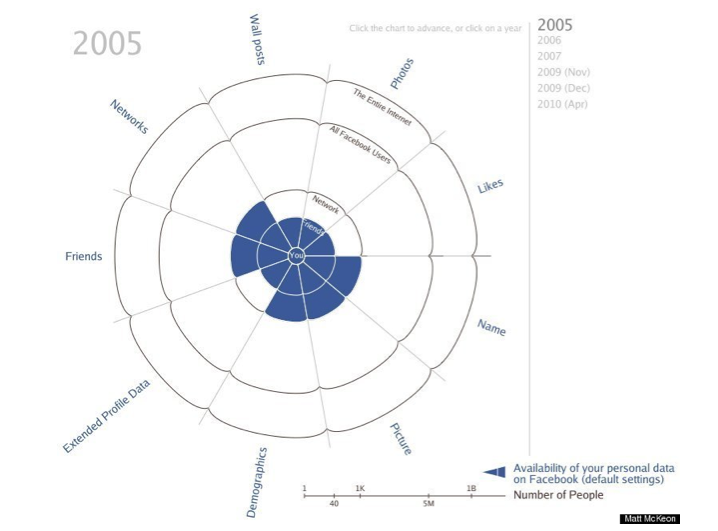
Facebook have made some significant changes to their privacy settings in recent months. Matt McKeon has created ‘an evolution of Facebook’ and has used some very interesting visuals to denote these changes over time. I used them with Yr 11 students last week and they certainly took notice.

It’s a powerful representation of their default settings and the changes that have been made over time. Show these to your students and I’m pretty sure you’ll see them heading home to make some changes; changes they probably didn’t even know were necessary.

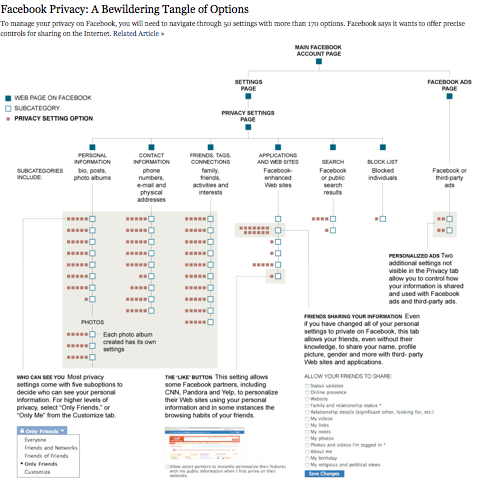
We have been taking our students through the account settings in Facebook, alerting them to changes that have been applied to their accounts. Some students know what’s happening and have ensured their settings are set to ‘only friends’, but many have no idea. Most don’t bother to check the ‘Applications and Websites’ settings, and don’t realise that Facebook has arranged to allow a user’s information to be accessible to nominated websites if a Facebook member accesses them. According to Facebook, it allows for a more integrated web experience and saves you time. According to me, it’s non-consensual use of my personal information. Facebook are overstepping the mark, and people are starting to sit up, take notice, and speak out.

The New York Times have been keeping up with what is happening and have produced a very good graphic showing the default settings and what needs to be done to manage your privacy;

Danah Boyd has written a ‘rant’ about Facebook’s lack of transparency. In it, she makes some observations that I’ve noted are common to students here in Australia too. Most are unaware of the fact that their information is accesible to friends of friends. What follows is a lengthy grab from Danah’s post, but she makes such good points they are well worth sharing (and of course, I’d encourage you to visit her blog to read the post in its entirity);

Over and over again, I find that people’s mental model of who can see what doesn’t match up with reality. People think “everyone” includes everyone who searches for them on Facebook. They never imagine that “everyone” includes every third party sucking up data for goddess only knows what purpose. They think that if they lock down everything in the settings that they see, that they’re completely locked down. They don’t get that their friends lists, interests, likes, primary photo, affiliations, and other content is publicly accessible.

If Facebook wanted radical transparency, they could communicate to users every single person and entity who can see their content. They could notify then when the content is accessed by a partner. They could show them who all is included in “friends-of-friends” (or at least a number of people). They hide behind lists because people’s abstractions allow them to share more. When people think “friends-of-friends” they don’t think about all of the types of people that their friends might link to; they think of the people that their friends would bring to a dinner party if they were to host it. When they think of everyone, they think of individual people who might have an interest in them, not 3rd party services who want to monetize or redistribute their data. Users have no sense of how their data is being used and Facebook is not radically transparent about what that data is used for. Quite the opposite. Convolution works. It keeps the press out.

The battle that is underway is not a battle over the future of privacy and publicity. It’s a battle over choice and informed consent. It’s unfolding because people are being duped, tricked, coerced, and confused into doing things where they don’t understand the consequences. Facebook keeps saying that it gives users choices, but that is completely unfair. It gives users the illusion of choice and hides the details away from them “for their own good.”

What really worries me, is that there are not enough people in our schools today who are confident enough with new technologies to understand how to help our students work these things out. This is part of the new digital divide that is starting to rear its ugly head. I have the feeling we will have students who are given an understanding of the benefits of creating positive digital profiles and they will do just that. They will understand that you don’t upload that unflattering photo or you avoid being photographed in compromising situations. You post the great things you are doing and your social resume helps you to get that job you’re looking for. You won’t be the kid on the other side of the digital divide who uploads all those photos from that party that got out of control. That same kid on the other side never created any great digital content because their teachers didn’t understand new technologies and never set any tasks that allowed them to show people what they were truly capable of. Their social resume is the one that recruiters look at, resulting in them sending their work resume (the one they’ve written) to the bottom of the pile.

Schools do have a part to play in informing our students about managing their lives in social networks. What this requires is teachers who are up to date with what is happening and with the nous to direct them to the information they need. It worries me that the only professional development our teachers are given to support them with understandings like these, come from blog posts written by other teachers who are doing it late into the night with dark bags under their eyes!

School’s out Friday – this one’s for Jill

No funny video this week. It’s been a tough one. This weeks School’s out Friday is a tribute to a fine lady.

WARNING!

Twst_bar.gif (1692 bytes)

When I am an old woman I shall wear purple
With a red hat which doesn’t go, and doesn’t suit me.
And I shall spend my pension on brandy and summer gloves
And satin sandals, and say we’ve no money for butter.

I shall sit down on the pavement when I’m tired
And gobble up samples in shops and press alarm bells
And run my stick along the public railings
And make up for the sobriety of my youth.

I shall go out in my slippers in the rain
And pick the flowers in other peoples’ gardens
And learn to spit.

You can wear terrible shirts and grow more fat
And eat three pounds of sausages at a go
Or only bread and pickles for a week
And hoard pens and pencils and beermats and things in boxes.

But now we must have clothes that keep us dry
And pay our rent and not swear in the street
And set a good example for the children.
We must have friends to dinner and read the papers.

But maybe I ought to practice a little now?
So people who know me are not too shocked and surprised
When suddenly I am old, and start to wear purple.

by Jenny Joseph

Twst_bar.gif (1692 bytes)

The world lost a very special person this week. Jill Vines, a friend and former colleague of mine, sadly passed away unexpectedly. Jill was a woman who packed more into her time here on earth than most of us will ever do in a lifetime. One of the former schools she worked at paid tribute to her by saying, ‘Jill could fill a room even when there was no-one else in it.’  And it was true. She could.

Jill loved the colour purple, and would read the above poem to our Yr 12 students at their Valedictory Dinner. It was read today in tribute to her at our school assembly. Emily, our literary prefect, who was inspired by Jill to pursue her love of reading and writing, did an exemplary  job delivering the poem that Jill loved so much.

Jill was a devoted and loving mother and wife and a warm and effusive friend to so many. She was a brilliant teacher and role model to all of the many students she had contact with in the schools who were fortunate enough to be graced with her presence. Those who knew her are struggling to understand her passing; just how is it, that she, who was so full of life, is gone from us?

Thank goodness Jill didn’t wait to wear purple. She embraced the message of this poem with the way she lived her life. There’s a lesson in that for all of us.

We will miss you Jill, but we will never forget your passion and your kindness. You were one out of the box.

Blogs – how to set one up and write a post that gets you noticed (maybe!)

I created this presentation for Students 2.0. Blogging can be a very powerful tool for young people who want to explore their interests and connect to others with similar bent. All too often I come across student blogs that are set up as class assignments and you can feel a lacklustre involvement with many of them. It’s one of the reasons I don’t get my students writing blogs. I think that blogging is an art, something that is best pursued by people who are passionate about what they are doing, people who write because they love their subject matter and want to share it with others.

That’s the best scenario in my opinion, but I do think there is worth in exposing students to ideas about what can be achieved if you choose to push yourself out there and share your thinking with others. Particularly for kids who have specific interests and don’t realise that you can advance your cause by connecting with the right people.

I visited a school a couple of years ago where students were given the task of putting together a ‘pitch’ to a company about something they were interested in. One student was a go kart racer and had real potential to make his way to the higher ranks where you could eventually become a formula one racing driver. I was very impressed with the effort he put into his ‘pitch’ and the dedication he gave to the task. It mattered to him. I watched the teacher thank him for his efforts, but I couldn’t help but think there was an opportunity wasted at that point. If he had a teacher who understood what blogging can do for people, he could have been encouraged him to start his own and create a profile that may get noticed by those who make decisions. He could have created the digital profile he needed.

What we need in our schools are teachers with skill sets that enable our kids to be exposed to social media tools that will help them take their learning outside of school walls and give them an opportunity to connect with others. My fear is that teachers with the necessary skill sets are few and far between. Hopefully a presentation like the one above will help some teachers relay an understanding to their students.

The Elluminate session was recorded. You can follow this link to listen to me expand on the ideas presented in the slides if you so choose to.

School’s out Friday

Right now, I’m hoping that my cat Bonnie has found herself a hot spot somewhere and is enjoying herself before she makes the journey home. She’s been missing since last night and I’m worried. Honestly, my animals have caused me headaches this year! Bonnie’s not a cuddly cat, but she likes to be around you. The weather’s pretty miserable here right now so it’s highly unusual for her to not be curled up in a warm basket inside.

*Update – not a hot spot. Cold spot under a distant neighbours shrub after being attacked by what we think was a fox. Thank goodness for the microchip that identified her when she was handed into a local vet. She’s recovering. Being suitably pampered at home.

Enjoy your weekend. I’ll enjoy mine if she makes an appearance!