Gmail ninja tips – I need them!

Image representing Gmail as depicted in CrunchBase
Image via CrunchBase

I had my children in 1996 and 1999, so my time in schools during this period and in the years up to 2004/5 was a bit patchy. I worked, but some of it was as a relief teacher and a large part of it was in a part time capacity. It’s been interesting because I wasn’t in schools in a full time capacity when computers really started making an impact.

I missed some essential learning as a result. I have no idea about spreadsheets and using programs like excel and my management of email leaves a lot to be desired. Just ask the IT Manager at my school who despairs because I don’t manage my folders well and I clog up the system. Much, in fact all of my learning re driving a computer, has had to be self directed. I’ll never forget the embarrassment of having to ask people how to set up a folder or how you cut and paste. It’s one of the reasons I try and help people as much as I can without making them feel inferior. I know only too well how difficult it can be to admit that you don’t know how to do something.

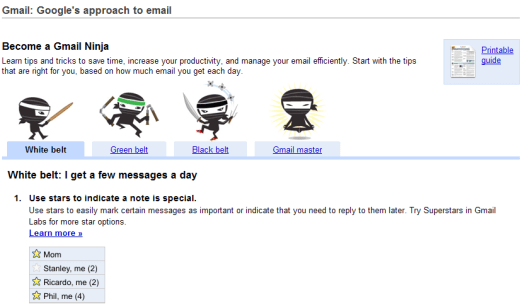
So I was pretty happy to discover Google has provided some tip sheets about how to become a Gmail Ninja.  Tip sheets are provided for White Belt, Green Belt, Black Belt and Gmail Master users. Just reading the White Belt tips has pointed me to tips I should be applying to my management of my Gmail.  For those of us who still need to hang onto something in print, there’s a printable guide available. I just might need that!

gmail_ninja

Reblog this post [with Zemanta]

Aha moment – ever had one of those?

Ever had an ‘aha’ moment? An experience where revelation comes to you suddenly. I had one of those when I started writing this blog. Writing my first post and waking up the next morning to see a comment posted was a real ‘aha’ moment for me. Everything I had been reading about in terms of connections and the ability of the web to bring us together seemed to coalesce in that moment.

I really like ahamoment.com, a site dedicated to sharing the aha moments of the people who chose to share their stories. Thanks go to Tony Hollingsworth who alerted me to its presence on the Web via a tweet. I like how they describe an aha moment;

Aha moments come in all shapes and sizes. We know from the real people featured on this site and with those to whom we continue to speak, that aha moments are personal. They have been described as, “magic,” “enlightenment,” and, “that moment of clarity when all the pieces fall into place.” They’ve told us that having an aha moment is like, “getting hit by a bus,” and that it just “hits you.”

I’m intrigued by the research they say has been conducted into aha moments and what happens physiologically before they happen;

“In 2004, researchers at Northwestern University wanted to discover the physiological responses that lead to the breakthrough moments known as aha moments. What they discovered was that a split — second before having an aha moment, we experience a burst of electrical brain activity… kind of like a big light bulb going off in your brain.

Another study in 2006 by the same research team found that aha moments tend to occur more often in the “prepared mind.” In short, if we’re open to change and maybe even looking for some kind of change — an aha moment is more likely to happen.”

A part of me believes very strongly in the 2006 study. I do believe we create our own situations to some extent. I think you have to work it, but if you visualise where it is you want to be in life you can find yourself there.

I could see this site being useful in school settings. People sharing insights into what has sparked a new direction for them could help inspire our students and could be the basis for writing or digital media tasks. Perhaps our students could upload their own stories to the site. 

My only concern is that the site is run by the Mutual of Omaha Insurance Company. I’m wondering what their motivation is for running a site like this? It looks like a clever marketing ploy to me; run a site that’s interesting and plug a few products like life insurance, retirement solutions etc. This could be another interesting educational exercise- part of the digital literacy learning our kids should be aware of. Get your students to visit the site and find out who is running it by having them scroll down to the bottom of the page and check out the detail that you find in the links there.

Interesting from many angles. Exploring the site was a bit of an ‘aha’ moment in itself!


Reblog this post [with Zemanta]

Students are doing it for themselves.

(sing the title to the Pointer Sister’s tune!)

I haven’t updated of late about the Year 9 Ning running across our four classrooms at Toorak College. Mostly that’s because life has been crazy for me and I haven’t had time to feed it to the extent that it needs in order for it to be a rich environment. One of the things I’ve learnt is that a Ning needs a leader to constantly drive momentum. It can’t survive with just a leader, the community needs to be plugging away too, but leadership is an essential component.

I wondered how things would go now that we are on school holidays. My prediction was that it would be quiet. We’ve been focused on assessment and end of term careers week and we didn’t get class time to prompt student involvement.  I figured this would translate into next to no activity.

Well, I’ve been pleasantly surprised. To start with, a fellow teacher uploaded a discussion about ‘Mid year holiday English fun’ and asked the students to reply to this;

What will you be up to during the winter break that is related to English?

* I’ll be curling up in front of the heater with a cat on my feet, cocoa with marshmallows in one hand, and a book in the other.
* I’ll also be visiting my local library to check out their new books
* I’m going to write in my diary
* I might go to see a play or a comedy show
* I’ll certainly be watching lots of movies!    

And yes, kids have been replying.

And then today, I got this email from one of my students;

My dad sent this to me and it is english related… i have also put it on the ning.

Now this is a student who was not particularly interested in the Ning at the start of the year. Here’ s what she posted as a discussion;

UP. A little word with a lot of meaning.

SIT UP AND TAKE NOTE:

“up”

Lovers of the English language might enjoy this. It is yet another example of why people learning English have trouble with the language. Learning the nuances of English makes it a difficult language. (But then, that’s probably true of many languages.)

There is a two-letter word in English that perhaps has more meanings than any other two-letter word, and that word is ‘UP.’ It is listed in the dictionary as being used as an [adv], [prep], [adj], [n] or [v].

It’s easy to understand UP, meaning toward the sky or at the top of the list, but when we awaken in the morning, why do we wake UP?
At a meeting, why does a topic come UP ? Why do we speak UP, and why are the officers UP for election and why is it UP to the secretary to write UP a report? We call UP our friends and we use it to brighten UP a room, polish UP the silver, we warm UP the leftovers and clean UP the kitchen. We lock UP the house and some guys fix UP the old car.
At other times the little word has a real special meaning. People stir UP trouble, line UP for tickets, work UP an appetite, and think UP excuses.

To be dressed is one thing but to be dressed UP is special.

And this up is confusing:
A drain must be opened UP because it is stopped UP.

We open UP a store in the morning but we close it UP at night. We seem to be pretty mixed UP about UP !

To be knowledgeable about the proper uses of UP , look the word UP in the dictionary. In a desk-sized dictionary, it takes UP almost 1/4 of the page and can add UP to about thirty definitions

If you are UP to it, you might try building UP a list of the many ways UP is used. It will take UP a lot of your time, but if you don’t give UP,you may wind UP with a hundred or more.

When it threatens to rain, we say it is clouding UP . When the sun comes out we say it is clearing UP. When it rains, it wets UP the earth. When it does not rain for awhile, things dry UP.

One could go on & on, but I’ll wrap it UP , for now …….my time is UP , so time to shut UP!

Oh….one more thing:
What is the first thing you do in the morning & the last thing you do at night?

U P 

Well, it’s made my day. It made me smile and it made me realise that the kids are connecting with this forum. The fact that a student who was disinterested in the beginning, now makes the connection between something her Dad sends her and the learning environment we have created at school is pretty darned impressive in my opinion.

I’m feeling UP about the Ning right now. Let’s see if the Ning can remain UP at the forefront of my students’ minds over a three week break.

School’s out Friday

Thanks to the generosity of my husband’s cousin, last night we saw Pink in concert at the Rod Laver Arena here in Melbourne.  This excerpt on Youtube is from the opening number. The concert was part of Pink’s, ‘Funhouse tour’ and it was incredible. It was one of the 54 shows she is performing in Australia over a  period of four months. Her athleticism and amazing voice outstripped the spectacular staging. You were focused on her performance from beginning to end. Far and away the best concert I’ve ever been to. To top it off, we got to watch it from a corporate box. Free and luxury surrounds. Doesn’t get much better than that!

Hope your weekend treats you well. School holidays have begun for me so rest and relaxation will be the order of the day – make that days!

Twitter Search in Plain English

The Lefevers are at it again. This time it’s ‘Twitter Search in Plain English’ . It’s a very useful explanation of how you would use Twitter to gain insight about news and trending topics. Especially useful for educators. This is one of the ways we can explain to our students how to use social media to keep abreast of what people are thinking and where they are sourcing their thinking from. The links that are fed through Twitter are examples some of the most useful filtering taking place by users of the web. For breaking news it’s very hard to go past Twitter. I know that I am aware of big topics a long time before the television news media have got their act together.

Thanks once again to Lee and Sachi. You make our teaching lives a whole lot easier with the work you do.

What do friends mean?

A tweet came through today that pointed me in the direction of a post on The New York times site. Interesting that I should be influenced by a post from New York, when I should have been tramping the streets of that city today. I’m not, and nor will I be attending the NECC conference in a couple of weeks.  Life’s been throwing me some curve balls of late and that’s why the post I’m discussing held such relevance for me.

June 15, 2009, 5:41 am

<!– — Updated: 5:41 am –>What Do Friends Mean?

INSERT DESCRIPTION

Today’s idea: The rise of social media and the downturn in the economy have people thinking long and hard about the value and meaning of friends — psychologically, socially and economically. Upshot: confusion.

That was the opener.

Over the last month or so I’ve had cause to consider the meaning of friendship and the importance it holds in our lives. I’ve come to the conclusion that good friends are good friends, be they physically close or far away. And I’ve realised  that the friends I have made online who truly care about me are good friends in the true sense of the word.  

I’m not confused, as the above post suggests. I’m firmly grounded in the belief that there is good in the world and when you need it, the true nature of friendship reveals itself. That has certainly been my experience.  Surprisingly, it extends from unexpected quarters too and new friends reveal themselves.

So, my answer to the question posed? What do friends mean?

A heck of a lot. Thanks to my good friends out there. You know who you are.

Google Translate- is this changing the nature of LOTE teaching?

LONDON - APRIL 13:  (FILE PHOTO) In this photo...
Image by Getty Images via Daylife

I was involved in a session the other day with Yr 9 students. We were exploring techniques for searching the web to find the information you need. We spent some time looking at Google Scholar and this led to an exploration of some of the other applications Google offers. When we touched on Google Translate you could see this ‘look’ appear on the students’ faces. It was like I’d uncovered their hidden secret.  

What emerged quite clearly was that the students were using Google Translate to assist them with their LOTE classes. Obviously they were under the impression that the teaching staff weren’t tuned into the wonders of Google Translate and all it offers.

If you haven’t used it yet, you should check Google Translate out. I’ve had to use it recently when I had comments in Russian left on this blog. I thought they might have been Russian spammers, but they were legitimate comments.  It helped that I work with a Russian colleague who was able to verify that the returns I was getting from Google Translate were close to the mark. I can only imagine that the students at my school have discovered this as a pretty effective tool for handling homework easily. I’m just left wondering whether the LOTE staff are onto it.

If they’re not, they should be, and so should all the LOTE teachers out there. Hopefully people are finding ways to make it an effective tool to support the learning of students. All you need to do is place text into a box, select the language you want to translate to and hit enter. Check out the screenshot below.  

Google_Translate

Using it has made me think about travel and how handy Google Translate would be if you were overseas and had an internet enabled phone. You could use this as your translation tool to navigate your way through  non- English speaking countries. I know that when Iwas in Shanghai by myself last year, I had moments where I felt completely vulnerable due to my inability to communicate.  Google translate would have been a  lifesaver, especially for those moments when I was trying to hail Taxis and have them take me to my hotel when all I had was the hotel name written in English. You can imagine the difficulties I had. All I can say is, you live and learn!  

Interestingly enough, it’s made me consider the Tower of Babel story from Genesis. When I was in my first year of Teacher’s College,  I had to write a 3000 word essay about the perception of God based on the Book of Genesis.  I had enormous difficulty finding references as I was presenting  the viewpoint that God had it in for man. I literally had to hole myself up in the State Library of Victoria for a period of time, as the only book I could find that went anywhere near supporting my viewpoint was one by Erich Fromm that was only housed there. 

How do I bring this anecdote to my discussion of Google Translate?

It’s a leveller. It enables collaboration across cultures distanced by language. And unless the almighty disables the internet to divide mankind, the use of a tool like this will help to faciliate the  abilty of cultures to work together to communicate and maybe, just maybe, work together to solve the problems that plague this planet.

In the meantime, LOTE teachers, get yourselves up to speed. The kids you teach might be just one step ahead of you. 


Reblog this post [with Zemanta]

School’s out Friday

I know half the world has probably seen this, but the fact that my entire family stops and watches when the Cadbury Eyebrows ad appears on television, has got to mean something about its appeal factor. Last night I went to my son’s school concert. Two of the students replicated this ad; it was a standout highlight.

Plenty of others on YouTube have had the same idea. Here’s a selection of examples.

Here’s Lily Allen on Channel 4 (not a patch on the kids);

And another;

And finally,  to demystify the whole thing, here’s a tutorial showing you how to make a replica of the ad without having to have your actors move their eyebrows;

No reports to do this weekend so sleeping in will be the priority! Enjoy whatever it is you are doing.

SlideRocket for Education

I’ve been using SlideRocket, an online presentation tool, for the past year for presentations I have given at conferences. To start with, I badgered them for an invite to use the product before it’s release. To my surprise, they obliged. I then moved over to the free version when it had general release, but felt it was limited so had to sign up for the premium version. Around that time SlideRocket sent me a survey asking my opinion about pricing for K-12 education. My response was that they needed to make it affordable, under $500.00 for a site licence. To be honest with you I didn’t think  it was anywhere near possible as I’d just had my school sign up for the one user premium package at a price of $240.00 a year.

SlideRocket announces preferred pricing for K-12 education


I was surprised last week to get an email from SlideRocket letting me know that they were going to be announcing pricing for education. When I looked at what they were offering I was very pleasantly surprised. Here it is;

Schools with less then one hundred and fifty students will pay $249 per year, schools with less than one thousand students will pay $449 per year and schools with over one thousand students will pay $999 per year. All pricing is per school allowing every member of the school community – teachers and students alike – to create his or her own SlideRocket login and gain access to SlideRocket’s premium features.    

 In my opinion, that pricing is pretty good given the features SlideRocket offers. I found my last couple of presentations pretty easy to put together. I was able to access flickr creative commons attribution only pictures from within the SlideRocket application and load them easily into my presentation.  I could create a library of my slides so that I can use them easily in new presentations should I need them.  My presentations are stored online so I could access them from any computer anywhere provided I had an internet connection.  They also allow you to download an offline player allowing you to cache your presentation should internet access be a problem.

There are other features I’ve yet to explore that hold real potential in educational settings. You can work collaboratively on a presentation and access a shared library of resources with the SlideRocket community. The pricing is wonderful for a school my size (under 1000). $449 US dollars converts to $568 Australian dollars. Less than one dollar each for students and staff for use of a premium package is pretty good value.

Now, to lobby for it to go into next year’s budget…..     

(If you want to see Sliderocket in action visit my wikispaces site where my presentations are embedded.)

Reblog this post [with Zemanta]

Friending your students – a researcher’s perspective

When I was in Form 6 (today’s Yr 12) I had a teacher who gave us his phone number so that we could contact him if we needed clarification about the work we were doing out of school hours. We knew that on certain nights he had umpire training and wouldn’t be home until after 10.30pm.

Did I ever call him? You betcha I did, and so did the other students from our class. Even after 10.30pm on some occasions. He was an extraordinary teacher; a real father figure who guided us and believed in us. Did we ever abuse the privilege and hassle him? Never. We respected him and would do anything he asked. I still hold him in high esteem and hope that I am modeling the kind of good teaching practice he lived and breathed.

Danah Boyd, Researcher at Microsoft Research New England and a Fellow at Harvard Law School’s Berkman Center for Internet and Society , has recently posted on her blog this post, ‘When teachers and students connect outside school ‘.   It’s a common sense post in my opinion. Refreshing really. There is so much she says that I see as valid when it comes to this discussion. She makes these important points;

The fear about teacher-student interactions also worries me at a broader societal level. A caring teacher (a genuinely well-intended, thoughtful, concerned adult) can often turn a lost teen into a teen with a mission. Many of us are lucky to have parents who helped us at every turn, but this is by no means universal. There are countless youth out there whose parents are absent, distrustful, or otherwise sources of frustration rather than support and encouragement. Teens need to have adults on their side. When I interview teens who have tough family lives (and I’m not talking about abuse here) but are doing OK themselves, I often find that it’s a teacher or pastor that they turn to for advice. All too often, the truly troubled kids that I meet have no adults that they can turn to for support.

I worked in a tough Govt. school for many years. (The same school I attended as a teenager as a matter of fact!) Many of the students there needed supportive and well intentioned adults around them who were looking out for their best interests. In quite a few cases, the only people in their lives who met that criteria were their teachers. These were the kids who’d turn up at school on pupil free days even if they’d been suspended the day before.  School was the structure lacking in their lives. There were kids there who I gave my phone number to, kids who needed a supportive adult who would be there for them to listen when life was tough. Not a whole lot of those kids rang me, but I know they appreciated me showing them I cared. 

One of my former students is my hairdresser now. She convinced me awhile ago to join Facebook and become a member of the school’s alumni group. So many of my former students have added me as a friend and left kind messages. Quite a number of them are the kids who would put you through the wringer in class. These are the kids who say, ‘Hey, great to see my fave teacher here.’ It’s amazing really. You see how much influence you have had, influence you may have never realised without a forum like Facebook.  

Danah offers this when discussing whether or not teachers should be adding students in social networking sites;

Teachers do not have to be a student’s friend to be helpful, but being a Friend (on social network sites) is not automatically problematic or equivalent to trying to be a kids’ friend. When it comes to social network sites, teachers should not invade a student’s space. But if a student invites a teacher to be present, they should enter in as a teacher, as a mentor, as a guide. This isn’t a place to chat up students, but if a student asks a question of a teacher, it’s a great place to answer the student. The key to student-teacher interactions in networked publics is for the teacher to understand the Web2.0 environment and to enter into student space as the mentor (and only when invited to do so). (Translation: teachers should NEVER ask a student to be their Friend on Facebook/MySpace but should accept Friend requests and proceed to interact in the same way as would be appropriate if the student approached the teacher after school.) Of course, if a teacher wants to keep their social network site profile separate from their students, they should feel free to deny student requests. But if they feel as though they can help students in that space, they should be welcome to do so.

I have had current students request that I be their friend on Facebook and I’ve hesitated. I haven’t added them, but I’m not sure it would be problematic if I did. I’m highly conscious of my online behaviour and enter these spaces as a teacher, first and foremost. One of my students is on Twitter and I follow her. I do so to support her in that online environment and we often speak at school about something that may have popped up on Twitter. It is a mentoring role and because I use Twitter as a professional tool for learning I feel very comfortable about this.  

It’s a debate that will continue I have no doubt. I encourage you to read Danah’s post and reflect about what you feel is appropriate. Danah leaves her post with these questions;

What do you think is the best advice for other teachers when it comes to interacting with students on social network sites? When should teachers interact with students outside of the classroom? What are appropriate protocols for doing so? How can teachers best protect themselves legally when interacting with students? How would you feel if you were told never to interact with a student outside of the classroom?  

I wonder what your answers would be. I’d love to hear them if you care to leave a comment.

The comment thread on Danah’s post is interesting to read. John Heffernan shares this (and I’m sorry John, there is no link to a blog that you may be writing. Are you,  I wonder, the John Heffernan who writes children’s books in Australia?) ; 

I wonder if Socrates was walking in the Agora, would he stop and talk to his pupils outside of teaching time?

Teenager’s Agora is now predominantly online.

If Socrates was alive today, where would he sit and would he still be charged as “corruptor of youth”?

 

Reblog this post [with Zemanta]