“Books, newspapers face battle in dawn of digital revolution”. So says the Geelong Advertiser.

Yesterday I posted about the Geelong Advertiser and the interview I conducted with them after they contacted me via Twitter. At that stage I’d searched the site but couldn’t find any article referencing my name.

Today I received this tweet from John Pearce;

mrpbps @jennyluca The Geelongaddy article re U and someone called Pesce who dominates conversation 🙂 is now online Go Jenny http://bit.ly/3fkxj

Mark Pesce’s comments were the main focus of the article. He made reference to the function of Libraries in the future and this is where my comments were slotted in. Here’s what was mentioned;

While it sounds like a new world order, Mr Pesce believes people will turn to libraries to restore order in their own lives.

The public library will be where people go to catalogue the huge data shadows they are creating with digital photographs and recordings, he said, while books will become archives.

“Today librarians keep catalogues to keep books ordered. They are going to pass this on for you to use.

“It’s going look different but it’s going to help order your digital lives,” he said.

Toorak College librarian Jenny Luca said libraries will become a place for discussion and connection.

“It’s absolutely essential that we look at the new technology and find ways to make it meaningful for the kids that we teach. The collaborative nature of those tools is such now that we will actually make connections with the people behind the keyboards and learn from those people.”

But books will still have a role. Fiction is still a vital collection, Ms Luca said, while non-fiction was losing relevance to online content

I have to admit to being pretty chuffed to see my name in an article alongside Mark Pesce’s. Thanks Peter Farago for interviewing me and getting the article to print.  Special thanks go to John Pearce for making the effort to let me know the article had been published. 
 

Reblog this post [with Zemanta]

Newspapers using Twitter

I had an interesting experience last week as I was heading out to attend the Digital Fair at Geelong Grammar. I sent out a tweet saying I was about to leave and received a reply from Geelongaddy. Geelongaddy turned out to be someone from the Geelong Advertiser, the local newspaper for the Geelong area, and they wanted to talk to me about the upcoming Digital Fair.  

A few tweets back and forth resulted in me participating in a phone interview where I was asked questions about the future of libraries and why we need to be aware of new technologies. The reporter and I shared a discussion about newspapers and their need to embrace online publishing in order to survive. I was extremely impressed that they were using Twitter to disemminate news about the Geelong area and that they were actively searching it to find reference to the Digital Fair. This proactive action enabled them to make connections with me, a participant and presenter.

They also interviewed Mark Pesce who delivered a powerful keynote about digital citizenship and how we as a society need to respond to the influence of the internet on our childrens’ and students’ lives. You can watch this keynote archived on his blog.

I’ve searched their site for the report to no avail. It may well be that it will appear later this week. I’ll post a link if it does. 

*update. A couple of people have sent me the link to the article written by the Geelong Advertiser. No mention of me; guess that’s the nature of newspapers. You have to be newsworthy. Mark Pesce is, I’m not! 

It seems to me that this is the way of the world now. Newspapers obviously need to react to our changing world and find a way to remain relevant. Looks like the Geelong Advertiser is on its way. 

Reblog this post [with Zemanta]

YouTube now big screen

A tweet from Alec Couras sent me to Open Culture and a post by Dan Coleman alerting us all to the fact that you can now watch some full length documentaries and feature films on YouTube.

*update –  Some films are not available for viewing in Australia. When you click on the video you want to watch you will find a pop up appears if the film is not available for viewing in your country.

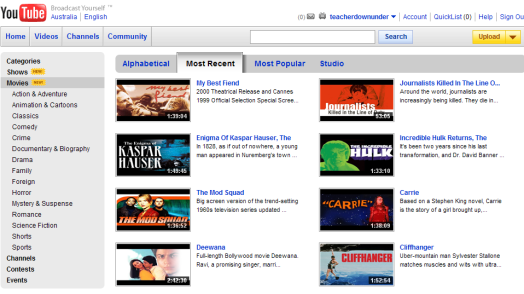
Take a look at this screenshot to get some idea of what is available;

youtube_movies_and_documentaries1

My husband is going to be thrilled to see his all time favourite, Cliffhanger, featured there. (I still can’t bear to watch the opening scene myself!) If you take a look through the categories you’ll find some areas sparse but others quite heavily populated with content. The documentary and biography  section has a number of additions including Morgan Spurlock’s Super Size Me.


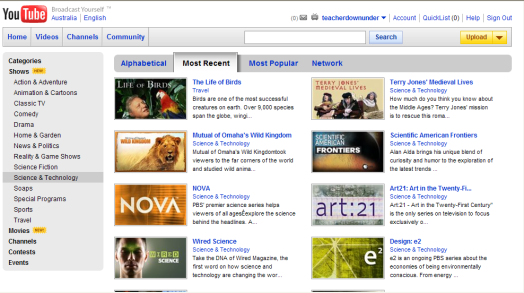
Shows are also now available. This is a screenshot of the types of offerings from the Science and Technology category;

youtube_shows 

This is another example of the great content available freely on the Web now. Television content on the ABC and SBS sites also stream many of the programs that feature on free to air TV. Not to mention a site like Surf the Channel that enables you to find pretty much any program you like.

Makes we wonder why we in schools invest so much money and manpower in systems like Clickview. The times they are a changin’ and high cost systems in our schools better take note and react with more favourable price options accordingly, or their days will be numbered.   


Reblog this post [with Zemanta]

Vitual Learning Communities for staff professional development and student engagement. Digital Fair presentation.

This is the presentation I gave yesterday at the Australian College of Educator’s Digital Fair that was held at Geelong Grammar.

It was well received and, as is usual for me, I didn’t manage to get through all of the presentation as I have a tendancy to elaborate. It’s very difficult to relay the concept of learning communities and all that goes with the formation of them in an hour. I fielded questions along the way but didn’t get discussion time factored in. If anyone would like further elaboration on anything in the presentation leave a comment and I’ll do my best to address what it is you need to know.

Vodpod videos no longer available.

more about “Vitual Learning Communities for staff…“, posted with vodpod


Reblog this post [with Zemanta]

School’s out Friday

John Connell referred to this TED Talk in his keynote address today athe Digital Fair run by the Australian College of Educators. I’ll post more about that later tonight hopefully.

On the TED site it says this about the talk by Stuart Brown;

A pioneer in research on play, Dr. Stuart Brown says humor, games, roughhousing, flirtation and fantasy are more than just fun. Plenty of play in childhood makes for happy, smart adults — and keeping it up can make us smarter at any age.

There are some wonderful scenes involving a polar bear and and a tethered husky. I’m sure you’ll be moved.

Enjoy your weekend. I certainly intend to! Last one before a return to work on Monday.

The future of libraries, continued….

I’m finding it harder and harder to get to my RSS feeds in my Google Reader. I’ve no doubt this is in large part due to Twitter consumption. The temptation is always there to just check in to see what’s going on and before you know it you’re off exploring 8, 9, 10 links to new stuff that’s just downright interesting. Of course, as you’re exploring those, the hypertext environment that feeds off these links takes you other places and before you know it, two hours have elapsed!   

Well, I’m glad I found some time because I stumbled on a link to a blog post by Adam Corson-Finnerty, a Library Administrator from Pennsylvania. He was referring to Academic libraries, but I think his message has meaning for school librarians too. It’s time we shifted our mindset if we are going to remain at all relevant in years to come. Read what he has to say;

              Get out of Real Estate

Close as many libraries as you can.

Get out of the Study Hall business.

Your remaining facilities should be recast as “learning labs” or “learning environments.”

Downsize or eliminate your high-density-storage facilities.

Get in to or get out of the Book Storage Business.

Convert your storage facility into a regional storage facility that is self-funding, or

Pay another institution to store any books that you absolutely have to own, and

Pay this institution to loan you books as you need them from their combined holdings, or

Have this institution scan any book that you need and produce your own POD copy, and give it to the patron to keep (you really don’t want it back).

Get out of the book-buying business—only buy books when they are requested.

Keep only what is heavily used

Use “scan on demand” ILL services wherever possible

Use print on demand

Use in-house or nearby print-on-demand service for quick production.

Re-deploy your people

Get your people out of supervising the study hall, standing-behind-a-service-desk, giving directions to the nearest bathroom.

Retrain Librarians as “Informationists” or “Informaticians” or whatever new term breaks them out of the old mold. Your new librarians will be full members of academic research teams, or will “team” with individual scholars, including undergraduates. Many on your staff will have to become data curators, if not database creators.

Focus on the delivery of digital resources, services and tools

Continue and strengthen your role as Information Broker for the entire University

Emphasize training patrons in information-finding skills.

Emphasize digital self-help.

Emphasize collaborative tool-development with faculty

Emphasize collaborative resource-building, and resource-sharing with other Research Libraries

Emphasize physical and digital preservation of assets.

Lots of what he says here rings true for me. What about you? I’m sure there is still much to be said about the future of libraries. How we respond to prompts like these is the truly difficult and confronting challenge facing us, but face them we must if we want to remain relevant.

Adam provided a link to No Brief Candle: Reconceiving Research Libraries for the 21st Century. You can download the PDF at that link.


Reblog this post [with Zemanta]

Twitter Mosaic

I needed to post this Twitter Mosaic for a presentation I’m doing this week for the Australian College of Educators at their Digital fair in Geelong. Some of my talk will focus on Twitter as a learning network. This mosaic shows my followers. It’s pretty overwhelming, even for me, to comprehend. It’s certainly one powerful network for learning. Many of these people lead me to information I wouldn’t access any other way.

Get your twitter mosaic here.

Reblog this post [with Zemanta]

ProCon – Secondary School debators take note

I’ve spent a bit of time looking at ProCon, a website that has as its mission;

 “Promoting critical thinking, education, and informed citizenship by presenting controversial issues in a straightforward, nonpartisan primarily pro-con format.”

It’s origins are from the United States, so Australian schools will find it limited to some extent, but it does provide good overviews of controversial topics like Drugs in Sport, Euthanasia, the Israeli/Palestinian conflict, the US decision to invade Iraq, the Death Penalty and various others. These are issues students in my school investigate so I’ll be pointing them to it when they are in the process of formulating their research.

They provide a one minute overview page, did you know facts, and in  some cases top 10 pros and cons about issues. Here’s a screen capture of part of the Israeli-Palestinian page;

procon_screen_capture

I’ve had a look at their about us page to try and find out more about the creators of these pages. There are a number of contributors and if you click on their names you are taken to a profile page where their educational backgrounds are detailed. You can find on this page information about the researcher who is handling topics on the site. All of these researchers can be contacted via email addresses that are available on their about us page. You can sign up for RSS feeds, share the pages and even follow them on Twitter – they are procon_org.

If you’re in a school in Australia and looking for a site that explores current issues, you should consider getting  a subscription to Echo Education Services. It’s a small organisation doing a really great job for Victorian students but their services are valuable for other Australian States and Territories. Here’s what they do;

What is Echo?

The Echo’s information content is drawn from newspapers and the Internet.
Echo selectively indexes three major Australian newspapers and provides a searchable index on-line.
Echo also publishes regular issue outlines. These are analyses of newspaper treatment of events, controversies etc. The outlines set out the arguments for and against (as put forward by journalists and commentators) and provide background information on the particular issue.
The issue outlines also contain links to vetted, relevant documents and sites on the World Wide Web.  

What I have found particularly helpful are the issues outlines pages. The lady who compiles these pages is an English teacher. She scans the newspapers for current issues and puts together a very detailed analysis drawing on the information she has obtained from various newspaper reports, all of which are referenced at the end of her outline. They have recently started including YouTube content to provide the multi-media angle so necessary in today’s ever increasing digital media world. I can’t tell you how many students at my school this lady has assisted. Students who are finding it difficult grasping what is required in a critical analysis of a media issue are very often shown the way from her insightful and easy to access information.  I was fortunate enough to be able to relay my thanks to her personally when I attended an in-service Echo ran a couple of years ago, She was genuinely surprised. Their service is very cheap; a subscription costs around $340.00. Well worth the investment. 

Check out both of these resources for your students to use. Thanks to Richard Byrne for sending me to ProCon.

School’s out Friday


Now this is clever.

It’s an interactive Easter Egg hunt on YouTube uploaded by naders07. What you do is watch the video that has been annotated by Nadine. You can tell it’s annotated because square boxes appear on the screen. When you click on one of these it takes you to another YouTube  video from Nadine where she reveals whether or not you have discovered an Easter treat. All told, Nadine has uploaded fourteen videos to YouTube for our Easter Egg hunting pleasure. I, for one, am pretty impressed by this feat. My 10 yr old son and I have had a lot of fun seeing if our guesses our correct.


Thanks go to Jarrod Robinson (MrRobbo on Twitter) for tweeting about this. Just what I needed today Jarrod. Thanks.  

I hope all of you (whoever you may be!)  have a lovely Easter break.  Enjoy the time spent with family and good friends.


Stephen Downes – learning is distributed

I saw Stephen Downes present on Monday afternoon at Wesley College here in Melbourne. As I anticipated, it was an interesting and informative presentation focused on the importance of recognising that learning has become distributed. The message was that learning consists of interacting in communities of practice; we want students to engage with learning communities from an early age so they know how to navigate them, giving them the ability to take charge of their learning. 

You’ll get no argument from me in regards to that message. My engagement in these networks has led to enormous personal and professional growth. The challenge that exists is how to convince other teachers to join the show and then how we transfer this to the students we teach. I feel like I’m working towards the realisation of this for my students in as much as I’m testing out the formation of an internal learning community with our Yr 9 Ning. The sheer fact that I recognise that I need to find ways to extend the reach of my students by having them write in a hypertext environment puts me one step ahead of most I’d think.  I still have to work towards the realisation of that.

 I asked Stephen, “How do we scale teacher involvement”. His reply was model and demonstrate. I’m not entirely sure that the audience on Monday night were ready for the message. Stephen spoke about the formation of learning networks from an intellectual standpoint and I’m not sure that the audience came away realising that he was talking about the formation of human connections and not computer hardware connections. Perhaps modelling and demonstrating what one of these networks looks like would have been a wise move to get the audience understanding where he was coming from.

It was Stephen’s birthday and thanks to a Twitter connection I managed to go the dinner after the talk. At the end of the evening one of the people there asked me if I’d managed to get my work done during the presentation as I’d had my laptop out. When I explained that I’d been sending out tweets via Twitter about the presentation she was amazed. It brought home to me how many people really have little idea of these means of communication and just how much work needs to be done to help people gain an understanding of learning communities and the power of sharing ideas and insights.

Model and demonstrate. Let’s all remember that message and keep at it!

Reblog this post [with Zemanta]