Cybersafety- getting the message

I came across a great video to use for teaching responsible internet use from a Twitter link (thanks Heidi Chaves) today and was thrilled to hear the Australian accent. One of the things that has become apparent to me is the necessity to convey a message in not only student voice, but in an accent they can relate to. The cleverness of this video is pretty cool- even a hardened YouTube watcher will be impressed I’m thinking when you see those students walk out of the screen. I am giving a presentation to the Grade 5 and 6 students at my school this Thursday and I’ll be using this one with them. Unfortunately, I’m continuing to have problems loading YouTube videos using the URL and it’s impossible to grab the embed code so you’ll have to follow the link to see it. It’s worth it, so take the time to do so. I’m pretty sure you’ll be wanting to use it in your classrooms too.

Toorak College (my school) is a pilot school with The Allanah and Madeline Foundation’s Esmart initiative. Here’s what they are hoping to achieve;

The Alannah and Madeline Foundation’s Cybersafety and Wellbeing Initiative aims to make cybersafety a normal part of every young person’s life by equipping them to use technologies in ways that protect them from the associated risks.

The development of the initiative is informed by a number of cybersafety experts from across Australia.  The first major focus of the initiative is to help schools to create a cultural norm of smart, safe and responsible use of communications technologies.  The initiative will:

  • help schools develop policies and practices encouraging students to use technology responsibly
  • point schools to teaching resources on cybersafety, but also to resources to help them create a safe, respectful and caring environment
  • encourage schools to embrace the positives of technology for teaching practice and enhance young people’s learning
  • establish a system for schools to provide evidence that they are actively implementing these policies and practices
  • reduce the digital divide between adults and young people, so adults can become a credible source of advice on avoiding the risks of cyberspace.
  • We had a meeting of local pilot schools last week and I was quick to reinforce that I’m interested in keeping our students safe online, but I don’t want the fear factor message to be the driver. I want a balanced message delivered, one that acknowledges the benefits of sharing in collaborative online spaces. I was very happy to see the dot point above as part of their aims; ‘encourage schools to embrace the positives of technology for teaching practice and enhance young people’s learning’

    As part of our Esmart program, we are introducing the concept to our Senior School students at tomorrows assembly. We’re using the following series of videos, Your Photofate, as part of the presentation (Thanks John Pearce for posting the link to these videos on Twitter -they’re invaluable). Students are presenting to students; our teaching staff won’t be on stage. The students have scripted the presentation themselves and it’s our belief the message will have more meaning coming from them. We recognise the need for our students to see their teachers as credible sources of information about responsible internet use, and for that reason we’re embedding this into curriculum across Years 5 – 12. It’s our Teacher-Librarians who will be driving the teaching and I am very pleased about this. We realise all teachers need to take responsibility for this, but we want some focused instruction to start the discussions that need to take place continuously throughout the education of the students in our care.

    Here are the videos. They’re derived from the AdCouncil in the United States, but this message transcends international boundaries. Sexting has become an issue in communities the world over, largely due to the ubiquitous nature of mobile phones with cameras. I have little doubt many students are naive as to the consequences of their actions, hence the need for explicit teaching in our schools and homes to reinforce the message that what you post in online communities has far reach; consider carefully if you really want to share an image that you wouldn’t be comfortable having members of your family viewing.

    Choose what happens next

    Sorry

    Out of your hands

    I’m pretty sure the message will translate.
    School’s out Friday

    School is officially out for me today. Yep, the year is at an end and the long summer break beckons. So much has happened this year; when I take a moment to reflect I realise just how busy it has all been. Next year we’re going to be occupying our temporary library and making the best we can of that while the new one is under construction. It will be interesting, but challenging. Nothing like a challenge to make life interesting. The only way to look at things I’m guessing! I thought I’d recognise the end of the school year with a video created by some of the students at my school. Micro wave.mov is a great example of the humour and creativity we see from the students at Toorak College all the time.

    I found out this week that a presentation proposal I submitted  for ISTE 2010 has been accepted. So, not only will I be heading to the States in January for Educon 2.2 in Philadelphia, but I’ll also be in Denver, Colorado in June for ISTE. Wow, big year ahead!

    I’m heading to Sydney next week with my two gorgeous kids.  Off to show them some of the cultural heritage of the country we live in. I’ll post some pics! Enjoy your weekend.

    School’s out Friday

    Now this is special.

    This video is just a little something the students at my school put together to celebrate the fact that it was their last official school day on Wednesday of this week.

    Milly Davison and Elly Dixon were the brains behind it all, inspired by a video shown to them by Media/Art  teacher Emma Cleine. Here are Milly’s words about how it was achieved;

    We were inspired by a video on youtube that we saw, and decided to try to recreate our own version. The planning process was a little bit tricky in working out how best to get everyone to be in the right places at the right time, as well as how we would be able to film it steadily. We filmed at 7am on a cold rainy morning before school, with a set of iPod speakers duct taped to the top of the camera playing the song through at full blast. After a single practice run through we started filming, and on the third take we had a near perfect shot!

    Aren’t they just brilliant. You have to know that staff and students from Yr 5 – 11 were all in the school hall watching this at the start of their last assembly. The final shot in the video ends in the foyer of that hall with a picture of the door. As soon as it finished they all came charging in to thunderous applause. Schools really are special places aren’t they? Such community exists within its walls.

    They really are a very special group of girls. It was this group who helped me begin my Web 2.0 journey really. They were in Year 9 and I worked with them on the creation of digital stories in reponse to the Literature Circle books they were studying. They produced wonderful work back then, and you can see how they have evolved into inspiring film makers today. Who knows what will lay in store for this special group of very talented (and incredibly fun to be around!) girls. We will definitely be missing them. Good luck to the Toorak College Yr 12 students of 2009!!

    Here’s the video that inspired them. It was produced by students from the University of Quebec.

    Below is a QR code from Kaywa QR code generator. Now, how to read it? Next part of the puzzle!!


    qrcode

    Guest post: Liana’s making Wikis (with the help of Year 7)

    You know that feeling when you think things aren’t happening, but then all of a sudden you realise that your efforts are starting to pay dividends? Well, that’s what’s happening at my school (Toorak College) now. I feel like we are making inroads. Kids are using Nings and Wikis and it’s becoming the norm. There isn’t the questioning that used to come with the introduction of new ideas. Teachers are starting to take on board what I’ve been rabbiting on about and they are seeing how effective the learning can be using collaborative tools.

    Liana Gooch teaches at my school and was part of our PLP group. Here is her guest post. Take it away Liana!

    Coming from a country in which bush fires do not feature as a significant hazard as they do in Australia, the events of February 7th 2009 have left an indelible mark on the memories of myself and my students.  It was extremely heart breaking to view the images of destruction and loss experienced by those people involved in the Victorian Bushfires. As well as the human cost, it is also essential to consider the havoc wrecked upon nature. A lot of creatures were helpless to escape the fury of the flames and many that did manage to survive have suffered immense injury. 

    When it came to consider a unit of study related to endangered species with my year 7 Humanities class, I was determined to create a research unit that was not only compelling but also relevant. Students would usually choose to explore overseas endangered species but coverage of the Victorian Bushfires’ impact upon many already endangered species alerted me to taking a more local focus. In the back of my mind I also was concerned about the potential lack of knowledge regarding their own state’s endangered species. My suspicions were confirmed when I surveyed the class about identifying the state’s animal symbol, the highly endangered Leadbeater Possum – only one student was able to identify it. Thus, the inquiry ‘ How can we protect our backyard?’ emerged. 

    Another focus of this inquiry project would be to expose students to a range of technological tools that would be easily transferrable across their range of subjects. Working with Jenny Luca and Megan Davies, we decided that a wikispace would be an ideal medium for students to post and convey their research to the rest of the world. While the students knew I would be assessing their page, they knew that this inquiry was going to have to be authentic due to the wikispace being open to the public. Students were taught how to manipulate many of the tools available on the wikispace and a lot was learnt through the process by trial and error. As students were working collaboratively it made sense to use Google Docs which allowed students to simultaneously work and edit a written piece together on different computers. It also eliminated the age old problem of when students are absent and have the written piece with them thus hindering a group’s progress. This tool proved invaluable and it has been exciting to observe students use this tool for other projects since this inquiry.  Jenny also taught the students about a range of websites where students would be able to use copyright free images for their pages. Another skill gained was the ability to write comments using the pins of Google Maps. One student produced her own clip of a journey through the affected Kingslake area and used voice thread to create her own commentary.  Students found the application of technology to be an effective tool which made the learning process a lot more interesting. ‘It is a lot of fun and instead of being boring the work was challenging and interesting so it made it a lot easier to work. It is a great way to become more familiar with internet tools and skills.’ (Hayley) 

     I wanted students to actively engage with concepts we had explored earlier in the unit related to sustainability. Students were initially exposed to Dr Seuss tale of The Lorax’ which made many of the complex components of sustainability easily attainable. A reflective component of their inquiry which would test their understanding of some of the big ideas would require them to reflect upon how the Lorax would perceive and comment upon the causes and effects of the Bushfires as well as  the ensuing actions to reduce their impact.  Following through the list of aspects to be explored students would be able to explore a range of both primary and secondary resources ranging from newspaper clips, you tube videos, podcasts from experts and contact with applicable organisations. Students constructed questions to inquire about the actions taken by their selected organisation’s actions to assist with affected animals. Many students were extremely excited about receiving information directly from organisations especially when a lot of the information could not be directly found in the range of resources available online or otherwise. 

    The inquiry took about three weeks in total during which time students were completed engaged and engrossed in their research. There were several occasions when it was actually difficult to get the students to stop working! It took considerable time to do my initial research and creation of the inquiry assignment. I also had to learn some of the new technological tools before I could launch the project, however the benefits of undertaking a project with which many of the students were so connected were immense. Their understanding of endangered species in their own backyard and the critical role that humans play has been significant. ‘it shows that we have to be aware of sustainable development and reducing our resources for the future. The Victorian Bushfires has decreased the amount of trees, land, homes and animals, and that reduces many resources for the future.’ ‘This project has made me think about animals in a completely different way then I had before.’ Rather than just producing an assignment which would only be viewed by the teacher, themselves and family, Students were courageous as they gallantly rose to the challenge of creating commentary which was up to scrutiny by the public.  It was also extremely encouraging to hear students comment about taking social action as a result of this project. One student has become involved in adopting a koala and to date, our class are considering fund raising to either help adopt an endangered animal or contribute to a wildlife fund. Another student is starting to consider a career path related to the care of injured animals. To me, this is what learning that is inspiring should be all about – making authentic, meaningful and relevant links to the world around us.

    Well done Liana and well done Year 7. You’ve created a rich resource for others to use and you’ve learnt some new skills in the process. Make sure you visit their wiki.

    The tweet that led to Mirka Mora: Part two.

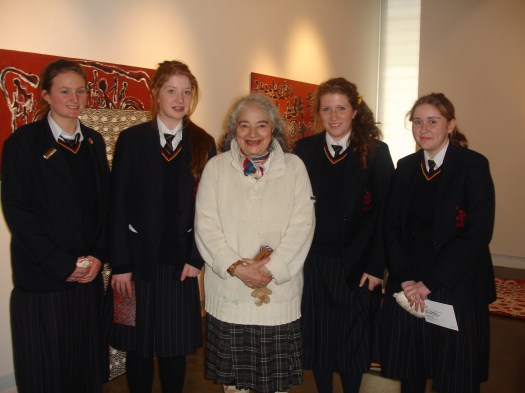
    Last week I wrote about sending out a tweet on twitter asking if anyone had a connection to Mirka Mora, as my daughter and her friends were doing a project about her and would love to get the opportunity to interview her. After some help from Lauren O’Grady,  Gina Milicia very kindly responded and set the wheels in motion. Mirka was happy to be interviewed, and my daughter and her friends conducted a phone interview that was recorded and posted to YouTube and on the wikispace they had created for the project.  At the end of the interview Mirka remarked to me that she was impressed with their astute questions and would like to invite them to afternoon tea.

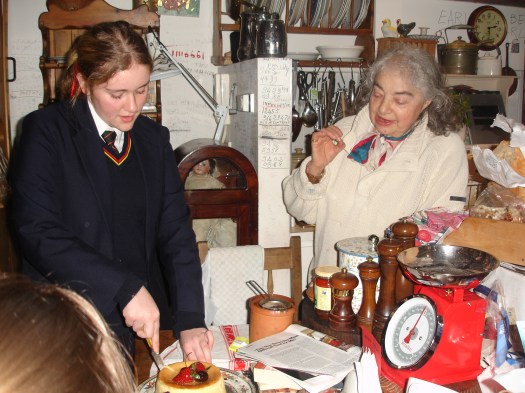
    Well, that very kind invitation was taken up this afternoon. My daughter and her friends, and a colleague and I, spent a very pleasant hour and a half visiting Mirka’s home sharing cheesecake and lemon tea.

    Mirka Mora 001

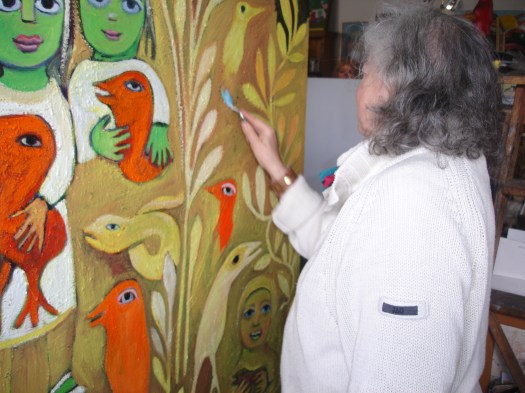
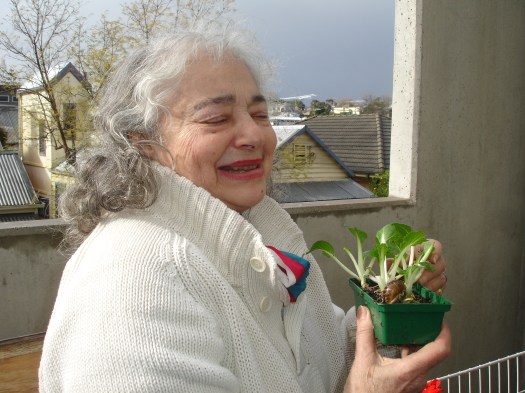
    Mirka welcomed us with a loud chorus of classical music and a warm smile. She is such a  generous soul, full of wisdom that she imparted to us over the course of our visit. One of the first things she said was that we should always praise ourselves; in other words, exhibit self belief. The stories she shared demonstrated her ability to take risks and do things that she was not always confident about. This self belief led to great success and opportunities for Mirka. She was friendly with some of the great Australian painters and recounted stories about her great friend Marcel Marceau.

    Mirka Mora 017

    Mirka’s home is full of memorabilia and artwork. In  her studio she had three art works on the go and she said this is how she paints. She likes to move to where she feels best able to extend her creativity.  It was such a privilege  for all of us to be invited to her private space and be able to see what Mirka is all about. And what is she about? Life, and living it to the full, pure and simple.

    Mirka Mora 010

    Mirka and her pet snail! Her beloved cat died two years ago.

    Mirka shared a story that epitomised what she is about. Her doctor told her a few years ago that she should have a walking frame when out and about. Mirka would have none of that. Instead, she invested in prams and now has 16 or so that she uses when out shopping. One day she was out and saw a woman with four children, one of whom was very young and struggling to keep up. The mother looked harried. Mirka approached her and gave her the pram she was using. She told us how they shared a moment together; they were united in the shared experience of motherhood.  When telling us this Mirka’s eyes were teary and I have to admit, mine were too. 

    Mirka Mora 023

    This has been a wonderful learning experience for our students (and my daughter!)  I think it safe to say that Mirka found it equally powerful. I think she was genuinely impressed with the students’ questions and with the fact that she is having an impact on our younger generation. It’s an example of Network Literacy; teachers using social media tools to connect our students to the subject of their research. I know that these students will never forget Mirka Mora and they know what led us to her. As we walked away today from from Mirka’s home one of them said,  “That’s it. I’m never dissing Twitter again.”

    A great experience for all. Thank you so much Mirka for your graciousness in allowing us into your home and for sharing your life with us. We are all the richer for it.

    Sleepout 4 Schools – well worth the effort

    I’ve been meaning to post about the Sleepout 4 Schools event run by the Yr 9 students of Toorak College for the last week, but time keeps running away from me. It’s vitally important that I give it the space it deserves; the students involved worked tirelessly and pulled off a marvellous day to support girl’s education in Kenya and India.

    The idea began with a whole day activity where the girls were exposed to ideas about how they could make a difference. They found out about the Bal Ashram in India and their plans to build a girl’s school to help save girl’s from child slavery. They also listened to Mark Lukach when he skyped in from San Francisco and told us about Daraja Academy, a girl’s school in Kenya started by Jason and Jenni Doherty that had just opened its doors two weeks before.

    That day sowed the seed and ideas germinated. A  meeting of 30 or so interested students saw them decide on the idea to hold a sleepover at school as a fundraiser for the two schools.

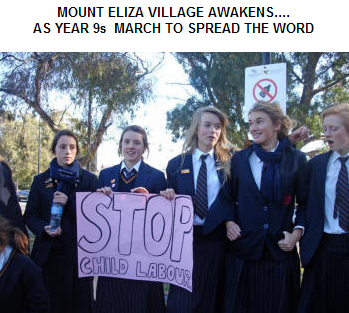
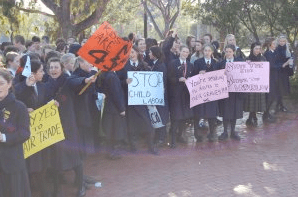
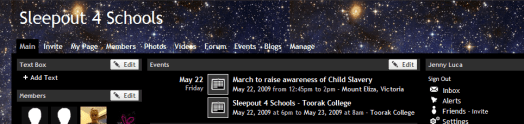
    After quite a few weeks of planning the event was held on May 22nd. During the day the girls participated in a Global march into Mt.Eliza to raise awareness about the plight of children forced into child slavery. A neighbouring school, Mt.Eliza Secondary College, joined them and lunchtime shoppers and proprietors of our local shopping centre listened to the girls’ message. It was very well received and the girls felt like they had made an impact.

    global_march_sleepout_4_schools

    global_march_3

    At 6.00pm the sleepover began. As teachers, we’d been given a running sheet from the girls in the organising committee, but we fully expected that we’d have to step in to get things going. We couldn’t have been more wrong. They were supremely organised. All of the girls, all 54 of them, had paid to sleep over. During the  night they raised money by selling popcorn and lollies and a group of them made friendship bracelets that they sold. Some of them had sought sponsorship from family members and friends to collect after the event.      

    At 11.00pm we skyped Mark Lukach in and he talked about the progress of Daraja Academy. He was pretty #stoked (you have to know Mark on Twitter to get that one!) that 54 students had gone  to the effort of getting together to do something good for others. Jason Doherty, the founder of Daraja was the next to skype in. This was Jason’s first ever skype call so it was pretty exciting. He was able to give us a lot of detail about Daraja and how the girls there are faring. Jason extended an invitation to our girls to visit the Academy; who knows, maybe one day we will get there. Jabiz Raisdana then skyped in from Qatar to let us know he was impressed with the effort of our students. It helped to let the girls appreciate the global nature of what it is they are doing.  

    It was after 12 midnight by the time we’d finished our calls so you can imagine it took a bit of time to settle to sleep. We were up and at ’em by 7.00am the next day. We still have to get a final total of how much money was raised, but it should be close to the $1,000 dollar mark.  Last Monday two of our students visited a local radio station and spoke eloquently and passionately about what they’ve been doing. 

    We are very proud of the efforts of these Yr 9 students. They have a genuine sense of the importance of service unto others, of thinking outside yourself. That’s an important part of being human as far as I’m concerned and school communities can be instrumental in helping our young people to understand this. These students have also gained an understanding of their role as global citizens. They have used technology to connect with the people they want to help; we can’t get to Kenya direct yet but we are hoping to start to write to the girls over there. The girls created a Ning to support the project  because they wanted to reach out to others to try and gather support. We didn’t quite manage that, but there’s always next year!  

    Sleepout_4_Schools_May_2009

    Nice work girls. We’re very proud of you all.

    Reblog this post [with Zemanta]

    So, how’s that ning going?

    Some of you who have been reading here would be aware that I started a ning for the Year 9 English students at my school. When I started I told you I’d be checking in every now and then with a progress report.

    So, here goes.

    All told I’m pretty happy with the progress. Very nearly the entire year level is signed up; we’ve had hiccups with one class but they should be resolved next week. The students don’t all contribute, but we have some active users and some of them have continued to start forum topics with no prompting from staff members. 

    One of the most popular forum topics relates to the novel Twilight. One of our teachers started it and it’s been popular with a wide range of students. It’s certainly been a means of forming the community. I like the fact that the students can see that we as staff can relate to their reading interests.

    Certainly the staff involved have adopted it and are embedding it into their practice. When we meet as a team we discuss how we can use the ning to support our learning outcomes. In the coming weeks we intend to upload our issues topics as forum discussions and will encourage our students to post their opinions. We can see that this will offer students access to opposing points of view and will probably assist those students who are struggling with ideas.

    Having YouTube videos easily accessible in the ning has been wonderful for just in time teaching moments. When we were discussing teenage pregnancy (a feature of our novel study of Bye, Beautiful)  I was able to flick into the videos page in the ning and show relevant videos that demonstrated the thinking of 1960’s Australia. I’ve been locating some music video clips that relate to Romeo and Juliet in preparation for our text study next term. You can see how many views each video has had which is useful in tracking student use of the ning. It’s clear that students have accessed these videos out of class time which is really pleasing.

    The students like the fact that they have their own pages and can change their profiles. Latest activity in the ning often indicates they are leaving one another messages or updating their profile. I like the fact that you can open a student’s page and see where they have made input into the ning. I’m figuring this is going to be useful to use in parent conferences.

    Just having an opportunity to read some of their reflections from across classrooms is very powerful. The fact that I can comment of the reflection of a student I don’t teach is wonderful I think. I’m able to support my colleagues and that student to understand that teaching can be available to you from others in spaces like this; you aren’t restricted to the one classroom, one teacher notion that pervades most school systems.

    Certainly the flurry of activity that was evident in the early stages has slowed down. You have to work a ning. You need to be adding new content all the time to keep it fresh. But I think we’ve seen adoption. In the last couple of weeks I’ve heard the word ning used at a school assembly and the Principal referred to it in his newsletter item for our school community. How many schools out there would be using this term – not a whole lot I’m betting.

    I presented our Yr 9 ning to our English faculty this week and was excited today to hear today that our Yr 12 teachers have started a ning for their English students. A staff member told me how impressed they were with what was happening at Yr 9 and how they thought the discussions that can be generated in  ning would be helpful for the students. I was thrilled -this was exactly the message I was hoping to convey in my presentation. The fact that adoption is spreading is testament to our involvement in PLP (Powerful Learning Practice). I truly believe we would not be making the leaps that we are without the impetus this program provides.

    I’m hopeful that we are going to have one of our PLP cohort schools involved in our ning. The school is a boy’s school from the United States and we have invited them to join our ning to engage in forum discussions with our girls. This is a means of bringing male voice into our school – we are an all girl’s school, and while I believe there are advantages to single sex education, I do think exposure to  a male viewpoint is important.  Having them join the ning will be a means of addressing this issue for both of our schools. The girls are certainly excited about this possibility so I hope it pans out for us.      

    Do I think it’s been worth implementing?

    Absolutely. No question. And I think my students would agree. I do feel a real sense of community, a feeling that we are in this together and we are there to help to one another out. There’s no doubt it’s not the forum for everyone, but it certainly is a powerful tool and one that I feel is worth the investment of time.

    Theory into practice – making it meaningful in the school library.

    A tag cloud with terms related to Web 2.
    Image via Wikipedia

    This year, we’re trying to make Web 2.0 more meaningful in our School Library. Last year we moved most of our pathfinders over to wiki format to encourage collaboration and input into the development of  resources to support subject areas and projects. The take up was pretty good and most people know what a wiki is now, but you run the risk of getting ‘wikiied out’. Sometimes you could hear the collective groan of ‘not another wiki’ and that is something you want to avoid at all costs.

    We’re not giving up on Wikis, but we are trying something new. We used to put out a monthly newsletter with interesting websites, news and book reviews, but it went to staff only. It was very good, but not frequent enough and got lost in the barrage of emails that hits the computers at my school. We wanted to do something that delivers information, but more frequently and something that encourages the two way exchange of ideas that Web.2.0 typifies. So we’ve started a Library blog that’s open, not one that’s operating within our Sharepoint Scholaris platform.

    Last year when I attended Learning 2.008, I had the pleasure of meeting Ann Krembs.  She talked of her Dear Librarian blog that she runs at the American School of Bombay in Mumbai, India. I’ve been inspired by Ann’s efforts and have set up 2rak info 4 u to serve our school’s information needs, and perhaps the information needs of others.  

    tc_lib_blog

    We launched it just over a week ago and although it hasn’t set the world on fire, it has had quite a few hits. We need to find ways to have it become part of the culture of the school and something that staff and students use as a ‘go to’ place for information.  We are trying to set up an RSS feed to it within our Scholaris platform so that posts will be visible, updated and in the face of  our staff and students. This have proven to be problematic but we’re working on it.  

    All of the library staff have been set up as authors and all of them have been uploading posts. This is learning curve stuff for most of them but they are rising to the challenge and are pretty chuffed when they see their efforts. It’s proving to be excellent professional development; they are ‘doing’, not just reading about what can be done. The clustr map has certainly generated some interest; it really does have an impact when you realise that people from far and wide are viewing your work.

    Hopefully we’ll see it become part of the fabric of our school. Take a visit and see what you think. I’d appreciate your feedback if you feel so inclined to offer your thoughts.   


    Reblog this post [with Zemanta]