Habits of mind – good habits to have!

I went to a workshop today to learn about Art Costa’s Habits of Mind. James Anderson ran the workshop and took us through each of the Habits of Mind with examples and suggestions for use of them in our classrooms. (I’ve just looked at his about page and realised he worked in the same bookshop I worked at when I was young – he started the year after I left. How’s that for six degrees of seperation!) I like the messages they are relaying to both our students and ourselves as teachers. The Art Costa Centre for Thinking lays out the 16 habits;

The habits of mind is the work of Dr. Arthur L. Costa, professor emeritus of the California State University. He has identified a total of 16 habits that successful people exhibit as cognitive as well as character traits.


The 16 habits are;

  • Remaining open to continuous learning

  • Persistence

  • Striving for accuracy

  • Thinking flexibly

  • Thinking interdepently

  • Creating, imagining and innovating

  • Metacognition

  • Finding humour

  • Listening with understanding and empathy

  • Responding with wonderment and awe

  • Gathering data through all senses

  • Managing impulsivity

  • Applying past knowledge to new situations

  • Precision of language and thought

  • Questioning and posing problems

  • Taking responsible risks

The 16 habits are available as posters with graphics representing each habit. They would be effective displays in classrooms; I’d like to have them on display in my classroom next term. I’d envisage taking the students through the habits and using them as a reference point for discussion and reflection as we work through class tasks. I saw them in use at Belmont Secondary College recently and liked how the students were encouraged to think of these Habits of Mind as they approached, worked through and reflected on   learning tasks.

Reading them today made me reflect on how many of these Habits of Mind have been modelled in this blogging journey. I definitely feel like I’ve persisted, responded with wonderment and awe, have taken responsible risks, been creative, imaginative and innovative, have thought and communicated with clarity and precision etc, etc. Most certainly I’ve remained open to continuous learning. It also made me think how easy it would be to marry these habits of mind with the integration of ICT into our classrooms. So many of them fit perfectly into the idea of establishing learning networks.  It’s important for us as teachers to model these behaviours for our students; we are all life long learners!

Telepresence – is this the future for presentations and maybe education too?

I came across this fascinating presentation via Garr Reynolds Presentation Zen blog.  If you’re not reading Garr yet you should be. He’s coming to Sydney in a couple of weeks and I’m hoping to get there to soak up his Zen advice about presenting and engaging your audience.

The video is a Cisco presentation held in Bangalore, India. John Chambers, CEO of Cisco, has Marthin De Beer, Senior Vice President of the Emerging Technology group,  appear on stage using Telepresence. Marthin was in San Jose at the time and appeared on stage as a holographic image. It’s very effective and opens our eyes to the potential use of technology like this. It would enable us to have face to face conversations, interacting as we would do in any real life situation except for the ability to physically touch the participant.

The Human Productivity Lab explains how they did it;

The Musion display technology is similar to the tech that telepresence provider Digital Video Enterprises uses for their seamless tele-immersion room.  A sheet of Musion’s patented, transparent Eye-liner foil is stretched across the stage.  The ultra high-definition image of Marthin De Beer and Chuck Stucki are captured in San Jose and the images of the virtual humans are then transported over the Human Network to be displayed in Bangalore.

Imagine the impact on conference participation. Keynote speakers wouldn’t have to jump on planes and travel halfway around the world. You’d just need a venue and your session leaders could particpate using telepresence. I’m going to be watching the NECC conference with interest; I’m not going, but I’m sure that I’m going to feel like a part of the event with participants ustreaming, live blogging, posting detail on Wikis and tweeting what they’re learning to their networks. In years to come will we even have to go to conferences like NECC, or will we be able to have a virtual presence using these new and innovative technologies?

There is a longer version of the Cisco Telepresence presentation that you can watch here.  John and Marthin talk of how this technology is going to transform business and the length of time it will take to get product to market. They also refer to the use of Wikis as a mass collaboration platform to enable creativity and innovation. Cisco has an internal ideas wiki that has apparantly led to new innovations taking root. 

Watching this has cemented my belief that it is necessary to empower our students with an understanding of these networking tools. We have many wikis in operation at our school now across many year levels. They’re still a new idea for many and some work better than others, but I think it’s essential that our students learn the nature of them and how to utilise them to best effect to benefit all. This is the business model they will be walking into when they enter their working life. Surely they are going to be a step ahead of the pack if they have exposure during their formative years.

Isn’t it our job as educators to prepare them for the future? We need to be making sure our schools are shifting into this 21st century. Let’s use the tools they are going to find when they start their working life. Let’s make school relevant.  

School’s out Friday

Yes, it’s that time again. School’s out Friday. And aren’t I glad to see this Friday. Teachers everywhere are battling through this time of year when assessment and reporting are occupying much of our thinking space. It’s been a lean week for me in terms of this blog – I’ve only posted twice!

Definitely need a laugh to see in the weekend. A colleague sent this to me today and I couldn’t help but join Ethan as he laughed at the simple joy that comes from tearing a sheet of paper. Oh, to have such an uncomplicated life!

Viewzi – another new cool visual search engine.

On the back of yesterday’s post about Searchme comes the release today of Viewzi, a new visual search engine. I pity the poor software developers out there trying to hack their brains for new names that are going to stick! Like Searchme, the visual interface is intriguing.  Viewzi opens up to a clean interface with a search box. When you enter a term your results page looks like this;

My search term was whaling and 15 possible windows presented themselves for opening. There are a variety of mediums for you to select from; MP3 files, video files, Reuter’s News view,  Web screenshot view, Simple Text view with rankings from Alexa, Google and Yahoo, 4 sources view which searches Ask, Google, MSN and Yahoo and many others including photo sites, Amazon and even cookbooks!

Here’s what the page looks like when you select video files;


You can remove tags from the results page and this will eliminate videos that are tagged with that term. A good visual way of teaching students how you can narrow a search according to key words you use. There’s no doubt this is a busy search engine with a plethora of options that may be a bit overwhelming for the novice searcher. However I do think it’s another great way to demonstrate to our students that there is more out there than their usual default search engine of choice.

As John Connell and Clenda pointed out in comments on my Searchme post, the results you get may be a bit hit and miss at this stage. These search engines are in beta and need time to develop into something great. I’m still going to give them a go -I think they’ve got the engagement factor that can get our students excited about search and may go a long way toward leading them to new learning opportunities that they may have missed if they’d just scanned through the first page of results from their text based search engine. Give Viewzi a try.    

Searchme – visual search engine suits me!

A comment on my blog from Charles Knight led me to this visual search engine that I hadn’t seen before. Searchme has huge appeal for all those visual learners out there. It has huge appeal for me and I don’t necessarily think I fall into the visual learner category (but I could be wrong about that!). 

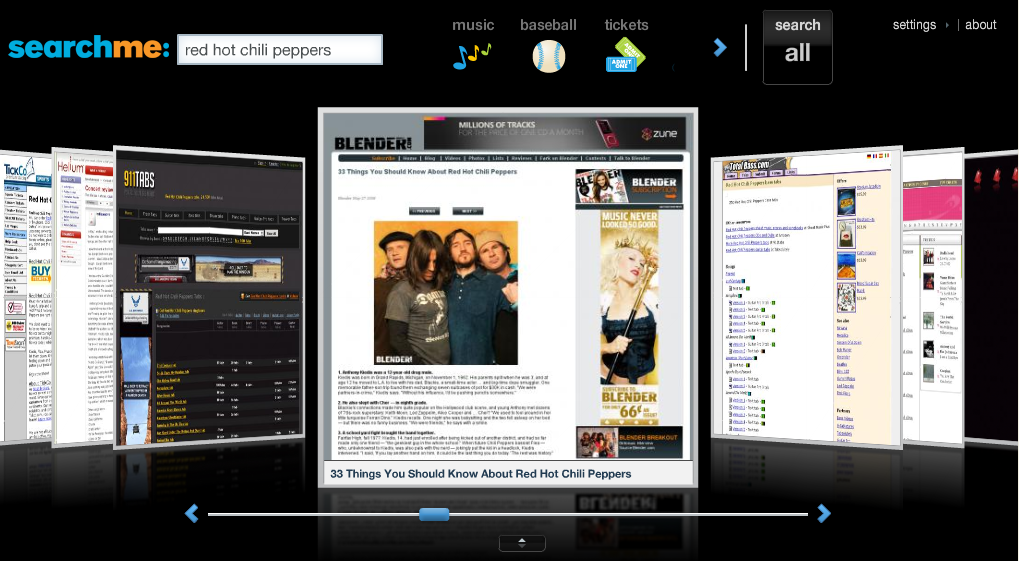
I love it because of the way it represents search results. It’s like the iTouch – your search returns are represented with the actual page on the screen – behind it are the other pages that you can view by clicking on them or using the scroll tab at the bottom of the page. Here’s what it looks like. I searched for one of my all time fave bands, the Red Hot Chili Peppers. 

You get the idea, right? I’m loving it. I can see the appeal for students today. Most of mine default to Google because they don’t know what else is out there. They get a page of results and click through text after endless text trying to find something suitable. With Searchme they get a eyeball on the page straight up and can start assessing its suitability from the get go. When you start typing your search request categories pop up to allow you to filter your search or you can choose the search all option. It’s still in Beta so you can’t expect brilliant returns every time, but Charles at AltSearchEngines has posted about it saying that it has just received another billion or so in funding so things can only get better.

Don’t you just love what’s happening with Search engines today? Semantic search engines like Mahalo and visual options like Searchme are helping to make search more meaningful for our students. If Google don’t watch out they might have some competition on their hands. Better get Knol out there soon I’d say! 

Thanks Charles for the comment and for your great site. AltSearchEngines – check it out!  

School’s out Friday

This YouTube vid is another recommendation from one of my students. It’s Matrix Ping Pong and is some very clever work from Japan I’m assuming. Being Friday night, I’m too tired to do some further investigation into its origins. It really is a clever piece of theatre – it takes a while before you realise there are people controlling both the ball and the people.

Hope the weekend treats you well.

Surf canyon – refine your search results with a bullseye!

Just found this cool little tool while browsing through Download Squad. It’s called Surf Canyon and what it does is to find good search results from the pages in search engines that you’re not likely to look at. Let’s face it, anyone working with kids these days would have to be noticing that they are not likely to search through the entire first page of Google results, let alone move onto pages 2, 3 or 4. I do try and search beyond the first page, but I’d suggest I’m in the minority! I remember asking students last year how many of them looked beyond the first four results from Google – there were less than five hands raised from a class of 24 or so.

That’s why I’m keen on exploring the possibilities of Surf Canyon. Once you’ve downloaded it (it works for Internet explorer and firefox) you will find a bullseye icon appearing next to the results you have received. When you click on the bullseye, you will find ir opens three search results recommended by surf canyon for the keyword you have searched for. Next to each result also appears the page number the result was on. Here’s what I found when I searched myself! and clicked on the bullseye.

This would be a great tool for teachers to use to help demonstrate to your students how a relevant search term could be hidden on page 7 of your search results. I need to play around with it a bit more to see if it returns relevant results on a regular basis, but it looks like an interesting tool that I could use for instruction.

Thanks Drew Orlanoff from Download Squad for the heads up.       

Skyping with Laura.

Today in my Yr 7 class we were involved in a Skype call with the inspirational Laura Stockman from Buffalo, New York. That’s Laura above with the special care packs she has put together for Cheerful Givers, one of the charities she has been supporting. (I hope you don’t mind me using your picture Laura – if you do please let me know and I’ll take it off) It wasn’t all smooth going – our connection was a little scratchy and it dropped out a couple of times but we ended up with a pretty good link towards the end. We were using a webcam but I don’t think Laura could see us. We couldn’t see her either, but no mind. My students asked questions about her blogging experiences and a lot of general ones as well. It’s fascinating to see them react when they realise that they have the same tastes in music and leisure activities in spite of the distance between us. This global platform is a chance for us all to understand that we probably share more in common than we would otherwise realise.

A standout moment was when my students sang our National Anthem, Advance Australia Fair, to Laura and her mum Angela who was helping her with the call. They both got a kick out of it but declined to sing theirs for us! We did have a large chorus and there was only the two of them – perfectly understandable!

Hopefully we’ll be able to maintain the connection and work with Laura towards raising money for a global cause. This to me is a fabulous learning opportunity for my students. We have the ability to learn from an inspirational 11 yr old who is a role model for us all, we can make meaningful connections with a global partner and we can do good along the way.  All positives as far as I can see!  

Sir Ken Robinson and creativity


Here’s Sir Ken Robinson delivering his latest message about creativity. He speaks of the need to transform education to recognise the importance of creativity and its importance to our global economy. He wonders why we continue to have a linear approach to education with a heirarchy of subjects eg: english, maths. He suggests that all subjects are important and should be valued equally. He speaks of a second climate crisis the world is facing – a crisis of human resources. Our inability to recognise the potential of our students for their creative talents leads, he suggests, to the economics of distress in our world today. He discusses California and the spending on the penal system which eclipses the spending on education threefold.  Sir Ken Robinson is a riveting speaker who holds his audience without a bullet point in sight.

Original ideas that have value – this is the creative capacity that we need to cultivate in our students today and this is the 21st century challenge we face. Watch Ken Robinson – he makes you think.

Thanks to Camilla Elliot whose post led me to Sir Ken’s latest talk. 

Social Media in Plain English – new from Commoncraft.

Can’t believe I missed this. Well, I can actually, because my Google Reader has been playing up and I haven’t been able to load the page. This was posted two days ago on the Commoncraft blog . It’s Lee and Sachi Lefever’s latest effort explaining how social media works. They do it well, using ice-cream as an example to explain how people can produce and communicate to deliver a message or opinions with the world, using tools such as blogs, podcasts and videos uploaded to sites like YouTube.

Thanks Lee and Sachi once again. You do it so well (but I am missing the yays and boos!!)