
OMG!! This posterous thing really works. Thanks so much to Jane Lowe and Sue Waters who saw my tweets to Jeff and alerted me to the ease of posterous for posting to my WordPress blog using email. This is very cool. Yet another fine example of the power of Twitter – my personal learning network (PLN) is teaching me all the time. 24/7 professional development for free!
And a big happy birthday to Dean Groom, another favourite in my PLN who teaches me so much. Have a great day Dean!
Testing this out!
Right. I’ve signed up to posterous and it tells me that it will post anything I write in an email sent to post@posterous.com to my WordPress blog. I’m signing up because Jeff Utecht has informed me that WordPress is blocked in China and I want to be able to get information about the conference out to people here in Australia (and maybe elsewhere) who are interested in what is going on. This is my test go and I hope it works!
School’s out Friday
This week has been a killer for me. We’ve had all of our Year 7 students working on an inquiry week project project called ‘We’re making history at Toorak’. They interviewed old girls from the school and canvassed archival material to collate information for their digital story presentation. The students used flip cameras to record their interviews and used Windows Moviemaker to put the stories together. To say we encountered technical difficulties is an understatement. We didn’t just encounter them, they hit us in tsunami like proportion. Flip video files didn’t work in Moviemaker, we had to convert them and then we encountered difficulties with that. It was a very long three days to say the least.
Nonetheless, the students continued to impress me. Despite the difficulties they forged on and found ways to work around their problems. They didn’t let adversity get in the way and did their level best to get a digital story happening. My own daughter was one of these students. Her group had no video files that were useable and Moviemaker just wasn’t working on their computers. They reverted to Photo Story and used Audacity to capture the audio file of their interview. I was so proud of her determination to come up with a result despite the fact that she was not well and really shouldn’t have been at school today. I saw a side of my child that I hadn’t anticipated; a determined young woman with a strong resolve to do the best she could for the sake of her group. I couldn’t have been more proud.
Next week I’m attending Learning 2.008. I fly out on Wednesday for Shanghai. Right now, I’m totally exhausted and don’t know how I’m going to do everything that needs being done by next Tuesday afternoon. Big weekend ahead I’m guessing.
Next Friday is ‘Talk like a Pirate Day’. Here in Australia it’s a fundraiser for cancer research. A couple of Library staff at my school are going to be running the event from our Library. Maybe I’ll get something going at the Learning 2.008 conference – nothing like a bit of pirate talk to forge productive working relationships! Take a look at the ‘I’m a pirate’ song to help you get into the swing of things.
dy/dan – a young teacher reminds us of home truths and shows us how.
I’ve recently discovered Dan Meyer, a young teacher sharing his first years of teaching on the Web. His blog makes very interesting reading and viewing; he has recently recorded a series of videos detailing his experiences thus far; he cleverly, and with expert film-making flair, demonstrates the effort he puts into his teaching and shows us the creative techniques he employs to make the teaching of maths interesting for his students.
I admire Dan; he shares. I’ve always liked teachers who share. They are often the natural teachers, the ones who have abilty to convey meaning and who aren’t afraid to learn alongside their students. In a recent post Dan has shared his entire Geometry curriculum with his readers and encourages people to share it with others. There should be more of this in the teaching profession; we are all reinventing the wheel in our own schools over and over again. Why not work together, collaborate, share. Demonstrate the kind of risk taking with our learning that we expect from our students.
Tomorrow I’m going to be engaging in the learning process with my students. We are having our Year 7 students create digital stories that will capture the experiences and memories of past students of the school. Some of these stories go back decades. It promises to be very interesting and memorable for our students. I’m nervous about the technology and the possibilities of things not going well but that’s part and parcel of the learning journey we’re on. I know I’m going to learn a lot in the next couple of days and so are my students -we’re in it together.
Dan’s latest post ‘The First Fortnight’, talks of dealing with the difficult student who demands attention. He provides some pretty good strategies that young teachers could pay heed too. What I like most about the post is the last paragraph;
I’m also realizing with this new group of students exactly how tight last year’s class and I became, and something else which is nice to realize and never a guarantee: that the time we spent together wasn’t meaningless.
A good thing to realise. The connectedness you have with your class at the end of a year is a special thing; I’m feeling it now with my Yr 7 group. I’m already pondering the wrench I’m going to feel when I have to relinquish them to someone else. They’re a special group of kids; the work they have produced of late has been outstanding. Their creative stories have blown me away. Can’t keep them forever though; they’d get sick of my stories and need exposure to the ideas of others. I will miss them though.
Do yourself a favour and take a read of Dan’s blog; well worth the visit.
Large Hadron Collider – physics teachers take note
I read an article today in a newspaper (I was at my in-laws house, where no internet exists and all information is relayed in newsprint or from TV services!) about the Large Hadron Collider, an incredible engineering feat that is going to be switched on this Wednesday. According to this article, we all better be making the most of the next few days because they could be our last.
I’ve read a bit about it since, and I’m not even going to pretend that I fully understand what it’s purpose is. My limited knowledge can tell you that scientists are trying to gain a greater understanding of the origins of the universe by pinpointing particles of Dark Matter which are thought to permeate the universe. The article that I read today suggested that switching it on could result in earth being sucked into a giant black hole instantaneously. Cheery stuff really. Other news reports are saying there is nothing to fear. Canada.com in an article titled ‘Wednesday not doomsday’, reports this about what will happen on Wednesday;
The LHC, installed in a 27-kilometre (16.9-mile) tunnel on the French-Swiss border, is to start unleashing a beam of protons next Wednesday in the first stage of its commissioning process.
Two parallel beams of particles, one going clockwise and the other anti-clockwise, will blast around the underground ring.
At four locations on the ring, superconducting magnets will bend the beams so that groups of protons smash into each other in a giant chamber which is swathed with detectors to record the resulting sub-atomic debris.
It goes on to say we have nothing to fear;
The new Safety Assessment Report says that any black holes produced by the collider would be “microscopic” and decay almost immediately, as they would lack the energy to grow or even be sustained.
“Each collision of a pair of protons in the LHC will release an amount of energy comparable to that of two colliding mosquitoes, so any black hole produced would be much smaller than those known to astrophysicists,” it says.
I’ll be interested to see the media coverage that results on Wednesday, assuming we’re all around still to be taking notice! What’s also interesting is this LHC Rap that has been posted on YouTube explaining what the Large Hadron Collider is all about. Kate McAlpine put this together – I think Physics teachers around the world should be sending her thank you notes for doing this. What a great way to transfer meaning about what to me is a complicated idea. It makes me think that this would be a great activity for students to do – explain a process as a rap, act it out and post it to YouTube. Share it with the world and help students everywhere gain understanding of concepts and enjoy it at the same time.
When I was searching for information for this post I used Silobreaker, a search engine with a focus on news results. Great returns, interesting layout with lots of visuals; well worth adding to your list of alternative search engines to use.
School’s out Friday
Friday again. Today was a wonderful day at our school. It was House Drama and Variety day, a day that is steeped in tradition and gives our students an opportunity to display their creative talents through drama and dance. It’s a highlight in the school calendar as far as I am concerned. Houses compete against one another and the students create a production that melds dance, comedy, some lip syncing, some hammy acting and most importantly, loads of fun. It does interrupt our curriculum, but it provides the connective experience that I think is vital for schools – it is a day they will all remember, long after they leave the place.
Wouldn’t it have been great if we had uploaded some of this wonderful creaative work to YouTube so the world could see how great they are and they could help to foster a positive digital footprint of themselves. Maybe next year….
So, because we can’t see Tripp house’s brilliant retelling of Peter Pan, we’re watching Bill Gates and Jerry Seinfeld. This was broadcast on US television last night and is the first of a series of commercials to try and get the public to see Vista in a new light. It’s a bit obscure at the moment – as the series unfolds I’m sure the story will gel. I can see they are taking principles that Garr Reynolds would no doubt find interesting. They are relying on story and the connectedness that forms through this to imprint their message. Will be interesting to see how the story unfolds. (Just as an aside, apparantly Jerry was paid 10 million dollars to appear in the ads . Nice little earner!)
Enjoy your weekend. Spring is here in Melbourne and the air feels warmer. Ain’t life grand!
Wordle – Rhonda and Dennis are on the bus!
I’ve been catching up on some reading tonight. My Google Reader has been sadly neglected of late – too many things to do and not enough hours in the day. I haven’t read The Shifted Librarian for awhile and was thrilled to see Rhonda Powling’s post about Wordle featured in it’s entirity on Jenny’s blog. Good for you Rhonda. Great to see an Aussie Teacher-Librarian blogger getting attention. Wordle is a neat application that allows you to paste text in and it will create a tag cloud formation with the most used words appearing larger than others. No thinking required, but great effect. It has a lot of potential for display purposes and to generate class discusssion about word choice. It would be a fun activity to insert the text of a well known peom and see if your students were able to piece together which poem it is and how it should appear in regular text format.
Dennis Harter discovered Wordle this week. He put out a tweet (on Twitter for those of you wondering what on earth I’m referring too!) asking if he was late in catching up with this app. I very kindly replied that yes, he was! He wrote about this exchange in his first post for U Tech tips and recounted it with good humour. The focus of his post was, you guessed it, Wordle, and he included one he had created using Martin Luther King’s ‘I have a dream’ speech. It looked brilliant – the kind of thing you’d want to laminate and use in your library or classroom.
I’m sure you’re wondering why it is that I haven’t got an example here of the kind of thing you can do using Wordle. Well, that is because, for some unknown reason, I can’t get Wordle to work. I paste in the text of Robert Kennedy’s speech after the assassination of Dr. King, and it keeps telling me there is ‘no plugin available to view this content’. I have the latest version of Java installed, and can’t understand why what looks to be the easiest application available on the Web will not work for me!
If you’re reading this and have an answer to my dilemma, please leave a comment and put me out of my Wordleless misery! Yes Dennis, I may have known about Wordle before you jumped on the bus, but I’m still waiting at the stop!
Google Chrome – now they have a browser. World domination beckons.
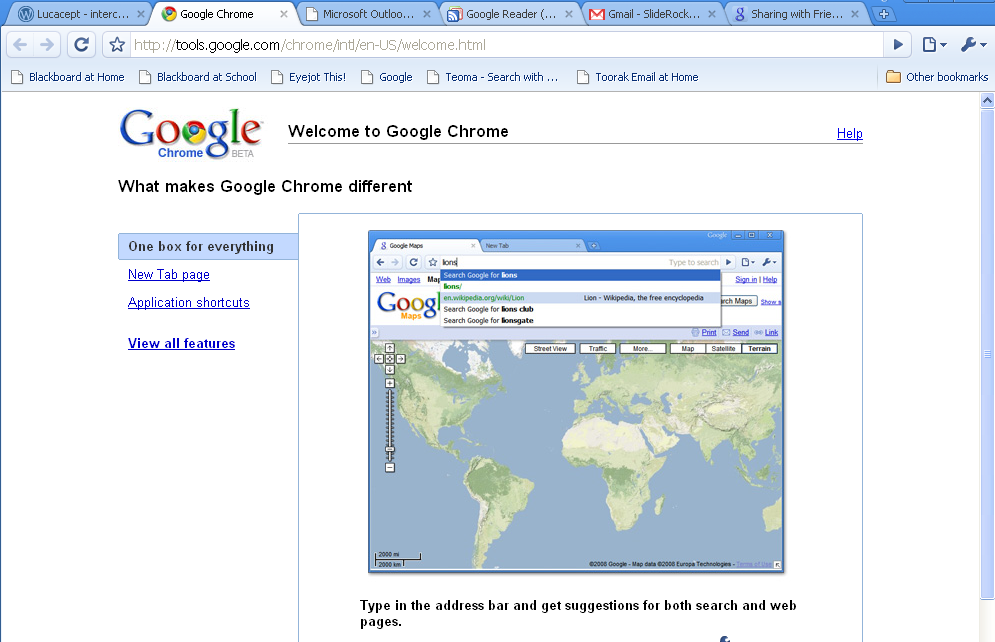
I’ve just downloaded Google Chrome. This is Google’s new browser, released about an hour ago. Just playing right now but it’s looking pretty good. The pages load very quickly and I seem to be moving faster into applications. I’ve been using Internet Explorer. Flock didn’t do it for me and Firefox has problems at work so I just went with what was comfortable. Lately I’ve been having so many problems loading pages with IE I’ve just about been going crazy. I’ll be interested to see how this works. the buzz on the net so far is that it’s pretty slick.
Google really are covering all bases to ensure that they become our brand of choice. I really heavily now on my Google Reader and Gmail. At this early stage, looks like I might become reliant on their browser too. They’ve relased a video explaining the story of Google Chrome. Check it out.
Google Reader – Commoncraft helps explain what we’re all on about!
A turning point for me in my development as an online learner, was when I set up my Google Reader and started subscribing to blogs written by teachers and people interested in education and the impact of technology on learning. Whenever I talk to people about how I made the leap from someone with no idea to someone with some idea, I make reference to the importance of my Google Reader and how it keeps me up to date with current thinking.
Now I can point them to this. Lee and Sachi Lefever from Commoncraft (almost feel like I know them now!) have made a plain English video explaining Google Reader. Google asked them to do it. Way to go Lee and Sachi!
Watch and learn.
“…we have to work globally to stop the accreditation tail wagging the learning dog” – now that’s a quote to use and an idea to ponder.
John Connell is a Scottish blogger who I consider to be a mentor of mine. He thinks deeply about education and the direction we are headed in. I always feel enriched after reading his blog; he writes well about important issues facing education. He was kind enough to leave a comment on my previous post which I think is worth highlighting in full. Once again he’s made me think;
The core issue is as you describe:
“……in the light of the stringent exam structure that exists in our senior years of high school. The argument that was presented suggested that our parent community wanted high enter scores. Our job at those year levels was to get our students through the curriculum and prepare them for 700 word essays, and it wasn’t helping them to have them learn how to collaborate with students from around the world. ”
I believe that such arguments, while inevitable, need to be tested to destruction. I have found over the years I have worked in education that the estimation of parental views held by too many teachers is, at the very least, stereotypical, and too often, rather patronising. I just wonder what would be the outcome if you (ie Toorak College) were able to find a way to test the depth and nuance of parental views on these issues.
Of course, parents want the best for their children, and they want to ensure that they have the greatest chance possible to make progress in life. I know from our chat over dinner a few weeks ago that you want the same for your own kids as my wife and I want for ours.
BUT – I am equally sure that most thoughtful parents are far more aware than is generally recognized in education of the need to find a reasonable balance between the demands of accreditation and entry to higher education, and the demands that life in all its complexity will place on our kids as they face the future. Too many teachers prefer to see parental views as one-dimensional and reductive in nature – I would challenge them to prove that their view is genuinely reflective of the actual views of the parent body.
So, I just wonder what the outcome would be if you could find a way – through straight talking and honest communication – to explain the logic and the humanity behind the kinds of messages we are trying so hard to build into the education systems for today and tomorrow. I am willing to bet that many more parents would express agreement with such views (while still wanting their kids to get what they need to go where they want to go) than the more patronising teachers realise.
Ultimately, I think that teachers and parents face the same dilemmas to an extent that we often fail to recognize. Why not test it? We might find that we can move forward together – teachers, parents, students – to find the ways and means to give our kids access to both realities.
Beyond that, of course, we have to work globally to stop the accreditation tail wagging the learning dog – but that is in the long term. In the short term, why not work towards finding a joint understanding between teachers and parents of the very real issues impinging on schooling, and impinging on the lives of our kids.
I am one of the parents at my school. My daughter began Yr Seven this year. What do I want for her? For me, it’s not about the highest possible entry score to get into University; it’s about development of the whole person and preparing her for the world she is going to be entering as an adult. Perhaps we do need to ‘test to destruction’ our assumption that parents are focused on university entrance scores and seek their clarification about what they want for their children? Perhaps they are unaware of the changing nature of the workforce and the types of skills that will be valued by employers of the future? There’s no doubt parent education is going to be necessary to assist them in understanding our motivations, but perhaps they get it already and we’re just underestimating them?
Thanks for visiting John – I value your input and your ability to provoke further thinking.
(and don’t you just love that line, ‘we have to work globally to stop the accreditation tail wagging the learning dog’. Going to have to use that some time!!)
 Lucacept - intercepting the Web